Browsing Category

RIMYI Experiences

RIMYI Experiences

Guest Teacher Series | Susanne Mayer : Hands & Feet in Yoga

May 22, 2020

Today we had the privilege to have Susanne Mayer as our guest teacher.  Susanne’s session was called Hands & Feet in Yoga.  The hands and feet are the base in all asanas, and we hardly pay attention to their placement and positioning.  When practicing asanas our attention moves to the gross body, and we rarely think of the seemingly ‘unimportant’ aspects of the asana. During the session we learned how to use our hands and feet to bring stability to our asanas and used blocks to understand them more.  Below is a recording of the class, since I know many of you will want to follow along.

I met Susanne about 4 years ago at RIMYI (Pune) and last year we hosted our first yoga retreat together in Liguria, Italy. Below is a snapshot of a conversation I had with Susanne some time last year.  I had intended to put it up on the blog back then, but have only gotten around to it now.

When did you start practicing yoga?
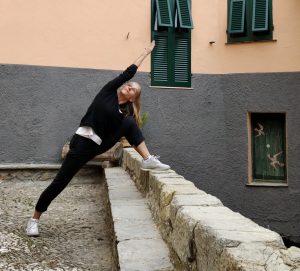
On a day off during our Liguria 2019 retreat.

I started practicing a long long time ago, but it was not Iyengar yoga.

My first Iyengar-like Yoga experience came from a used little pocket book I saw in the street of some South American city, I believe it was in Buenos Aires or Santiago – don’t remember. It was titled “Yoga for Americans” and is written by “Indra Devi” who was, just like Iyengar a student of Krishnamacharya (I didn’t know anything of that, back then…), but I guess she was at Krishnamacharya’s a bit later than Iyengar. She was the first woman who Krishnamacharya agreed to teaching yoga –- after first refusing to do so. He was basically forced by the Maharaja of Mysore’s wife in whose place he had lived and taught their children for so long. Indra Devi was American from Los Angeles and had developed an early love for India and the films produced there, subsequently she starred in several old movies from that time around the 1930s onwards…

That little book traveled with me and was pulled out each morning when I had to get up and out of our tight bed in our VW camper van in which I traveled with my boyfriend and another friend through South, Central and North America from 1977-1979. We were sort of hippes then…

But each morning I rolled out my woolen blanket when I had found a level patch somewhere near and started with some rounds of Surya Namaskara, then some other poses, but mostly learnt and practiced headstand. Without any wall behind my I just did as she describes in that book, and one day it worked. Don’t ask me what that looked like… 😉

Between then and my first time with Iyengar yoga, there were lots of periods when I’d rather dance, Contemporary, Jazz, Brazilian and classic ballet styles alike. But after a while I always returned to yoga, as it seemed to offer something on top of the beauty in bodies moving along with nice music, something deeper. resonating within me with more satisfaction and promising more understanding of whatever there was out there.

On that long way I had many different teachers and went to different yoga centres – Sivananda was the most wide spread in germany at that time, but only in big cities like Munich where I lived for a while, and Frankfurt where I also had a stint for work at television. Nothing in Stuttgart…   Somehow I lost it again and again because either I moved to another place for work or a good teacher changed pathways and went elsewhere.

Until I met an old friend at a jazz club one night who I hadn’t seen in a long time. I told me: ” I’m doing great, I practice yoga.” I was surprised – he didn’t seem like a yoga student type to me. He told me he had suffered from migraine all his life and was “out” for a few days each month but had been alright since he started yoga.

I instantly asked him where he went to practice and he told me about this great teacher close to my house, and I was there the next morning… 😉

After those first 90 minutes I walked out and felt my whole body vibrating and lifting up by itself.


That was it for me. I went back for years, up to 3-4 times a week. Until I asked my teacher how I could get deeper into the philosophy of yoga. He recommended a teacher training to explore that.  As I had been teaching at university for many years and was happy being a student, I didn’t quite want to go there, but he said I could just do it and then see if I’d really want to teach. So….

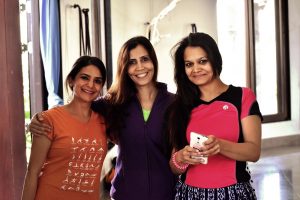
Susanne’s cute mini cooper was also our main ride to the city during the retreat.

What brought you to yoga?

My mat was and is my island – away from my continuous stream of work and my little family back then, and

presently, as someone who recently retired and has all the time of the day to their own disposition, it’s more and more to meet with my deeper inner being, experience my breath, and to still these endless movements of my all too vivid mind.

Back then, luckily my young son also had training sessions of sports on some evenings or didn’t mind me returning home a bit later, and my partner usually never returned from his office before 7:30pm for dinner anyway, and sometimes I also went in the early mornings, before I went to uni… It was doable. In 2012 I started my teacher training and since then, for me my life has continually developed in an uplifting and creative way, breaking through what had been limits to my life so far, and it’s simply great.

I somehow also started teaching just because I really believe in the power of practicing yoga in a multidimensional way and felt an urge to help passing it on to others.

I experience teaching as a most giving process. While I still worked at uni, sometimes I felt really tired when I went to my yoga classes right after returning home in the evening, but after teaching one or two yoga classes, I come out somehow elated and energized. Which is amazing and very fulfilling.

What keeps you going?

Yoga keeps changing my life for the better, my body is healthy, my mind is alive, I feel younger than ten years ago, in some ways at least as far as my energy goes.

With age my body is giving me new challenges with problems in several joint areas. Iyengar Yoga is the best to deal exactly with such issues, and this made me start studying yoga therapy a year ago. It is physio therapeutic work including the aligning, joining and relaxing aspects of yoga.

Yoga helps a lot with another process which comes with getting older, which is much more important than physical ability, I believe.It forces us to look inside ourselves and towards an understanding of our mind’s workings.

We overcome new challenges of all kinds with new and never ending confidence about our ability to tackle almost anything by simple continuous practice of asanas and meditation.

And so on…
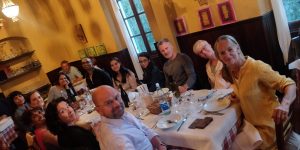
The entire Liguria 2019 crew having one last dinner before we bid each other adieu…until next year.

What was your day job?

I worked at the Stuttgart Media University, where I held a professor position for more than 20 years.  Nearly 35 years of facing ever changing media, software and computer systems, the amounts of communication that come along with these jobs simply made me sit, and sit and sit, looking into this square screen, not noticing how time flew away, until my body cried for help.

Plus – my son told me I was hunching forward at the dining table like an old woman (…children usually tell the truth as bitter as it may taste…), and mostly my bones told me I couldn’t really get up and walk after long hours of computer work –  I HAD to do something….
Why Iyengar yoga for you?

I noticed this was a different kind of teaching. I was told what do with my different body parts, where to put my attention to and what parts to connect or stretch – unlike in other yoga styles where there is no real instruction, just  showing poses with the order: …and now you do it (…which ever way you can…)

There was helpful correction into alignment and I started understanding little by little what yoga really was about.

I could feel the wholeness of my body and its limbs, including my minds workings, and I  understood the ways some parts wouldn’t go unless I was shown or told how to do it “right” – after which it always felt like another epiphany, one after the other…

How many times have you been to India?

Only twice in my life – but there will be more… 🙂 I had been scared for a long time, that India would catch me emotionally and I might not be able to bear seeing so much poverty next to utter luxury and not cry out loud…

But now… maybe due to my yoga practice and learnings on Indian history and philosophy I might be able and also want to understand a lot better. I can definitely feel my fascination with India’s culture after my only two visits during those last years growing…

The first time was in February 2017 when I flew back from Australia via Delhi to visit an Indian friend who came to visit my partner and me  some years before in Germany. She had invited me to come and meet her family in Delhi, always telling me, if I ever come to India, to come to her house so she could plan all else from there with me.

The whole family was incredibly helpful in answering all my “newbie” questions about their daily rituals, and also the reason for all these  maids in the house who all shared a different kind of mini job. Like one came just to do the dishes, another who actually lived in the house, was presently trained in cooking specials, where to shop for food and what to prepare, yet another came in each day for washing clothes (by hand…) and another one came to clean the house…

Still, my friend seemed utterly exhausted by having to manage all that along with her mother-in-law in whose house they lived.

I thought – WOW,  at home I do all that by myself… plus I raise my kid and have a full-time job…

After 3 or 4 days Delhi I sort of fled to Goa, just to be able to walk and breathe some clean air on an open beach again which I had just left behind in my favourite places in Australia…

But that didn’t happen before I explored some really stunning places in Delhi – like the Red Fort, Humayun’s Tomb and I couldn’t get enough of the beauty of architecture, harmony, geometry, and the poetry and music which was offered through the audio guides there.
All in all this was a great introduction to one of the biggest cities, rounded by a surprise concert with my favourite Tabla player Zakir Hussein who happened to play a charity concert at my friends’ sons’ college on my last night there.

Coincidence organized by the universe I like to think.

After about a week in Goa I went to Pune to visit the RIMIY institute for the first time – mainly to find out of I really felt I could go there half a year later for my practice month which I had signed up for already years before.

I had heard all kinds of stories…

I had passed my teacher assessment just 2 years before I went there for the first time, and BKS Iyengar had already passed away by then.


But I was received very friendly, was allowed to go into the big shala to watch a class given by Abhijata and Raya who I had both met before during yoga conferences in Berlin and Basel/Switzerland.

Your favourite aspect of Iyengar yoga?

The unending depth of further explorations into our true being which keeps evolving more and more over the years.Exploring interpretations of the Patanjali Sutras with those more than 2000-year-old insights on the workings of a human brain and how Patanjali mentions bit by bit all the obstacles from simple to complex we as humans are confronted with on a daily basis… then obviously as today: it’s the very same phenomena as we experience today what is being discussed there.

Western psychology could have won tons of insights many years ago from these deep Eastern philosophical musings, had it not been largely ignored by Western snobbishness. It’s very slowly showing and dawning on the horizon in Western medicine and psychology/psychiatry, thanks to the hard work of a few determined doctors, academics, philosophers and healers alike.
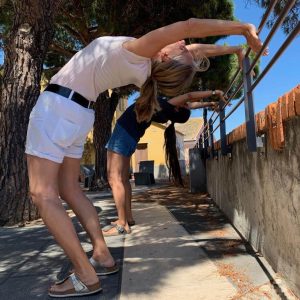
RIMYI Experiences

An Exploration of Ardha Chandrasana

May 19, 2020

At this point I’m no longer wondering what the new normal is.  I’m getting used to life as it is at the moment.  While I have been stepping out every once in a while to buy vegetables and other essentials, I don’t think I ‘miss’ going out.  My cooking and cleaning routines are getting more streamlined and I’m finding a new balance. Having to use my home as an office, a workout arena, a movie theater, a study and the Friday evening hangout zone is now become easier for me.

I’ve also realized that I’m quite enjoying teaching from home.  I find that now all my energy goes into teaching my classes and not on battling traffic, or even getting ready.  Yes, I have taught many a class in my pajamas. I have more energy for my personal practice, and in the lat few weeks I’ve attended classes with teachers across the world, and this is having a positive impact on my own teaching.

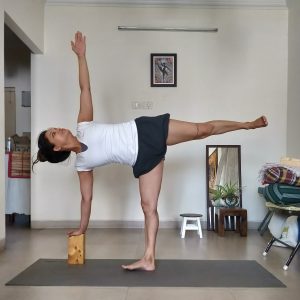
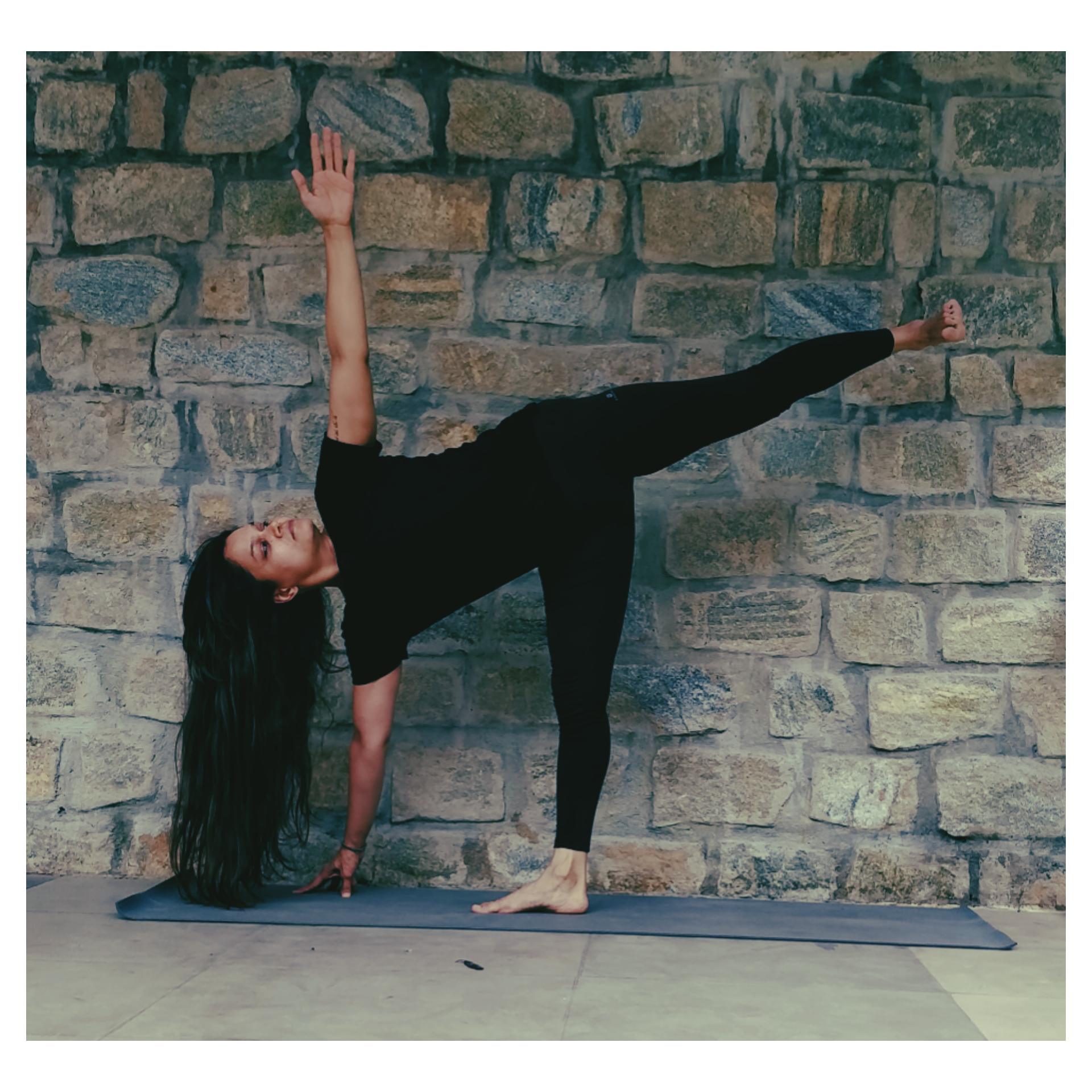
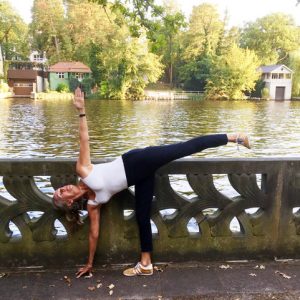
I’ve also started giving my students ‘homework’ and it’s gratifying to teach yoga concepts in depth and have students turn those ideas in their minds later.  Maybe practicing online is suiting many students as well!  The other day we delved deeper into the Ardha Chandrasana or the Half Moon Posture.  Most frequently, students get so focused on finding their balance in the posture that they forget about all the other aspects of the asana, such as an open chest, a long neck, straight spine….

This variation works the best for most practitioners. The hips are open, the spine is parallel to the floor and the arms make one line. The chest is open, neck relaxed and gaze is towards the ceiling. If you find it hard to balance with the gaze on the ceiling then keep your gaze on the floor or in front of you.


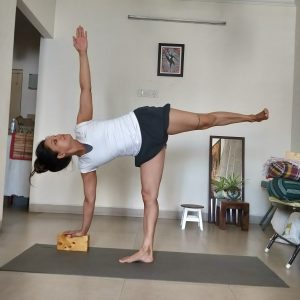
When you are most stable on your legs then reduce the height of the block. When we do this there is a tendency to lose connection with the core, which leads to the raised leg becoming lazy and descending. Keep the raised leg long and push the heel out. Bend from the hip, not from the sides.


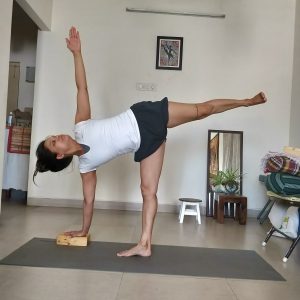
Here I’ve lowered the height even more. At this point the asana had started to become a little more challenging. It took a little effort to keep the raised leg in it’s position and to ensure that my body weight doesn’t lean entirely on my hand.


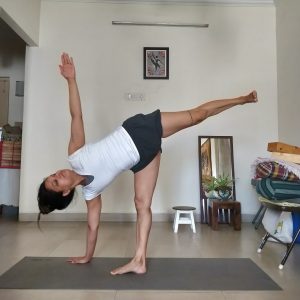
This is the classical Ardha Chandrasana. As you can see, it requires a significant extension of the sides. You should NOT practice this version until you have cultivated enough strength to keep the raised leg lifted and the chest open and strong.


If you’re a beginner….

If you’re a beginner to yoga and have just started your journey, this blog will show you step-by-step instructions about how to get into this posture.  You can also watch this video for tips on how to make your posture better:

You can order ‘Beyond Asanas’ here and learn more about the history and mythology of the Ardha chandrasana.

RIMYI Experiences

Teacher In Focus : Bhavana Mooteri

April 7, 2020

Divya, Bhavana and me 4 years ago at Bellur.

I met Bhavana for the first time when we attended the inaugural yoga workshop in Bellur.  Over the course of the workshop we got a chance to connect quite a bit.  It was a special time for all, as we were meeting Iyengar practitioners from all across the world.  We spoke quite a bit about our personal yoga journeys and even ended up staying in touch.

Bhavana has been practicing yoga since 2009.  She worked in the corporate strata for 15 years before she finally gave in to her passion and decided to devote herself full time to yoga.  She did her TTC from the Sivananda Ashram in Kerala in 2015.  In 2016 she went to RIMYI for a month to learn under the masters of Iyengar yoga.  She does workshops and retreats as well.  And now you can find her classes on line!

For more about Bhavana and her classes visit https://www.yogawithbhavana.com/


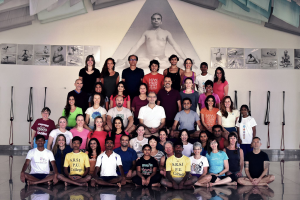
The entire gang for the workshop. Can you spot Bhavana and me?


RIMYI Experiences

A Pranayama Sequence – Day 7

December 5, 2019

Pranayama is the fourth limb of the Ashtanga system of yoga. The other limbs are (in sequence):
1. Yama
2. Niyama
3. Asana
4. Pranayama
5. Pratyahara
6. Dhyana
7. Dharana
8. Samadhi

Most scholars believe that this is a sequence and practitioners have to gain a certain level of mastery in one to go to the next one. Which is why in many schools of yoga, pranayama is only taught after many years of intense asana practice. For instance, beginners in of Iyengar yoga don’t practice pranayama. In 2017 I experienced a pranayama class at RIMYI and wrote about it here.

However, some schools of yoga believe that these are limbs and not steps. They believe that it is therefore possible to practice several of the limbs at the same time. At SVYASA pranayama is taught to all patients, regardless of fitness levels and health conditions. Also, some pranayama is included in the asana classes and trataka (candlelight gazing) medition sessions.

I’ve been attending pranayama class every day here and although I don’t practice pranayama in my personal practice (yet), those readers who are interested are welcome to follow the below sequence. This sequence has been designed by SVYASA after extensive research.

Opening Prayer

1. Kapalabhati
20 strokes
40 strokes

Mudra: chin mudra

Relax in the Shitali dandasana.

2. Sectional breathing
Abdominal breathing 5x
Mudra: chin mudra
Thoracic breathing 5x
Mudra: chinmaya mudra
Clavicle breathing 5x
Mudra: adi mudra
Yogic breathing 5x
Mudra: brahma mudra

Relax in the Shitali dandasana.

3. Nadi Shuddi aka anulom-vilom pranayama 10x
Mudra: chin mudra with the left hand, nasika mudra with the right hand

Relax in the Shitali dandasana.

4. Brahmari pranayama using the N-kara
Mudra: chin mudra or shanmukhi mudra

Cooling pranayama practices

5. Shitali pranayama
Mudra: chin mudra

6. Sitkari pranayama
Mudra: chin mudra

7. Sadanta pranayama

Mudra: chin mudra

8. Nada anusadana
A-kara 3x
U-kara 3x
M-kara 3x

Closing prayer.

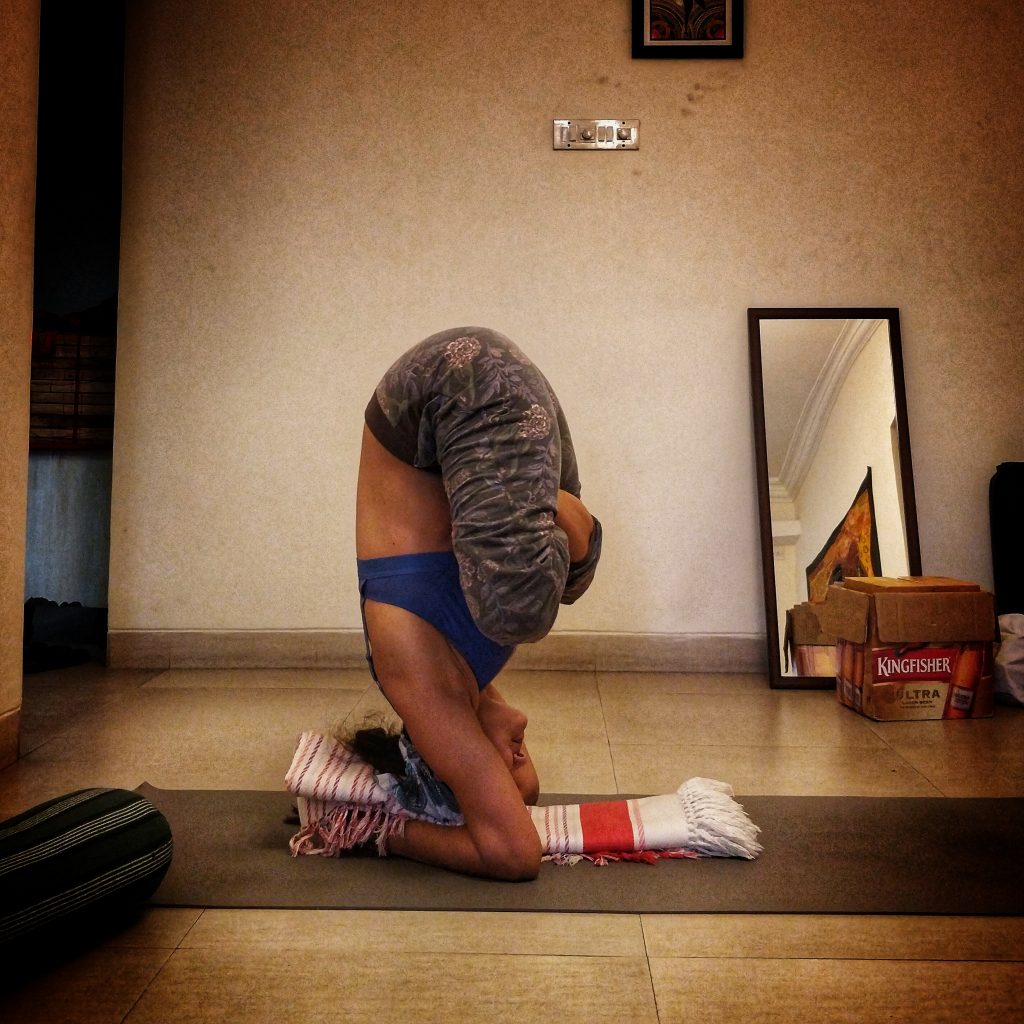
I’m missing practicing in my own space. This is from a practice session a few weeks ago. Although I’ve learned a lot here, I’m itching to head back home and resume asana practice.

RIMYI Experiences

Prop or Crutch?

September 19, 2019
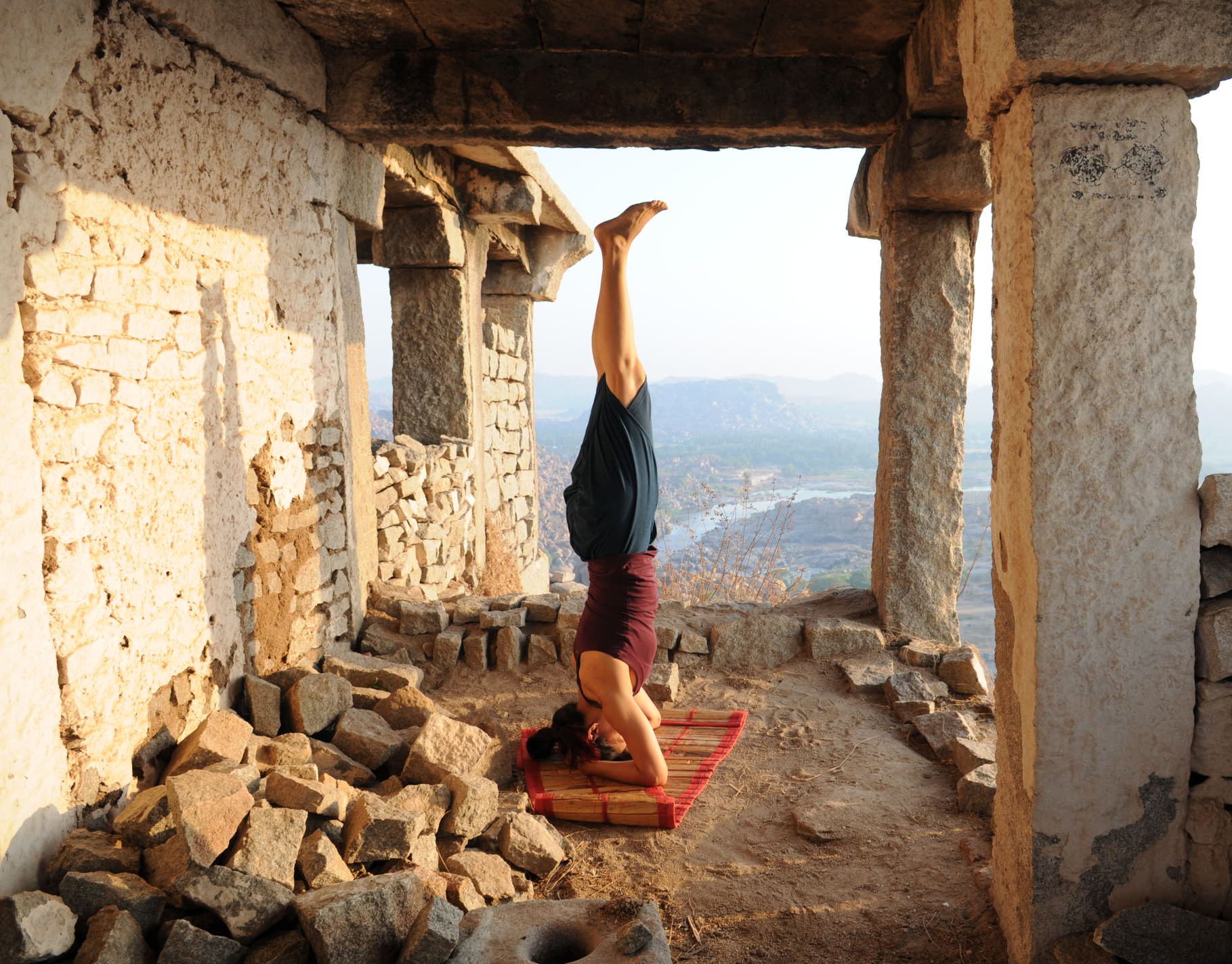
See the Sirsasana

This beautiful shot is part of the photos we took for ‘Beyond Asanas: The Myths and Legends Behind Yogic Postures”. Get your copy of the book on Amazon and Flipkart.

I had a 7 am class with Gulnaz Dashti today, my second with her this month.  I’ve recounted my hilarious class in 2016 with her here.  And last year here.  As evident in these blogs, she’s energetic, lively and funny.

Lately I’ve been having problems with the sirsasana.  It’s confounding.  I’ve been practicing sirsasana for years, even doing variations.  Here’s a video of me doing advanced variations too.  But suddenly one day I felt my neck starting to cramp up.  I hadn’t changed anything and I got a bit worried.

I decided that maybe I should change the way I use the blanket under my head.  Until now I was using a folded blanket between a folded mat.  I started to fold the blanket in the Iyengar “three fold long” style.  I felt it would give me height .  But that also didn’t feel right.  I spoke to Gulnaz about it last week.  “Is it possible for someone to do a pose for many years and all of a sudden to lose it one day?”

She said in her quick rapid style, “Until now you’ve learned how to do the sirsasana.  Now you’ll  understand the posture.  Go, I’ll see next week!”

So today before I went up I asked her for help.

“Why are you using a blanket?!” she screeched.  “You people become so used to the props!  Keep the blanket aside and go  close to the wall, I’ll adjust.”  She reached down and lifted my shoulders away from my ears.  I felt the weight shifting forward to my elbows.  My wrists and elbows woke up, and I pushed them firmly into the mat.    I teetered for a bit as I got familiar with the new center of gravity.

“Props were invented to teach you how to do a posture, not to become a crutch for you.  You people don’t even question the necessity of a prop!  You become so dependent on the prop that that’s all you see!  You don’t see the pose, you stop learning the pose!!!”

“Don’t be in a hurry to get away from the wall,” she cautioned me.  “Stay there and understand the pose.”

Got it Gulnaz – learn the pose with the props, and understand them without the crutches.

RIMYI Experiences

Don’t Go After the Stretch

September 10, 2019

pc: @khan.clicks @deavalin_david_dsouza makeup: makeupbyhennaanbaree location: Cubbon Park

I had a late class yesterday.  It started at 7.10 pm and went up to 8.40 pm.  The teacher was new to me.  After the usual queries (“Where are you from?  Who’s your teacher?”) I spread my mat and got ready for a class.

All the teachers at RIMYI have a distinct style of teaching.  The strong teacher-student tradition of yoga ensures that your attitude, approach and philosophy towards the practice reflects that of your teacher.  Your students will be able to see the ‘Iyengar’ or ‘Ashtanga’ shades in your classes.  If you go to multiple teachers/don’t go to any teacher – that is pretty evident too.

There isn’t much of a crowd at RIMYI this year.  Last night’s class had about 15 students.  We had enough space to spread out.  The class was quiet.  It wasn’t action-packed or fast paced.  We did very few asanas.  We held each asana for a very very long time.

As you continue to hold, you’re able to go deeper into the pose.  You can intensify the stretch.  You can observe which limbs are working, which are sleeping.  I worked on lengthening and opening my torso in Trikonasana – I noticed that I could actually activate the hamstrings more.  Similarly in Parsvakonasana.

“You may be feeling a stretch in your hamstrings and on your groin,” said the teacher.  “But feel the quietness in your abdomen.”

I blinked a couple of times. It’s a mannerism Ive noticed recently.  It’s an automatic response if I’m surprised or intrigued.

“Most of us go after the stretch.  We think asana works only if we feel the stretch.  But all asanas bring quietness in the abdomen too.  Find this quiet.”

And with these few sentences, he changed my asana practice forever.


RIMYI Experiences

The First Class

September 4, 2019

How many times have you quickly gone up into sarvangasana? Do you remember to pull the shoulders back, open the chest, activate the thighs and lift the tailbone up? Seemingly small modifications can change the entire posture.

Perhaps it was nervous excitement or maybe anticipation, but my first class was amazing.  By the end of the class my blood was singing and my body felt like it was thrumming (to the beat of my blood?).

I am a sucker for simple classes.  I believe if you focus on the simple stuff everything else falls into place.  This class focused on the tailbone and sacrum region.  We started the class with adhomukha virasana.  Rajalakshmi asked us to continue to extend the arms.  “This extension isn’t because you are lengthening your bones!!!” she boomed into the mike.

“The bones never extend!!!  It’s impossible for you to extend any of your bones!!!” she continued.  “Pay close attention to the parts of your body that make the extension possible!” she said.

She encouraged us to pay close attention to the tailbone-sacrum region and observe how it participates in forward bends and twists.

The most interesting part of the class was dissecting the parivritta trikonasana or the revolved triangle posture.  There are three movements that make this asana possible: the extension of the side, the bending forward keeping that extension intact and finally, the opening of the chest.  And once we were in the final posture we were asked to pull the tailbone and sacrum in to the body.

At one point Rajalakshmi caught me looking at my hip.  I realize I do this unconsciously every time I practice this asana.  I use my eyes to ensure that my hip is pushed back, which detracts from the overall experience of the asana.  “Your side is compressing and you’re becoming a ball,” Rajalakshmi explained patiently.  “Extend your chin forward and away from the sacrum.  Open the sacrum and lengthen the side!” she boomed again.

This is the magic of the annual pilgrimage to RIMYI.

RIMYI Experiences

Registrations at RIMYI

September 3, 2019

Finally getting the hang of this.

I headed to the institute at around 9 am this morning.  In previous years I’ve always registered in the evenings so I wasn’t sure what to expect.  I decided to wear my practice shorts just in case.

The person at the front desk smiled and nodded his head in recognition. He suggested I go practice first and come back later to get the registration forms.

Self-practice sessions at RIMYI can be intimidating. Alhtough you have people of all levels you tend to look only at those who are busy defying gravity. Today there were students going from adhomukha svanasana to urdhva dhanurasana and back again.

Watching students who have a better asana practice than you can be intimidating…or extremely inspiring. As a yoga student the one quality that has been of immense help to me has been that the only ‘I’ I take with me to a class is ‘I am a yoga student.’ Besides this I don’t think, ‘I can’t do back bends’ or ‘I have a mean urdhva kukkutasana’. I’m willing to explore what I already know. And willing to wrestle with prejudice, fear and doubt to discover new movements.

Besides the above two things, the other things I should mention for a month in Pune are:

  1. Don’t bring your yoga mat. You have every prop ever created available for use.
  2. Do bring comfortable walking shoes, preferrably ones that can withstand the rains. Pune is known for its sudden showers (it’s pouring as I write this).  Don’t forget a trusted umbrella.
  3. Students generally bring skirts or loose pants to wear over their practice shorts rather than changing at the institute.
  4. Don’t forget your passport photos (along with the other documentation such as visa copies, passport copies etc). It had completely slipped my mind that I needed passport photos, but luckily had some extras in my wallet.
  5. You can pay your fees through cash or card.
  6. A lot of students like to have a coconut post class. I would recommend bringing your own re-usable straws rather than using the disposable plastic ones.

These are the few things that come to mind right now. In case you have specific queries, drop a comment.

Post practice I got my schedule. I have evening classes three times a week, and today happens to be an evening class. Fingers crossed for a good class and an awesome month.

RIMYI Experiences

An Auspicious Start – Pune Day 0

September 2, 2019

This is my fourth consecutive year coming to study at RIMYI.  In previous years I’ve had the luxury to make lists and plan.  This time I was caught in a whirlwind.  I had to wrap up projects, attend a last minute Vedanta class, plan the quantum of assignments to work on this month, and so on and so forth.  I was, of course, also trying to stuff myself with as many idlis and masala dosas as I could.  Have to survive for a month after all.

I think all the frenzied activity of the last few days caught up with me last night.  While I was finishing my packing I suddenly felt sick and threw up my lunch.  My stomach settled down after that but I was in no position to eat and went to bed.

After a quick and simple breakfast of fresh steaming idlis (surprise!) this morning we drove to the airport.  A short flight later I alighted in Pune.

Ganesh Chaturthi in Maharashtra is special and I’ve been lucky to witness it for the last 3 years.  As I got into the taxi I could hear the processions and feel the excitement in the air.  The festivities will continue for the next few days and it’s great to be here this time of year.  I couldn’t have asked for a more auspicious start to my month.  Here’s to a wonderful month of growth, re-connection, beautiful discoveries and new friendships.

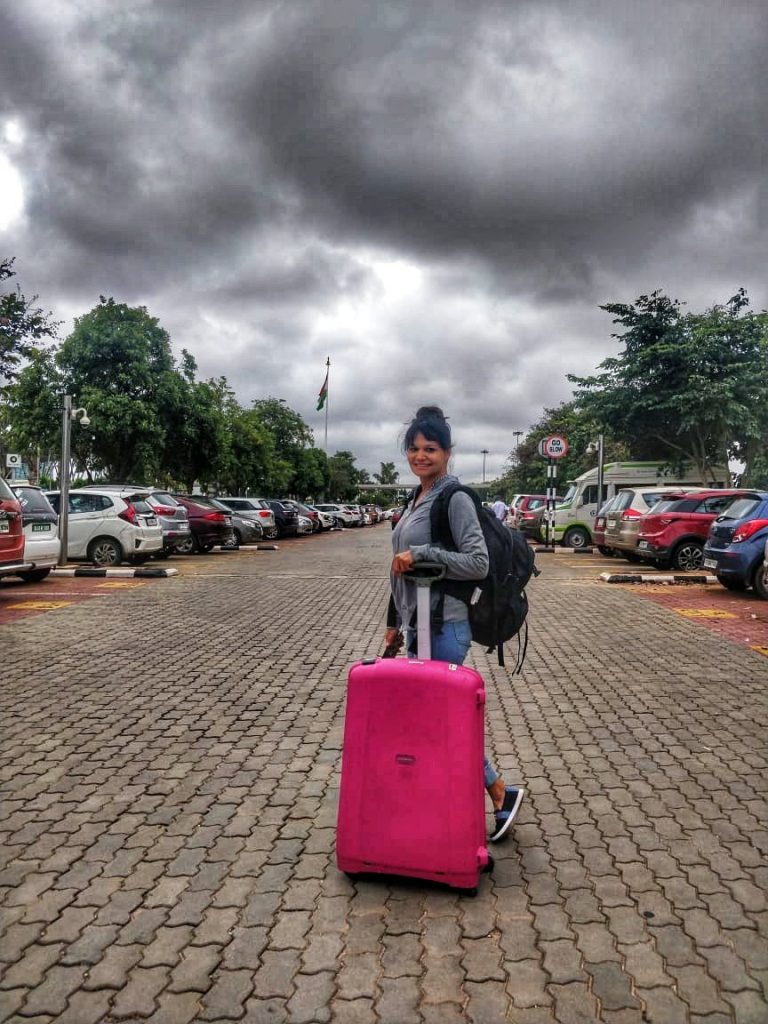
Fourth year in Pune for my trusted pink suitcase too.

RIMYI Experiences

The Pune Diaries – Day 2

August 2, 2018

While registering for classes yesterday I had specially asked to be in one of Gulnaz’s classes.  I was unable to attend class with her last year.  But during my first year here, her classes were the highlight of my schedule.  She’s energetic, spry, proficient, kind, shrill, entertaining and an overall awesome person.  And I’m glad that I started my month at RIMYI with one of her classes.
————————————————————————————————————————————-

We finally rolled out of the Halasana and lay there for some time, recuperating.

It had been a pretty challenging class.  We worked on shoulder opening and rotation.  We went through Trikonasana, Virbhadrasana, Parsvakonasana, Ardhachandrasana.

And finally the Sirsasana, Sarvangasana and Halasana cycle (where I got screamed at for using a blanket where none was required).

So when we were asked to roll our mats out again, all of us breathed a sigh of relief and sat down.

‘Urdhvahastasana!’  We lifted our arms up.

Gulnaz looked at us with a slight smile playing on her lips and told us to stand up and do the Urdhvahastasana.  A couple of us groaned as we stood up.

‘From here go into the Sarvangasana.’

She was expecting my puzzled look and with a twinkle in her eye said, ‘Yes!  From here go into Sarvangasana.’  And went on to show us. From a standing position she rolled back into the Sarvangasana and then rolled forward into standing Urdhvahastasana.  Watching a teacher demonstrate some things makes them easier, but 10 reps of this move had most of us breathless.  I was glad to sit down and let other people have a go at it.

Until Gulnaz walked by again and said, “Chal chal, aise kya baithi hai?!  Phir se kar.  Do another 10!”

I love it when a teacher gets so involved in a class that their energy seems to touch every single student in the class.  A student ceases to be just another body to be taught to move.  Instead, the student becomes another soul to guide and mold.  That’s when a class actually has an impact on you.  Beyond being able to transition from Urdhvahastasana to Sarvangasana and back again.

I have great memories of Gulnaz from the first time I took a class with her.  I recounted it here: https://yogawithpragya.wordpress.com/2016/09/02/a-yogi-in-pune-day-2/