Prompt: Describe the Color Yellow to Someone Blind From Birth

[This poem is a response to the NaPoWriMo (National Poetry Writing Month) prompt.]
[This poem is a response to the NaPoWriMo (National Poetry Writing Month) prompt.]
I was talking about pets the other day with some of my friends. One of them has recently adopted a dog and the other one is also planning on getting one. All of us know a dog lover or two. All of us know a downward dog lover or two too (#yogahumor)!
In ‘Beyond Asanas‘ the first chapter is about the downward dog pose. When researching this posture I looked at dog-lore from different cultures. My goal was also to unearth dog-related stories in our mythology. And sure enough – I found a few stories – two of which have made it into this chapter. In one story a dog helps Lord Indra and in another story a dog is granted admission into heaven after the battle of Kurukshetra.
The Downward Dog is a challenging posture. The most common challenge I see with students is the inability to lengthen the spine. Many beginners are in a hurry to place the heels on the floor, and this compromises the form of the lower back.
How To:
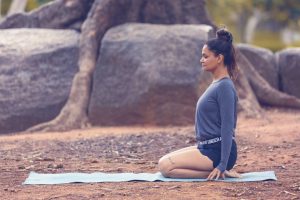
It’s a good idea to start in Vajrasana because your legs are together – which is how you want them to be in the final posture too.
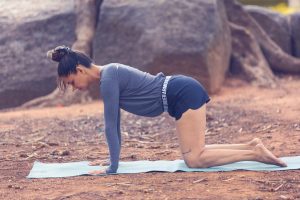
In this position position you need to make sure that your wrists are right under should shoulders. And here you can also separate your legs about hip width distance, making sure that the ankles and knees are in one line.
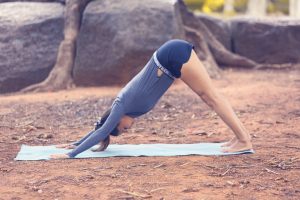
Notice the length in the spine. Things you must watch out for: allowing the shoulders to sag down close to the ears, a curve in the thoracic and lumbar spine, and bent knees. Watch this video to learn how to correct these alignment issues.
You can use props such as a wall, blocks and a rope to help you in aligning the posture. I’ve written a few helpful hits about how to improve this posture in ‘Beyond Asanas: The Myths and Legends Behind Yogic Postures’. Those of you who follow me on YouTube may remember this video I made in 2016. It’s a great video for beginners, because of the detailed explanation of how to get into the posture. Do check it out – it will surely help.
I’ve listed out at least 10 benefits of this asana in the book. However, there are contraindications as well, and those have also been described in ‘Beyond Asanas’. Pick up your copy today.
I’ve never had a dog, but I’m not impervious to their charms. If you’ve been following this blog, you’ve met Aston. He makes my time in Pune a little more fun, a little less lonely.
New patients come to SVYASA on Fridays. When I arrived last Friday I didn’t get a chance to see the in-patient process as I was registering myself as an intern. Today I saw patients coming in and consulting with the doctors. Doctors then refer them to the appropriate department where their vital statistics are taken and files created for each patient. The hospital at SVYASA doesn’t have your typical hospital feel. At any given time you have interns from other institutes and around the world and resident college students observing the processes and method of treatment. The mood is light and happy instead of somber and grievous.
It was interesting to observe the behavior of new patients today. Most described themselves as ‘no problems, just a little acidity all the time’ or ‘nothing as such, just from time to time some depression’ and ‘i have no issues as such, just a little bit of weight problem is there’…and so on and so forth. In a way there is lots of optimism, but somewhere I wonder, is there also denial? If you don’t truly believe that you need a change, regarding your health or anything else in life, will you put 100% into making that change? The only time I’ve been able to bring about change is when I’ve accepted that I need or want a change more than I want the status quo. It’s important to face your issues head on, rather than trivializing them.
Also tonight is my last night here! I can’t believe it’s been one week already and I’m really looking forward to getting back home, to my classes and daily practice. I still remember Day 1.
In other news – my Liguria yoga retreat is on track and we’re excited to announce that seats are filling up fast! Below is a snapshot of what happened in the last retreat. The next one is going to be bigger and better.
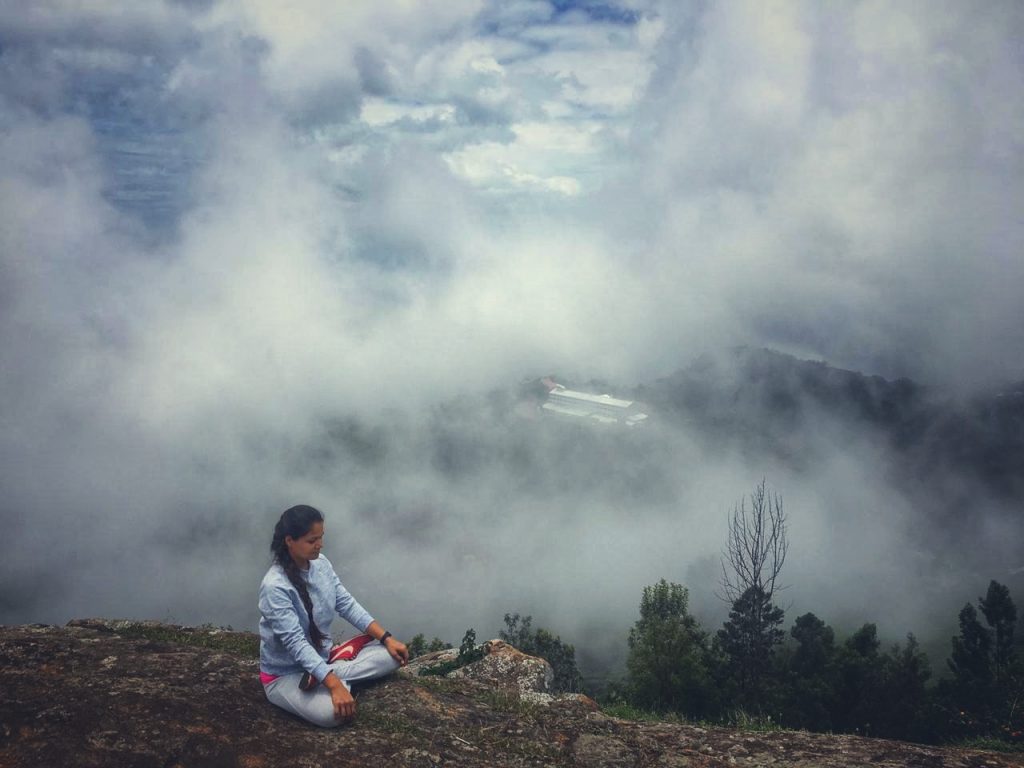
Meditating (or pretending to) somewhere in the hills of Kotagiri. How I long to be back there meditating and breathing the fresh air. pc: Animesh Jain
Today I was posted to perhaps the most interesting department. The Gastroenterology department.
And I’ve finally made a friend!!! She’s doing a BSc. here and is also employed as an Ayurvedic therapist. So she studies and works at SVYASA. She’s become my one stop shop for any queries, and it’s nice to have a friend who knows her way around!
Since the full time therapists are always too busy to answer my questions (and there are always so many questions), I usually end up discussing my queries with Aishwarya. I usually observe silently as patients describe their symptoms to the doctors. The doctors make notes in the files.
Later I pick Aishwarya’s brain.
The symptoms that most patients report are things like bloating and indigestion. If ignored or left untreated these can lead to more serious issues such as chronic constipation, IBS and ulcers. At SVYASA the first line of treatment is to put these patients on an Ayurvedic diet and have them attend various yoga and meditation sessions.
“But do you think the answer to a medical problem so prevalent is as simple as changing the diet and moving a bit more?” I asked her.
Apparently it is. Patients who come in with even severe cases of gastritis report a marked improvement after just a week on the SVYASA routine. Here their food and meal times are regulated. Although the quantity of food can’t be controlled but what the patients (and us) eat is very very simple. It is basically rice, roti, dal, a sabji and buttermilk. Not once has the food been too spicy or too salty. There’s never dessert. Fruit isn’t on the menu and in the evenings they serve a dairy-based malt instead of coffee/tea. We end up eating at the same time every day, which promotes healthy digestion.
We exchanged some personal anecdotes as well. She told me about how she was overweight before she came to SVYASA and her diet underwent a sea-change during the time she’s been here (the last 2 years). I described my weight-loss journey as well and how it was a solid asana practice and a supremely controlled diet that helped me. Aishwarya’s diet is similar to an Ayurvedic diet. Below are a few of the guidelines she follows:
. no sugar
. no milk
. no coffee or tea
. no refined flour, refined rice, refined oil
I didn’t ask her about alcohol but I’m sure that’s also a no. Also, she feels that the food served in the mess isn’t wholesome and so she also makes a malt for herself every once in a while. It’s a powder containing multi grains which she mixes with water and jaggery. Served hot.
Along with what we eat it’s important to eat at the same time every day. It builds regularity in digestion. Erratic meal timings lead to erratic digestion. Erratic digestion gives rise to every single condition treated in the Gastroenterology ward.
Sleep and stress are two factors that simply can’t be overlooked when it comes to digestion. Insufficient or disturbed sleep interferes with the secretion of digestive enzymes which is why you feel sluggish when you’re sleep deprived. It’s the same story with stress. Chronic stress inhibits the secretion of digestive enzymes. Chronic stress will also interfere with the secretion of melatonin, which will in turn lead to sleeplessness, which will cause digestive disorders…and the viscous cycle continues.
The only way to break this cycle is to wake up one day and commit to living better, one decision at a time.
Yesterday was my first day at the Department for Metabolic Disorders. The person in charge was short, squat and had a very aggressive look to him. His name is Shan and I decided to stay clear out of his way.
Class was almost over. All yoga sessions here are similar. Today many supine and prone asanas were included in the routine because we were dealing with metabolic conditions. I was surreptitiously checking the time when all of a sudden I realized Shan was talking to me. “Do you know how to do DRT?” he asked me with an evil glint in his eye.
‘No…uh yes!’ I stammered.
‘Yes or no?’
“I know what DRT is and I’ve attended sessions also but I’ve never conducted it,” I told him, finally getting a hold of myself.
“Hmmm….meet me in my office after class.” He looked at the other intern pointedly, indicating that she was also expected.
“What course are you doing here,” he asked in his office.
“MSc,” I said. “But distance,” I added, hoping that was some sort of justification for not knowing the Deep Relaxation Technique, a meditation technique patented by SVYASA.
“OK, first – tomorrow you both will bring your mats,” he said. “You guys must also participate in the classes. Seeing you the patients feel motivated to move.”
“Yes sir,” we both said in unison.
“Also tomorrow we don’t have class, we have kriyas. You guys be there by 6 am and help the patients.”
I saw this as my chance to practice kiryas under supervision, and quickly seized it. “I can do jal neti, but sutra neti and vamana dhouti are really difficult for me.”
“Then I will teach you. Do you know LSP?”
“Heard of it but I’ve never done it. But I want to!”
I reached the kriya block with my neti kit and my nerves in a bundle. It had been years since I’d done the sutra neti and vamana dhouti. And I was hoping LSP – Laghu Shankh Prakshalana wasn’t going to leave me with the runs.
“Sir, this sutra isn’t going into my nose,” I said as I worked the rubber catheter into my nostril. But he kept encouraging me and eventually the catheter was in the back of my throat. In fact, this morning (because he threatened that he would do it himself) I was able to reach into my throat and pull out the other end of the catheter. This was the second time in my life that I was able to do this.

Vamana Dhouti
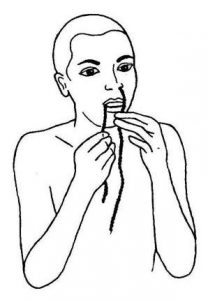
Sutra neti. I wish I had images of me doing the kriyas, but I was so busy doing them that I forgot to document them!
During vamana dhouti he told me about the importance and relevance of cleansing practices. “If you’re a regular practitioner you should do this once a week. Your asanas will improve. These practices are important.” I tried to re-gurgitate the water without resorting to pushing my fingers down my throat. In the end, it was my fingers that did the trick.
LSP is a technique to clear the entire digestive system. I drank 4 glasses of salt water and then did the basic stretching exercises. Then drank another 4 glasses and did them again. By the time I was back in my room I was ready to exploded in the thunderbox. It took a long long time. The water makes it way through the entire digestive system, bringing along toxins. You know your digestive system is clean when the water coming out of you is clear. As he said, “The water should look like your urine. If it doesn’t you have to go again.” It took me all of one hour, but I’m happy to report that my first time at LSP was good. I’m going to continue doing this practice at home too.
As I got the final sign-off from him, I noticed that his smile didn’t look evil or intimidating anymore. Note to self: the greatest lessons sometimes come from the most unexpected sources.
Sign up for my newsletter to get all the updates right in your inbox