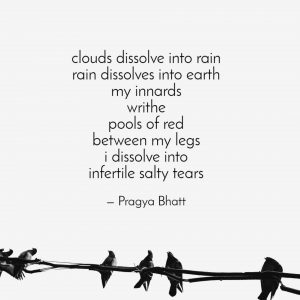
The above is my entry for the #SashaktWordsmithContest. It’s being organised by Sashakt – The Ovarian Cancer Foundation in collaboration with my literary agency called The Book Bakers. The theme is “Ovarian Cancer”.
The above is my entry for the #SashaktWordsmithContest. It’s being organised by Sashakt – The Ovarian Cancer Foundation in collaboration with my literary agency called The Book Bakers. The theme is “Ovarian Cancer”.
When I started writing Beyond Asanas, it was going to contain about 100 asanas. After all, I was writing my magnum opus. As the book took shape this number dwindled down to 30.
I chose asanas that I had been practicing for a few years. Ones which I knew and understood. There were, of course, the mundanities to consider. Visual appeal, my ability to execute the posture well, would my research yield interesting information about it?
The Ardha Chandrasana made the cut. I found a connection between this asana and the story of the near-destruction of the universe. When Shiva swallowed the halahala to save the Universe, the poison turned his body blue. Chandra stepped in to help.
Then there’s the story of why the moon waxes and wanes. Lord Ganesha and his temper are responsible for the moon manifesting in its ‘ardha‘ or half stage.
The Ardha Chandrasana is Chapter 5 of my book. To read the stories and the significance in more detail get your copy of the book.
Below are the step-by-step instructions, with images.
1. Start on the right with Trikonasana.
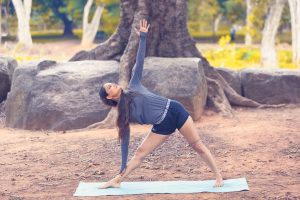
For more on Trikonasana see Chapter 4 in Beyond Asanas.
2. Bend your right knee and reach forward with your right hand. Place it on the floor diagonally opposite the right foot.
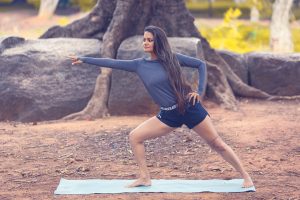
Note the extension on the right side of the torso as the outer edge of the left foot stays firmly on the ground.
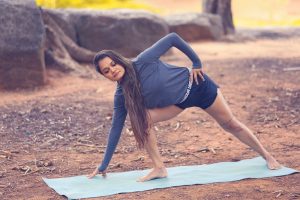
The right arm and right foot must be diagonal to each other, else balancing is hard.
3. Engage your right arm and leg, so that you can balance and support yourself on them. Slowly lift the leg up until it is parallel to the floor or slightly above hip level.
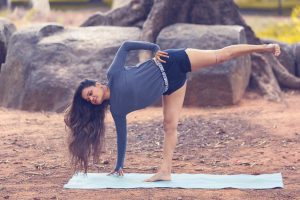
The key to balance is your gaze. The steadier and more focused your gaze, the better your balance.
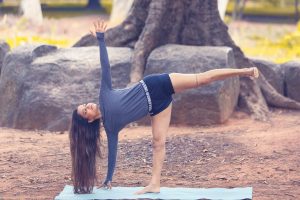
Behold! The final posture. The gaze swivels up to the left thumb.
4. To come down, bring your left leg back to the floor in the same way you took it up. You should end in the Trikonasana again.
5. Repeat on the left side.
These beautiful images are done by Farhan Khan of @khan.clicks and David of @deavalin_david_dsouza. The makeup is by Henna of @makeupbyhennaanbaree.
If you have any questions or queries, do leave a comment.
Get your own copy of ‘Beyond Asanas: The Myths and Legends Behind Yogic Postures’ here.
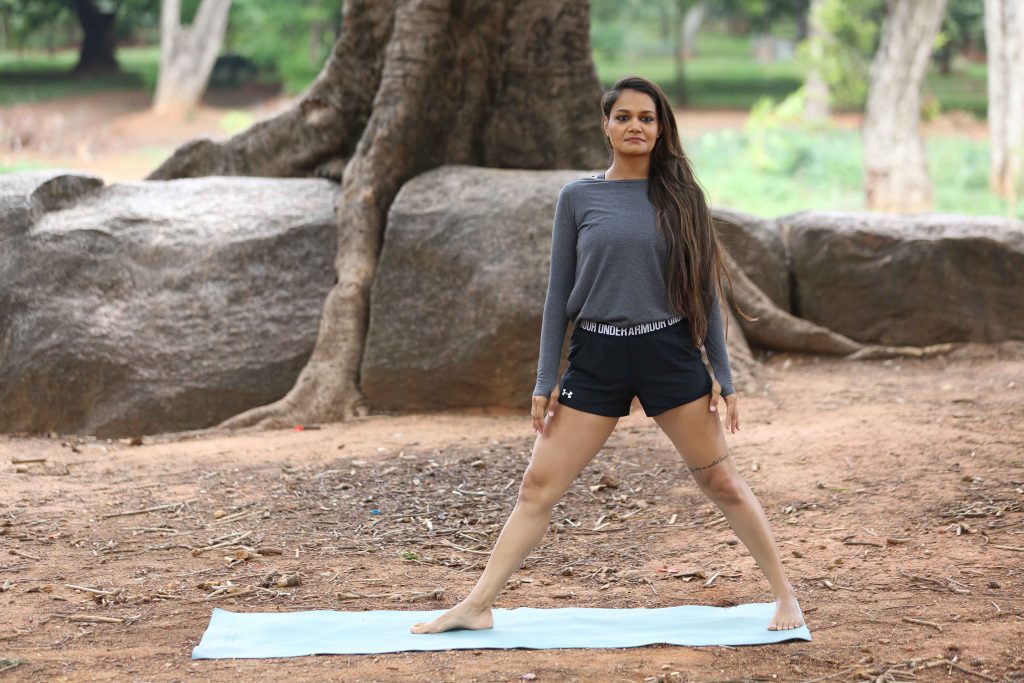
pc: @khan.clicks @deavalin_david_dsouza makeup: makeupbyhennaanbaree location: Cubbon Park
I had a late class yesterday. It started at 7.10 pm and went up to 8.40 pm. The teacher was new to me. After the usual queries (“Where are you from? Who’s your teacher?”) I spread my mat and got ready for a class.
All the teachers at RIMYI have a distinct style of teaching. The strong teacher-student tradition of yoga ensures that your attitude, approach and philosophy towards the practice reflects that of your teacher. Your students will be able to see the ‘Iyengar’ or ‘Ashtanga’ shades in your classes. If you go to multiple teachers/don’t go to any teacher – that is pretty evident too.
There isn’t much of a crowd at RIMYI this year. Last night’s class had about 15 students. We had enough space to spread out. The class was quiet. It wasn’t action-packed or fast paced. We did very few asanas. We held each asana for a very very long time.
As you continue to hold, you’re able to go deeper into the pose. You can intensify the stretch. You can observe which limbs are working, which are sleeping. I worked on lengthening and opening my torso in Trikonasana – I noticed that I could actually activate the hamstrings more. Similarly in Parsvakonasana.
“You may be feeling a stretch in your hamstrings and on your groin,” said the teacher. “But feel the quietness in your abdomen.”
I blinked a couple of times. It’s a mannerism Ive noticed recently. It’s an automatic response if I’m surprised or intrigued.
“Most of us go after the stretch. We think asana works only if we feel the stretch. But all asanas bring quietness in the abdomen too. Find this quiet.”
And with these few sentences, he changed my asana practice forever.
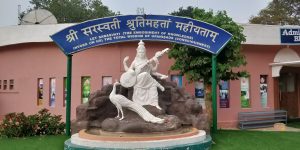
I recently enrolled for a Master’s program in yoga studies. I went back to SVYASA (Swamy Vivekananda Yoga Anusudhana Samsthana). It is a university dedicated exclusively to yoga and holistic health. In 2012 I registered for their YIC (Yoga Instructor’s Course) never dreaming that in 2019 I would be back for a masters.
Two months ago I went to the university to attend a few lectures. My days there were reminiscent of my Infosys Mysore training. Until now yoga has largely meant asana practice for me. Philosophy is intimidating.
I think this master’s program may just bridge the gap for me. The faculty at SVYASA comes with a long list of achievements and experience. All the members are well-known experts in their chosen area of study.
Our Yoga Therapy professor, Dr. Uma gave us some enthralling lectures. She lectured on the importance of an integrated approach to health care. One day the discussion turned to vegetarianism, veganism and other lifestyle related food choices. She told us about her personal conflict with milk. For years she had adamantly supported the consumption of milk. She holds an MBBS, MD as well as a BHMS. Milk is a panchamrit (five elixirs). However, latest research shows that milk is not good for you.
“Then I realized that milk as we know it now is not the milk Ayurvedic texts are talking about. The cows, the environment, the people were different, and so the milk was also different. Now I don’t have milk.”
“Nowadays disseminating information is easy. You will find 100 opinions on everything under the sun. What to eat, when to eat. What to drink, when to drink. Why to eat, why not to eat. Why to drink and why not,” she said. “You must not listen to everything. Find what resonates with you. What do you believe in-spite of all the information that you are being bombarded with? You must cut through the noise and find your center.”
“When the student is ready, the teacher appears.”
I’ve heard this phrase countless times, and even uttered this platitude a few times myself. But a conversation with a friend of mine (another yoga teacher and owner of a yoga studio) made me take a fresh look at the teacher-student relationship.
When we say this phrase our emphasis is always on the teacher appearing. That the teacher should know when the student is ready and then magically appear. But what a student does/is doing while they are waiting for the teacher to be conjured is also important.
I’ve noticed two kinds of students-in-waiting:
The most important aspect of any practice is the practice itself. Your yoga practice is your teacher. If you aren’t visiting your teacher daily then you’re not a student nor a seeker. Your desire to practice advanced asanas isn’t an indicator of your interest or your passion – it’s actually a measure of how tamasic you are. You are looking at an external force to help you achieve your goal, instead of putting in your own sweat, blood and tears.
Finally, the teacher-student (guru-shishya) relationship is very much driven by the student. The student must offer himself up first. The surrender happens, and then the learning commences. Until the student is able to turn off his ‘I-ness’, he will forever flail, grasping blindly for knowledge and wisdom which will always elude him.
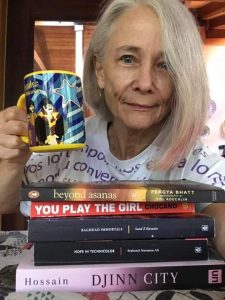
Pictured below is my 11-12th grade English teacher. Those of you who know me know that I went to different schools around the world until I landed in Dhaka, Bangladesh. At the American International School/Dhaka I had the double privilege of not only studying literature but also writing innumerable essays under the guidance of Ms. Spisso. Here she is with books written by her alumni. I like to think this is my guru dakshina to her.
Sign up for my newsletter to get all the updates right in your inbox