Nature is cyclical. Night goes to day and back again. Winter goes to summer and back. Life is cyclical as well. The cycle of birth and death. Years begin and end. At the beginning of every year we make resolutions. But it’s a good practice to endeavor to make resolutions all year round and keep them. Small resolutions to push the limits of your willpower. To strengthen you form the inside and center you. At the beginning of the month you can start with, I will cut down the number of mugs of coffee. Or I will practice every day without fail. Even things like, I will wake up 15 minutes earlier than usual. All these resolutions serve to keep the feeling of goodwill and positivity going in our lives. Through these resolutions we are constantly endeavoring to make our lives better, we live better and are making an impact on the universe in our own unique way. My resolution today is to be more tolerant and compassionate with those who are different from me. Often we forget that people are the way they are because of the lives they’ve lead and the circumstances they have dealt with. So the dour policeman, the irritated shopkeeper, the rude waiter – they’ve all lived through pretty nasty circumstances which have made them blind to the joys of life. It’s sad and unfortunate and the best we can do is to just take in a deep breath and take care not to send out a negative thought into the world. Better yet, send out a prayer to these people hoping that soon the blessings of happiness and contentment find them and make their lives easier. Yogis on the other hand are forever collecting blessings and positivity. Regular cleansing practices purify our minds and souls and this in turn purifies the environment around us. We are blessed to have found the gift of yoga. It’s time we started sharing the gift with others. Shalom.
In the freezing temperatures of New Delhi, one of the best things you can do for yourself is go out and get those nutrition packed, 100%-healthy and 100%-yummy vegetable juices available in just about every street corner in the city. I went out for a walk with my little sister yesterday and we had huge glasses of this wonderful and natural goodness. Carots, beetroot, mint, ginger and then a dash of lime to spice it all up and you have provided your body with a disease fighting mechanism and your skin with a reason to glow…and all of it for as little as Rs. 40! Haven’t tried it yet? Go out and get a glass right now and ensure you’re healthy and glowing all winter long. And to top this off my sister and I had corn on the cob while walking back. Nothing beats the feeling of a great walk, healthy food and a person you love for conversation! Love does make the world go round and good health helps us bask in the glory of that love. During this Season of Love think of your husband, you mom, your dad, your teacher, your dog – anyone who brings a smile to your heart and a twinkle in your eye and share a glass of vegetable juice with them :). I did with my lovely little sister – vote for her at: http://www.facebook.com/photo.php?fbid=319356268103583&set=a.318034891569054.73075.110568648982347&type=3&theater – click on the ‘Like’ button!
I would say that perhaps the best thing you can do for your body and your mind, and something that helps your practice is waking up a bit early, preferably at day break. I’ve met a lot of people who exclaim – “But that’s midnight!” However, I’ve found that waking up early, when its still a bit dark outside, when it’s quiet and still and when the morning traffic hasn’t started, energizes me for the day like nothing else can. (Yes, not even snuggling deeper into the warm quilt on those chilly January mornings for a few extra moments of sleep.) It’s at this time that the stillness and calm outside can penetrate deeper into your mind and help you balance yourself. What helps perhaps is that there are no distractions. Family members are still asleep, the maids won’t turn up for a while, and your to-do list doens’t have to begin until the sun is up. At this time it’s nice to listen to some peaceful music, perhaps some vedic chanting or just some other music that I find relaxing. Better yet, sit in sukhasana breathing deeply and listen to the delicious silence….
Perhaps the biggest question people have about yoga is what exactly is it? In the yoga marketplace there are a plethora of classes available. From chanting to asana to meditation to candle gazing…what is yoga? And more importantly, if I want to practice it, do I have to do all of the above or is there an easier way?
What is Yoga?
Put very very simply, yoga is an Indian philosophy with its origins in the Vedas, which deals with a human being’s mental and physical state. The ultimate goal of practicing this philosophy is to gain enlightenment, called samadhi in yoga. Many philosophers have codified this practice, most notably Patanjali in his Yoga Sutras. However, there have been other sages/philosophers who have contributed to this vast corpus of literature, such as Sage Swatmarama and Sage Vashishta to name a few.
I feel the essence of yoga can’t be encapsulated in a definition, an entire book, or even a 2-year long university course. It is as much a philosophy as it is a practice. It is as much candle gazing as it is trikonasana.
However, there are a few definitions that can help you get started, and which encompass the wide variety of things that encompass yoga.
Definitions
युज्यते अनेन इति योगः। – Panini
(Ujyate anena iti yogah.)
(Joining the individual soul to the universal soul.)
Panini in his exhaustive text about the roots of Sanskrit words (called Dhatupatah), has conjugated the root word of yoga, ‘yuj’ several times, and each conjugation has a different meaning. Sometimes it means the state of samadhi, sometimes control, and also joining or yoking together. Scholars have extrapolated that to mean that yoga is the joining of the individual soul to the universal soul.
तां योगमिति मन्यन्ते स्थिरामिन्द्रियधारणाम्। – Kathopanishad, Verse 2.3.11
Tam yogam iti manyante stiram inndriya dharanam.
(Yoga is holding the senses steady.)
The Kathopanishad is the story of Nachiketas asking Yamaraja (the God of Death) questions about aatma, the soul, the nature of man, and about what happens to us after we die. During their interaction Yamaraja tells Nachiketas that holding the senses steady is yoga because according to him we grow and decay and real yoga happens when you can remain steady during this process.
मन:प्रशमन उपाय:योग इत्यभिधीयते। – Yoga Vasistha, Verse 3.9. 32
Manah prasamano payah yogah itibhidhiyate.
(A technique to make the mind quiet is yoga.)
The Yoga Vasistha is an important yogic text attributed to Sage Vasistha. It talks about the how the individual soul can unite with the cosmic soul despite the trials and tribulations of daily life. Like the Upanishads, it emphasises the importance of self-enquiry to understand ourselves and the universe.
The Yoga Vasistha is attributed to Sage Vasistha.
योगश्चित्तवृत्तिनिरोधः। – Patanjali Yoga Sutras, Verse 1.2
Yogah chitta vritti nirodhah.
(Yoga is calming the disturbances of the mind.)
Sage Patanjali compiled his Yoga Sutras between 400-500 BC. Divided into four chapters, the Yoga Sutras of Patanjali outline how to attain samadhi through the practice of yoga. It is arguably one of the most widely read yogic texts.
Here’s a blog I wrote about the vibhutis or magical powers that a yoga seeker can acquire on his yogic journey. Some things on this list will surprise you!
योगस्थ: कुरु कर्माणि सङ्गं त्यक्त्वा धनञ्जय |
सिद्ध्यसिद्ध्यो: समो भूत्वा समत्वं योग उच्यते – Bhagvad-Gita, Verse 2.48
Samatvam yoga ucchyate.
(Yoga is a state of equanimity.)
In this long conversation between Krishna and Arjuna, Arjuna repeatedly expresses his misgivings about the war. Krishna patiently explains the concept of dharma and the importance of following that dharma to Arjuna and guides him to do what is right.
At least one of these texts is studied by most yoga students in their life times. On my part, I’m currently studying the Kathopanishad, teaching the Bhagavad Gita and continue to study the Patanjali Yoga Sutras.
What other definitions/texts do you feel should be included in this list?
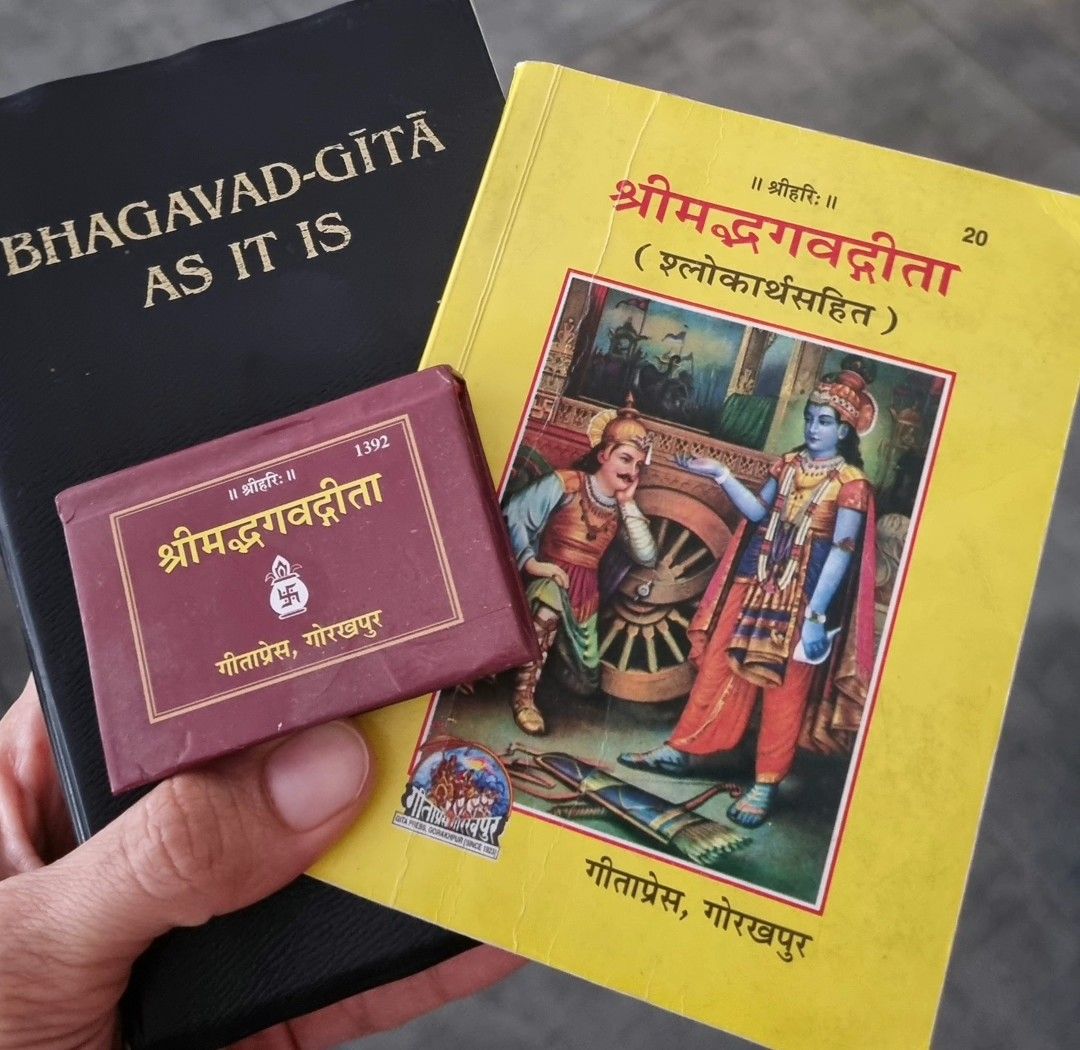
The Bhagavad Gita is the most widely studied yogic text in the world.