Pragya Bhatt | yogawithpragya

RIMYI Experiences

Prop or Crutch?

September 19, 2019
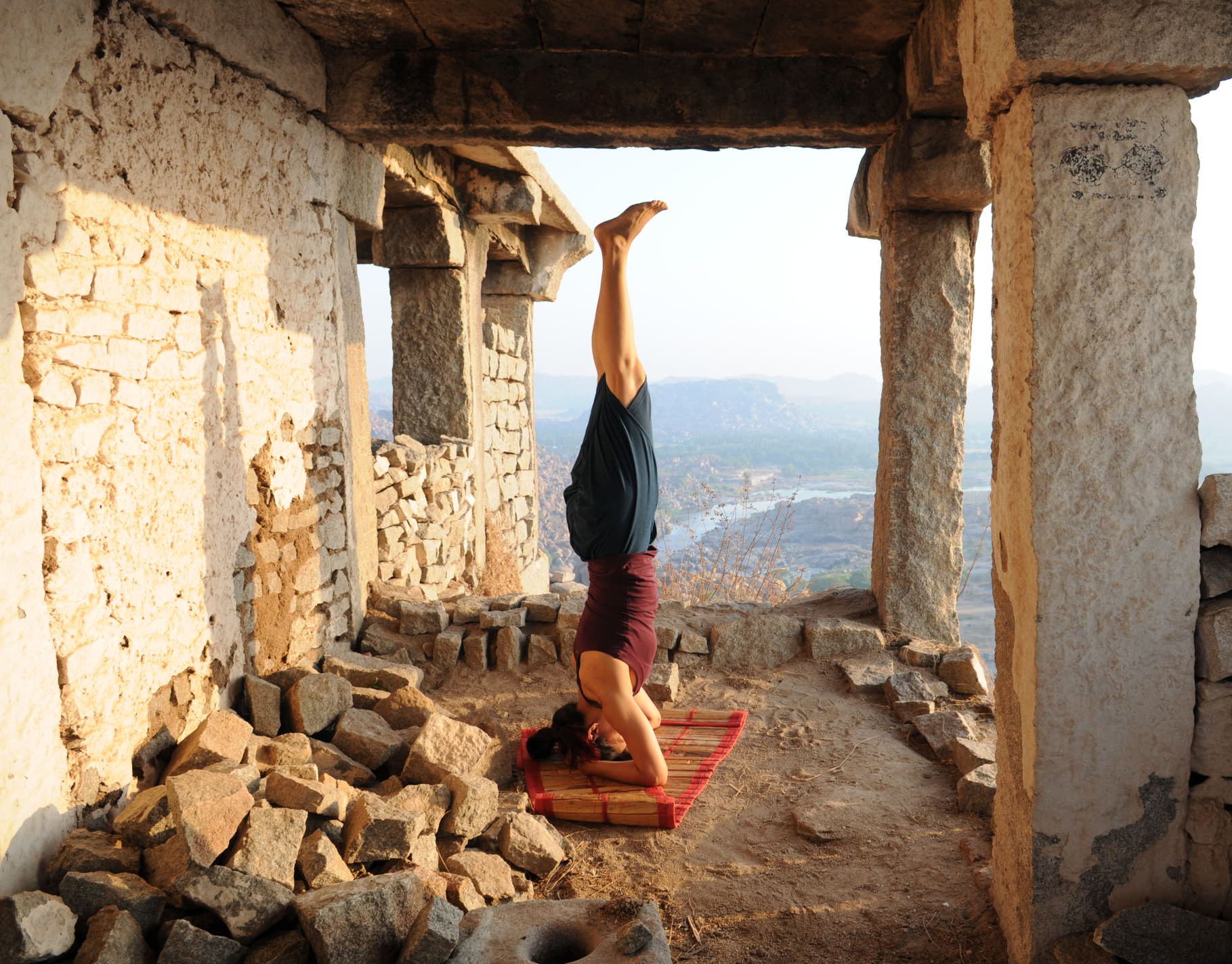
See the Sirsasana

This beautiful shot is part of the photos we took for ‘Beyond Asanas: The Myths and Legends Behind Yogic Postures”. Get your copy of the book on Amazon and Flipkart.

I had a 7 am class with Gulnaz Dashti today, my second with her this month.  I’ve recounted my hilarious class in 2016 with her here.  And last year here.  As evident in these blogs, she’s energetic, lively and funny.

Lately I’ve been having problems with the sirsasana.  It’s confounding.  I’ve been practicing sirsasana for years, even doing variations.  Here’s a video of me doing advanced variations too.  But suddenly one day I felt my neck starting to cramp up.  I hadn’t changed anything and I got a bit worried.

I decided that maybe I should change the way I use the blanket under my head.  Until now I was using a folded blanket between a folded mat.  I started to fold the blanket in the Iyengar “three fold long” style.  I felt it would give me height .  But that also didn’t feel right.  I spoke to Gulnaz about it last week.  “Is it possible for someone to do a pose for many years and all of a sudden to lose it one day?”

She said in her quick rapid style, “Until now you’ve learned how to do the sirsasana.  Now you’ll  understand the posture.  Go, I’ll see next week!”

So today before I went up I asked her for help.

“Why are you using a blanket?!” she screeched.  “You people become so used to the props!  Keep the blanket aside and go  close to the wall, I’ll adjust.”  She reached down and lifted my shoulders away from my ears.  I felt the weight shifting forward to my elbows.  My wrists and elbows woke up, and I pushed them firmly into the mat.    I teetered for a bit as I got familiar with the new center of gravity.

“Props were invented to teach you how to do a posture, not to become a crutch for you.  You people don’t even question the necessity of a prop!  You become so dependent on the prop that that’s all you see!  You don’t see the pose, you stop learning the pose!!!”

“Don’t be in a hurry to get away from the wall,” she cautioned me.  “Stay there and understand the pose.”

Got it Gulnaz – learn the pose with the props, and understand them without the crutches.
Poetry

Dissolution

September 17, 2019


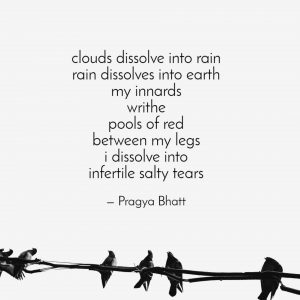
The above is my entry for the #SashaktWordsmithContest.  It’s being organised by Sashakt – The Ovarian Cancer Foundation in collaboration with my literary agency called The Book Bakers.  The theme is “Ovarian Cancer”.

Yoga & Vedanta Philosophy Yoga

Happiness Is Not in the Gulab Jamun

September 15, 2019

Missing my Sunday runs around the Ulsoor Lake.

I’ve been working on completing assignments for my MSc. The one I’m working on now is about happiness and man’s quest for it.

Lately more and more people reach out to me to discuss how to feel better rather than look better. They are interested in the mental and emotional benefits, rather than the physical benefits of yoga.

According to the Upanishads all beings (humans and animals) are instinctively attuned to sukha prapti (to gain happiness) and dukha niviritti (to overcome the misery). It’s this instinct that drives us. A penthouse, a limited edition car and an exclusive gym membership are the stuff dreams are made of, yet happiness still eludes us. Retail therapy isn’t getting us any closer to sukha prapti.

Psychosomatic conditions are rising at an alarming rate. We’re buying more than ever before but we’re also more sad. If only it was possible to buy away depression. We pin our hopes for happiness on objects of enjoyment and come away disheartened.

The Upanishads dealt with this question centuries ago. They state that man is in search of Reality and Happiness. This search yields answers to question such as the meaning of life, the goal of life and truth. It can drive away existential angst.

So whether it is eating gulab jamuns, getting the latest mobile phone or going on an expensive vacation, we want these because we feel these fulfill a deep seated need within us.

As my Vedas professor lectured: Whether it is eating gulab jamuns, getting the latest mobile phone or going on an expensive vacation, we want these because we feel these fulfill a deep seated need within us. We also want promotions, awards and praise. But the 50th gulab jamun doesn’t taste as good as the first one. The mobile phone loses it’s charm when the next version comes out. A vacation ends. And the desire for awards and promotions is never ending. Happiness is not in the gulab jamun or the mobile phone. Happiness shouldn’t be ephemeral like a vacation.

If only we could prolong the feeling of gastronomic delight of that first gulab jamun, of the excitement of the penthouse and car. Meditation is nothing but the prolonging of that state of bliss. Our happiness is always in response to an external event or object, and so it disappears in the absence of that stimulant. The Upanishads liken bliss to the musk of the musk deer. The deer searches the entire forest for the source of the glorious scent, and ultimately finds that he is the origin. Similarly, our happiness may be stimulated by something external, but the origin of the bliss is within us and therefore always accessible. To connect with this bliss you need to silence the citta vritti (the fluctuations of the thoughts in the mind).

The Upanishads have stated that yoga (beyond just the asanas) is the solution. The Gita states: yoga citta vritti nirodah. Yoga is the cessation of the fluctuations of the thoughts in the mind. When the fluctuations cease, silence pervades. And through this silence you can discover your bliss.

Happiness according to Vedic texts

Taittiriya Upanishad: When speech recedes and the mind reaches not there, one realizes Ananda, the Brahman; there he fears not.

Bhagvad Gita: Mind calmed down, sinless, all passions subdued, the Yogi establishes himself in the state of Brahman, the Supreme happiness.

Brahma Sutra: Brahman is Ananda, as repeatedly emphasized in the Upanishad.

Yoga

Cut Through the Noise and Find Your Centre

September 14, 2019

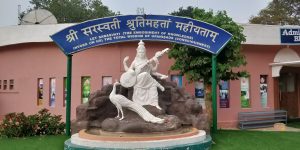
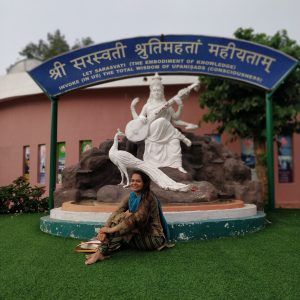
Saraswati is the goddess of knowledge, music, art, wisdom and learning.

I recently enrolled for a Master’s program in yoga studies.  I went back to SVYASA (Swamy Vivekananda Yoga Anusudhana Samsthana).  It is a university dedicated exclusively to yoga and holistic health.  In 2012 I registered for their YIC (Yoga Instructor’s Course) never dreaming that in 2019 I would be back for a masters.

Two months ago I went to the university to attend a few lectures.  My days there were reminiscent of my Infosys Mysore training.  Until now yoga has largely meant asana practice for me.  Philosophy is intimidating.

I think this master’s program may just bridge the gap for me.  The faculty at SVYASA comes with a long list of achievements and experience.  All the members are well-known experts in their chosen area of study.

Our Yoga Therapy professor, Dr. Uma gave us some enthralling lectures.  She lectured on the importance of an integrated approach to health care.  One day the discussion turned to vegetarianism, veganism and other lifestyle related food choices.  She told us about her personal conflict with milk.  For years she had adamantly supported the consumption of milk.  She holds an MBBS, MD as well as a BHMS.  Milk is a panchamrit (five elixirs). However, latest research shows that milk is not good for you.

“Then I realized that milk as we know it now is not the milk Ayurvedic texts are talking about.  The cows, the environment, the people were different, and so the milk was also different.  Now I don’t have milk.”

“Nowadays disseminating information is easy.  You will find 100 opinions on everything under the sun.  What to eat, when to eat.  What to drink, when to drink.  Why to eat, why not to eat.  Why to drink and why not,” she said.  “You must not listen to everything.  Find what resonates with you.  What do you believe in-spite of all the information that you are being bombarded with?  You must cut through the noise and find your center.”


Yoga Travels

Practicing Together

September 12, 2019

I don’t remember when I came across the word ‘jugalbandi’ for the first time.  Until now I thought the word meant a collaboration.  Before writing this blog I thought I should  probably check the meaning and found that it literally means ‘entwined twins’.  The word is used to refer to a collaboration between two artists, usually a duet between two solo artists.

I’ve attended a few jugalbandis in the past and enjoyed them immensely.  There is magic when great artists come together.  They bring their art and ‘entwine’ it with the art of another artist.  And it creates magic.  It’s not only a mingling of art, craft, technical excellence but also a mingling of hearts, souls and great minds.

If you go to yoga class and take a look around you will see many things.  Lithe bendy bodies and also not so lithe bendy bodies.  People straining to touch their toes, and people balancing on their fingertips.  But there is a common purpose that brings us together: to keep our bodies and minds healthy.

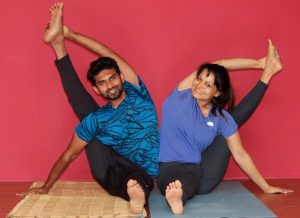
Which is why every once in a while I love to train and practice with different people.  I came across Dayananthan on Instagram one day and was blown away by his asana practice.  So I ‘followed’ him.  And to my surprise he followed me back and said he finds my practice inspiring.  I was thrilled.  More thrilled when he invited me over to his studio Nrityog to practice together.

Teaching yoga (or maybe teaching anything) can get lonely.  You’re either attending class, teaching class or practicing.  You have few ‘work friends’, don’t go out for drinks after work and have no team-building retreats.  So it’s always refreshing to find teachers who reach out.

I arrived at Nrityog early on a Saturday.  Dayananthan was finishing a class.  He is really as awesome as his Instagram profile makes it out to be.  We chatted a bit during which I showed him the postures that were my ‘goal asanas’ such as this one and this one.  We started stretching and decided to work towards the ek pada sirsasana.  I’ve been working on the pose for years and was hoping he could give me new insight into it.

As we stretched I got to know him a bit better.  He started Nrityog with his wife who is also a dancer. The studio is open, airy, full of plants.  The vibe is calm, much like Dayananthan himself.  He freelances at other studios too, which he loves because he gets to meet more people that way.  So you can catch him around in different part of Bangalore.

In about 35-45 minutes he was ready to tackle the leg behind head category of asanas.  My muscles were screaming, but I was game.


I look forward to practicing more with him once I’m back in Bangalore.  The Yoga Jugalbandi.

Meanwhile, if you’re in Bangalore do attend class at Nrityog!!!