Pragya Bhatt | yogawithpragya

Browsing Category

Yoga

Yoga

How To: Janu Sirsasana

May 8, 2020

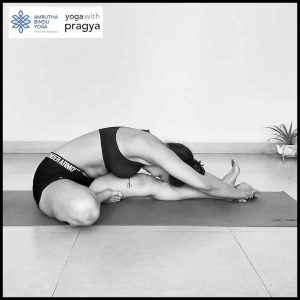
Janu means the knee.  Sirsa is the head.  In this posture sit with one leg stretched out on the ground and the other bent at the knee. (Light on Yoga, p148)

The Janu Sirsasana is my go-to pose when I want to do a more restorative and relaxing practice.  In fact, Geeta Iyengar has included it as an important asana for women during menstruation (Yoga: A Gem for Women).  This is because not only does this posture help to relax the mind, but it also helps to soothe feelings of restlessness and irritability.

Other benefits of the Janu Sirsasana include:

  • Relieving chronic headaches and migraines.
  • Helps to relax the eyes and the mind.
  • Reduces menstrual cramps.
  • Regulates menstrual flow.
  • Gives a great stretch to the hamstrings and calves.
  • Stimulates digestive organs.

Janu sirsasana is usually practiced daily by most practitioners.  I personally prefer a supported janu sirsasana so I use practicing it with props.  There are many different ways you can use props to make this asana feel more relaxing.  Watch this video to see how to do that.


Participate in our Work From Home Challenge this entire month and win a giveaway at the end of the challenge.  Download our practice tracker and asana sequence below:

[ddownload id=”8554″] Practice Tracker

[ddownload id=”8549″] Yoga Sequence


For more information go to:

Medha Bhaskar: https://www.instagram.com/medha.bhaskar/

Amrutha Bindu Yoga: https://www.amruthabindu.com/

Pragya Bhatt: https://www.instagram.com/yogawithpragya/
Yoga

How To: Ustrasana

May 7, 2020


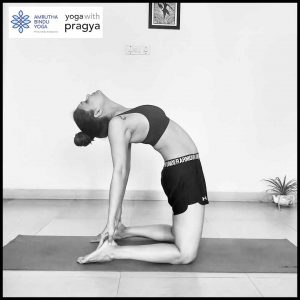
Back bends have never come easy for me.  I’ve struggled with them since the time I started practicing yoga.  Every time I feel I’ve made some headway, I return to practice the next day and realize that was probably just a figment of my imagination.

The key to progress in yogasana is consistent practice.  The key to progress in back bending is safe consistent practice.  I’ve injured myself many times thinking that I should just ‘push through the pain’. I now wish I had taken the time to understand the anatomy of the spine and even focused on basic fundamental movements rather than being in a mad rush to conquer the more difficult asanas.

In retrospect I would have made my daily practice more introspective.  How far can I push myself?  Am I pushing myself enough?  Is this a physical or a mental roadblock?  Am I doing my best to extend the spine?  Am I trying to proactively understand the pain, or letting my teacher do the work to figure it out?  Am I trying my best to make progress, or repeating old patterns?

When we understand ourselves, we know what we need.  Once we know what we need, we can work towards achieving it.  This way, we can take care of ourselves.  (Beyond Asanas, p 131)

Benefits of Ushtrasana
  • Stimulates and massages the thyroid gland.
  • Strengthens and stretches the back, shoulders and arms.
  • Expands and brings flexibility to the chest so the practitioner’s breathing becomes smoother.
  • Tones the abdominal organs.
  • Reduces menstrual cramps.
  • Improves posture and problems of curvature of the back.

(The above benefits taken from my book Beyond Asanas: The Myths and Legends Behind Yogic Postures.)

Participate in our Work From Home Challenge this entire month and win a giveaway at the end of the challenge.  Download our practice tracker and asana sequence below:

[ddownload id=”8554″] Practice Tracker

[ddownload id=”8549″] Yoga Sequence


For more information go to:

Medha Bhaskar: https://www.instagram.com/medha.bhaskar/

Amrutha Bindu Yoga: https://www.amruthabindu.com/

Pragya Bhatt: https://www.instagram.com/yogawithpragya/
Yoga

How To: Viparita Virbhadrasana

May 6, 2020

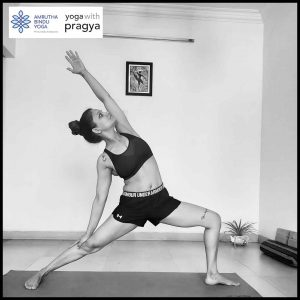
The Viparita Virbhdrasana is an asana that I haven’t explored too much as it’s rarely practiced in classes I attend.  As a result, I don’t teach it very much either.  In fact, I wasn’t even sure of the Sanskrit name for this posture before Medha enlightened me.


In a practice which has three different versions of the Warrior posture, why would there be a pose called ‘reverse’ warrior.  What does it signify?  Is there a deeper meaning?


The most common problem I see when students practice the Virbhadrasana 2 is the tendency to lean the torso forward, towards the leg which is bent and turned out.  But we need to try to keep the chest open and expanded, just like a brave warrior. The way I like to explain it to my students is that a warrior needs to protect himself and in the battlefield is surrounded on all sides by the enemy.  If he leans too much to the front, he won’t be vigilant about the danger that could be lurking behind him.  Therefore, it’s important to keep a long and strong torso, even as one leg is bent to the side.  The Viparita Virbhadrasana helps to correct the tendency to lean forward.

Benefits of the Viparita Virbhadrasana:

  • Great to stretch and lengthen the sides of the torso.
  • Opens the hips, groin and sides of the body.
  • Expands the torso, enabling better breathing.
  • Strengthens the legs.

Watch the video below for pointers for this asana.

Participate in our Work From Home Challenge this entire month and win a giveaway at the end of the challenge.  Download our practice tracker and asana sequence below:

[ddownload id=”8554″] Practice Tracker

[ddownload id=”8549″] Yoga Sequence


For more information go to:

Medha Bhaskar: https://www.instagram.com/medha.bhaskar/

Amrutha Bindu Yoga: https://www.amruthabindu.com/

Pragya Bhatt: https://www.instagram.com/yogawithpragya/
Yoga

The Up Dog and Down Dog Transition

May 5, 2020

I’ve written about the importance of transitions in a previous blog.  The up dog to down dog transition is perhaps one of the most famous transitions in the yoga practice.

In taking care of the spine it is also important to perform dynamic movements.  Although the spine supports the body, it also needs support from other muscles to work optimally.  If your abdominal muscles and sides are weak, the load of the entire torso is borne by your spine and this leads to compression of the back and back pain. This eventually leads to disc bulges, slipped disc etc.

Back pain can be prevented by keeping the spine supple and flexible.  Moving the spine from a concave to convex position i.e curving it in and out – is an excellent way to keep the vertebrae well conditioned and strong.

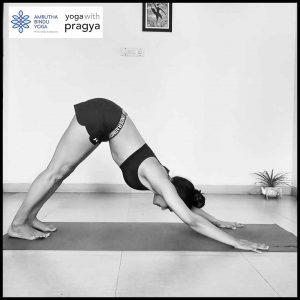
Adhomukha Svanasana

Adhomukha means face downward in Sanskrit.  Svana means dog.  There are many different ways of practicing this posture.  Sometimes with heels lifted up, other times with the toes lifted.  Sometimes with feet together, sometimes wide apart.  Sometimes with heels against a wall, sometimes with the hands against the wall.  Each variation has its own distinct benefit.

Benefits of Adhomukha Svanasana
  • Provides great relaxation to the body and mind.
  • Makes the shoulders and shoulder blades more flexible.
  • Great to tone and strengthen the legs.
  • Rejuvenates the entire body.
  • Stimulates blood flow to the brain and helps to relieve anxiety and depression.
  • Reduces lower backache.


It is advisable not to hold this posture for long periods of time when you are menstruating.  However, those with heavy and uncomfortable menses will benefit greatly by practicing this posture between their cycles.


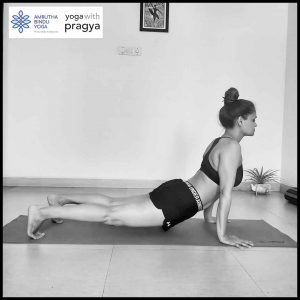
Urdhvamukha Svanasana

Benefits of Urdhvamukha Svanasana
  • Great to ease a stiff neck.
  • Rejuvenates the spine.
  • Great for those with sciatica, slipped or prolapsed discs.
  • Strengthens the spine.
  • Expands the chest, so enables better breathing.
  • Keeps the pelvic region healthy.


[Practice Tip] For beginners to yoga this posture is a challenge.  Most of us tend to collapse the shoulders and chest, and this puts a lot of strain on the shoulders and neck.  To prevent this, push your hands more strongly into the floor, making sure your fingers are spread wide apart.  Then elevate the chest up and forward.

Watch this video to understand the finer points of this transition.


Participate in our Work From Home Challenge this entire month and win a giveaway at the end of the challenge.  Download our practice tracker and asana sequence below:

[ddownload id=”8554″] Practice Tracker

[ddownload id=”8549″] Yoga Sequence


For more information go to:

Medha Bhaskar: https://www.instagram.com/medha.bhaskar/

Amrutha Bindu Yoga: https://www.amruthabindu.com/

Pragya Bhatt: https://www.instagram.com/yogawithpragya/
Yoga

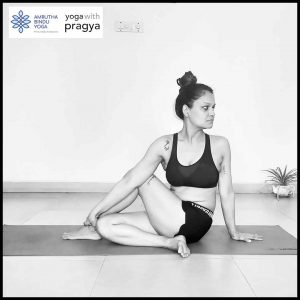
Supta Marichyasana – Reclining Spinal Twist

May 3, 2020

Marichi means ray of light.  The story of Sage Marichi goes back to the creation of the universe. (Beyond Asanas: The Myths and Legends Behind Yogic Postures, Pragya Bhatt)

Before I begin writing a blog, I like to research the topic a little more.  Surprisingly, there is very little information for this asana online.  Which is ironic because the Supta Marichyasana is practiced widely as a closing posture in yoga classes all over the world.  In writing this blog I had to look at my own experience with the posture and I also asked Medha for hers.  My introduction to this asana was through Baba Ramdev’s yog shivirs, where he endorses this asana as a great way to trim excess fat from the sides.

However, thousands of hours of asana practice later, I would say it’s power lies in its ability to gently stretch the spine, the lower back, the shoulders and the sides of your body all at one go.  Just a couple of years ago it was impossible for my knee to rest on the floor, my shoulders would lift off of the floor, I wouldn’t be able to breathe and it would hurt to push my knee down!

Over the years I’ve found that the key lies in the abdomen and the breath.  The breath must be long and steady and the abdomen relaxed.  Once this is in place it becomes easier for the body to sink into the posture.  Watch this video for more pointers on how to do this asana safely.


Benefits of the Supta Marichyasana:

  • Helps to reduce lower backache.
  • Reduces stiffness on the neck and shoulders.
  • Great to keep the spine supple and flexible.
  • Increases blood circulation to the abdominal organs.
  • Gently massages the digestive organs thereby improving digestion.
  • Improves flexibility of the hip, knees and ankles.


When to avoid this asana:

  • Menstruation.
  • If you’ve recently had abdominal surgery.
  • When you’re recovering from a back injury.


Participate in our Work From Home Challenge this entire month and win a giveaway at the end of the challenge.  Download our practice tracker and asana sequence below:

[ddownload id=”8554″] Practice Tracker

[ddownload id=”8549″] Yoga Sequence


For more information go to:
Medha Bhaskar: https://www.instagram.com/medha.bhaskar/
Amrutha Bindu Yoga: https://www.amruthabindu.com/
Pragya Bhatt: https://www.instagram.com/yogawithpragya/