Pragya Bhatt | yogawithpragya

Browsing Tag

pune blog

Travels Yoga

Stretching – Then and Now

September 11, 2016

pomelo_20160910012039_save.jpg

@Malaka Spice


It’s been close to 10 days here and my routine here is as challenging as ever.  I realize that if it’s your first time here, then it does take a while to adjust and adapt.  The first time I had a 4 hour practice I was incredulous … and didn’t know how to deal with it.  Rather, I didn’t know how to make the most of it.  When I practice at home it’s only for an hour and a half, and by the end of it I’m drained out.  So the first few days here, I was always exhausted.  So much so that I felt I couldn’t give the best in the asanas and always felt sloppy and ungainly throughout the practice.  Mondays and Tuesdays specially, since practice on those days is almost 4 hours long, and by the time I’m done with practice its an ordeal just to walk home.  My fantasies these days centre around buying an apartment next to the institute so that I can crawl home in no time and surface again only for the next class.

However, now I’ve started to get used to the routine.  I’m actually able to make the most of the extended practice sessions.  In fact, 2 hours is just about enough time for a satisfying practice…how I’m going to sustain this when I’m back in Bangalore is the stuff other blog posts are made of.

Yesterday I had my class in the evening (where I’m referred to as ‘Bangalore’, and another
pomelo_20160907151815_save.jpg
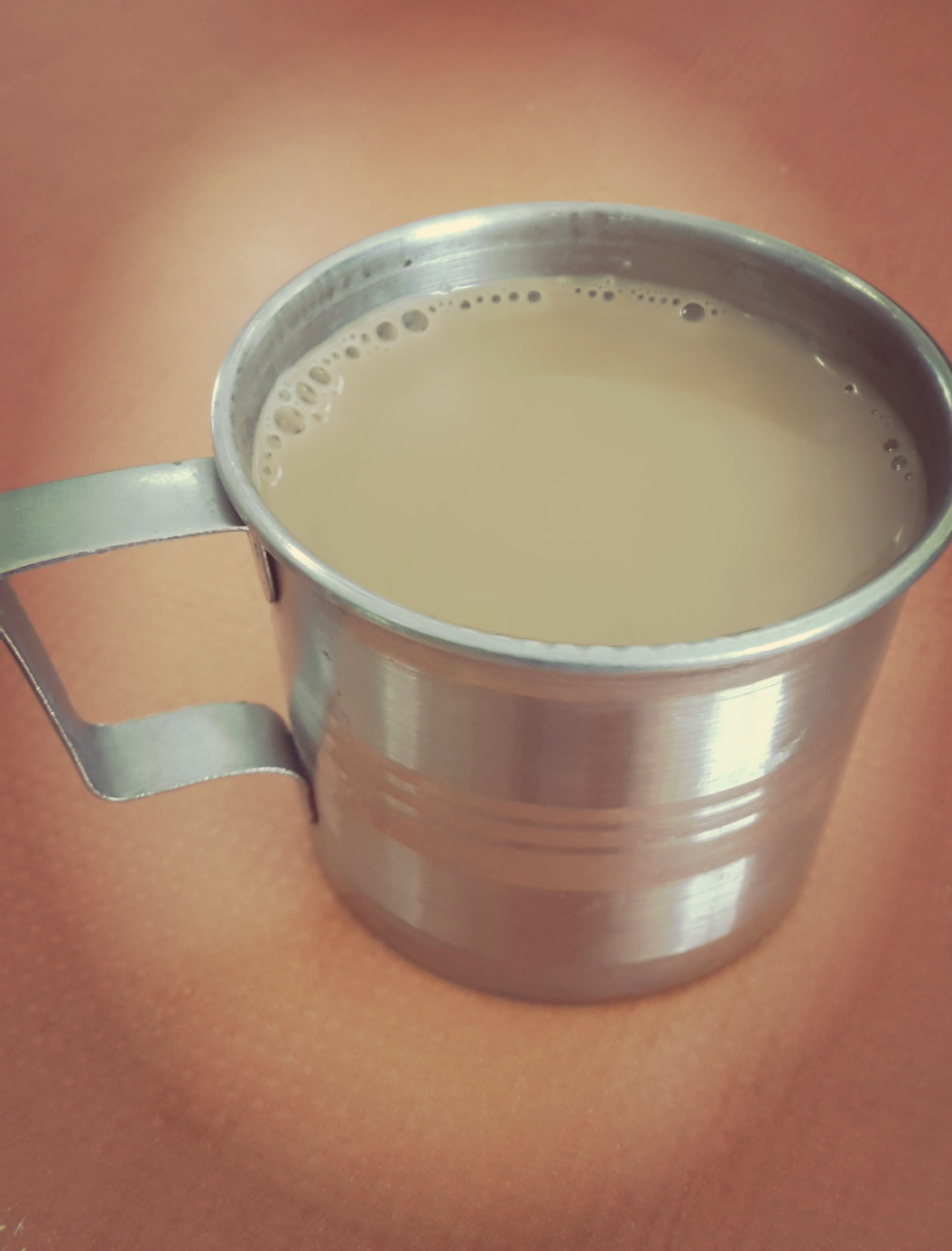
Milk tea just this once?

girl is called ‘USA’, oh and then there’s ‘Madam China’ in the 6 am session).  It was an amazingly intense session.  The class was fast paced with a focus on stretching the lower body (Janu Sirsasana, Paschimottansana, Baddhakonasana etc).  Finally we did the Upavista Konasana, which is a challenging pose for me.  I slowly made my way down and eased my torso onto the floor.  I remember the days when I started practicing yoga and this pose was a big challenge.  I wouldn’t be able to extend my back and my hip joint was stiff.  As the years went by, I was still pretty reluctant to practice this pose because it didn’t come naturally at all and it was frustrating.  Even now, sometimes I’m able to execute this pose well, and sometimes I feel like lead.

Yesterday I was able to ease myself down and placed my forehead on the floor.  I stayed there kind of happy and satisfied with myself.  There’s always an element of pleasant surprise also, because some days your body can extend and some days it just doesn’t.  This reverie lasted until I heard, “BANGALORE!  You’re sleeping!  Extend more!  Walk forward with your hands!!!  That’s it, that’s good.  Trance mein chali gayi thi phir se.”

And I realized that for the most part, this is how I practice.  I arrange myself into a pose and then my mind says, “This is it, you’ve done well.  You’re done.”  And then my pose goes dead, and progress stops.  Or, as the teacher said, I fall asleep.  So when I was told to extend more, I had to push through the limitations of my mind (kind of still the internal dialogue) and discover if I could, in fact, go further.  I realized that I could, and for that little bit of time I experienced new life.  And received a bit of enlightenment.

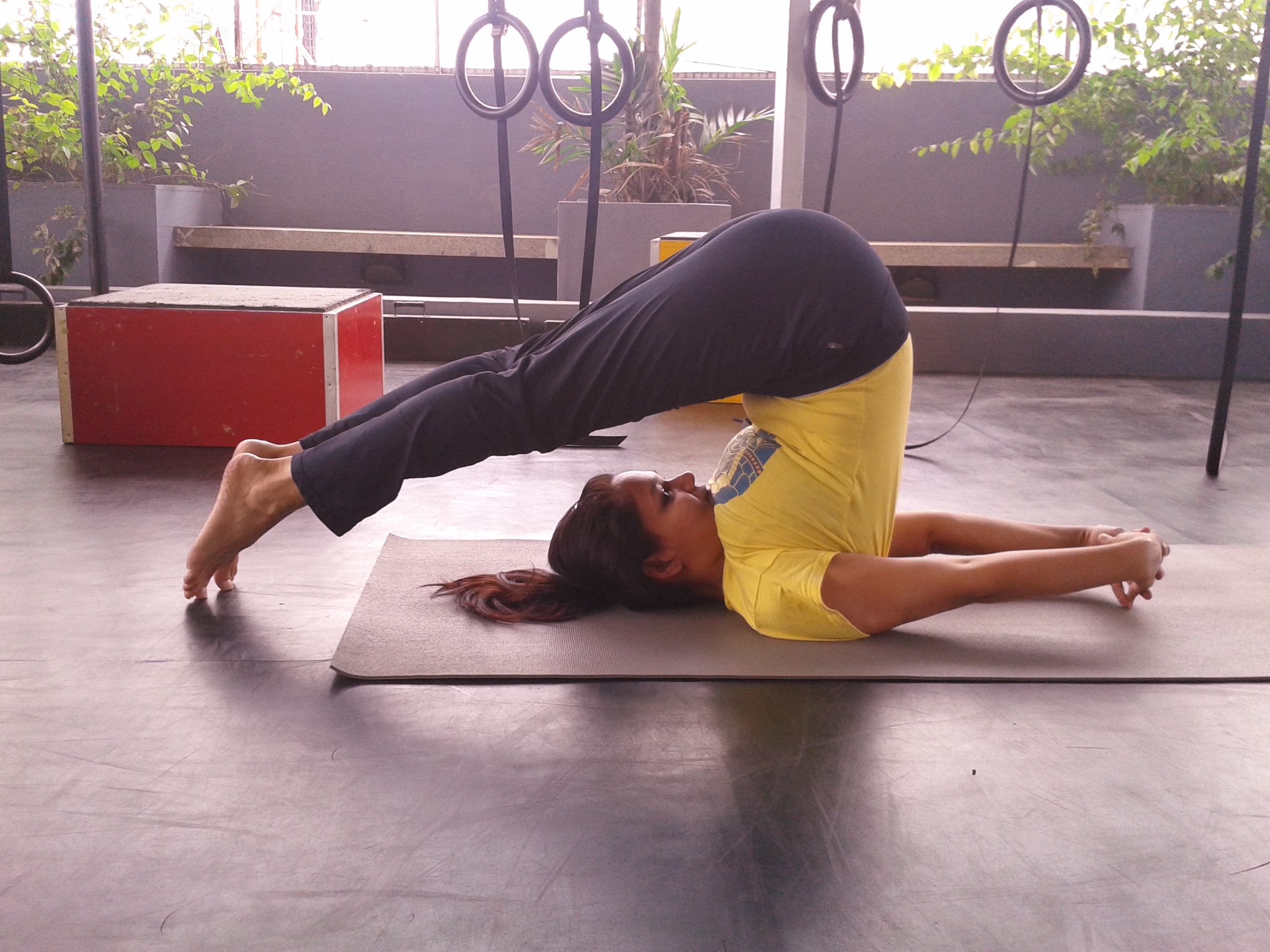
The Halasana is a pose that we do daily in class.  We use props to ensure that the spine and neck are straight.  The picture is of me doing the Halasana many years ago.  When my internal dialogue was loud and overpowering.  I’m sure it’s improved over the years.  And after this class, I know how to work in this (and in all other asanas).

Halasana (Plough Pose)

How To

  1. Lie down straight on your back making sure your head lies on the floor.
  2. Exhale, bend your legs at the knees and bring your knees close to your chest.
  3. Lift your buttocks off of the floor supporting your back with your hands.
  4. Make sure to plant your elbows firmly on the floor.halasana
  5. Bring your body perpendicular to the floor, until your sternum touches your chin.
  6. Gently extend your legs out behind your head.
  7. Keep your face and neck relaxed.
  8. Practice with your arms stretched out behind and fingers interlocked to relive pain and cramps in fingers, hands, wrists, elbows and shoulders.

Benefits

  • Relieves fatigue.
  • Helps to calm down the mind.
  • Relaxes your eyes and brain.
  • Controls hyper tension.
  • Improves digestion.
  • Lengthens the spine and improves alignment.
  • Reduces insomnia and anxiety.
  • Relieves stress-related headaches and migraines.

Contraindications

  • Don’t practice during menstruation and if you have cervical spondylosis.
Travels Yoga

Yoga and the Menstrual Cycle – Pune Day 8

September 8, 2016

To practice or not to practice – even the most devoted yogini asks herself this once a month.

Here in Pune, women on their period are given a different, more restful sequence to follow.  So they will do all the standing and seated asanas and the twists with the rest of the class.  When the class goes into inversions (which is what we practice towards the end of the session), the menstruating ladies go into either forward bends or restful supine positions.

When I was in Mysore last year I found out that in the Ashtanga tradition, women are allowed 3 rest days while on their period and these days are called the ‘Ladies’ Holiday’.

Now that we know that two very old traditions of yoga recommend rest during this time, it’s worth dwelling on why.  I’m sure I’ve talked about it in a previous blog, but the most obvious reason is that inversions force the flow of blood to go against the natural course, which may lead to unhealthy periods.  Also, when you start to integrate bandhas with your asanas, the mula bandha opposes the flow of blood again.

Mensturation is also the time when a woman’s body regenerates and gets ready to procreate again.  This ability to procreate is held holy and revered in many cultures.  This is a time for a woman to slow down and give time and space to her body, spiritually and physically.

When I first started practicing yoga, I admit I thought not practicing when you’re menstruating was just a myth.  And so I practiced all the time.  A lot of us can get away with intense challenging practice sessions even while we’re on our period.  However, your body will change and it’s important to be attuned to these changes.  Your flexibility levels vary day to day, as does your stamina and state of mind.  As your body and your practice change you can expect that one day you may just want to relax during your period.  Listen to your body, don’t just obey your mind.

How did I make peace with easing up on my practice?  I decided to take it the Iyengar way.  During my self practice I spent a lot of time in Supta Baddhakonasana and in various forward bends.  I did a lot of hip openers because I find that feels good.  I worked on my Hanumanasana as well.  My back feels relaxed and flexible and I still feel like I did a good practice.

On to other related topics.  Lately I’ve started looking into having a zero-waste period.  As many readers may know, sanitary napkins and tampons are non biodegradable or recyclable and end up in landfills.  There are reams online about TSS (Toxic Shock Syndrome) but my primary interest in a zero-waste period is the environment.  Pads and tampons started to feel like the deep-fried, coated in refined sugar, unhygienic sweet that I didn’t even want to look at.  I discovered alternatives.  Here’s a video that will shed more light on this:


And if you’re interested in getting your own set of re-usable pads, you can get them at the link below.  The reason I like this organisation is because they are involved with lots of rural initiatives.

https://ecofemme.org/domestic/

Books

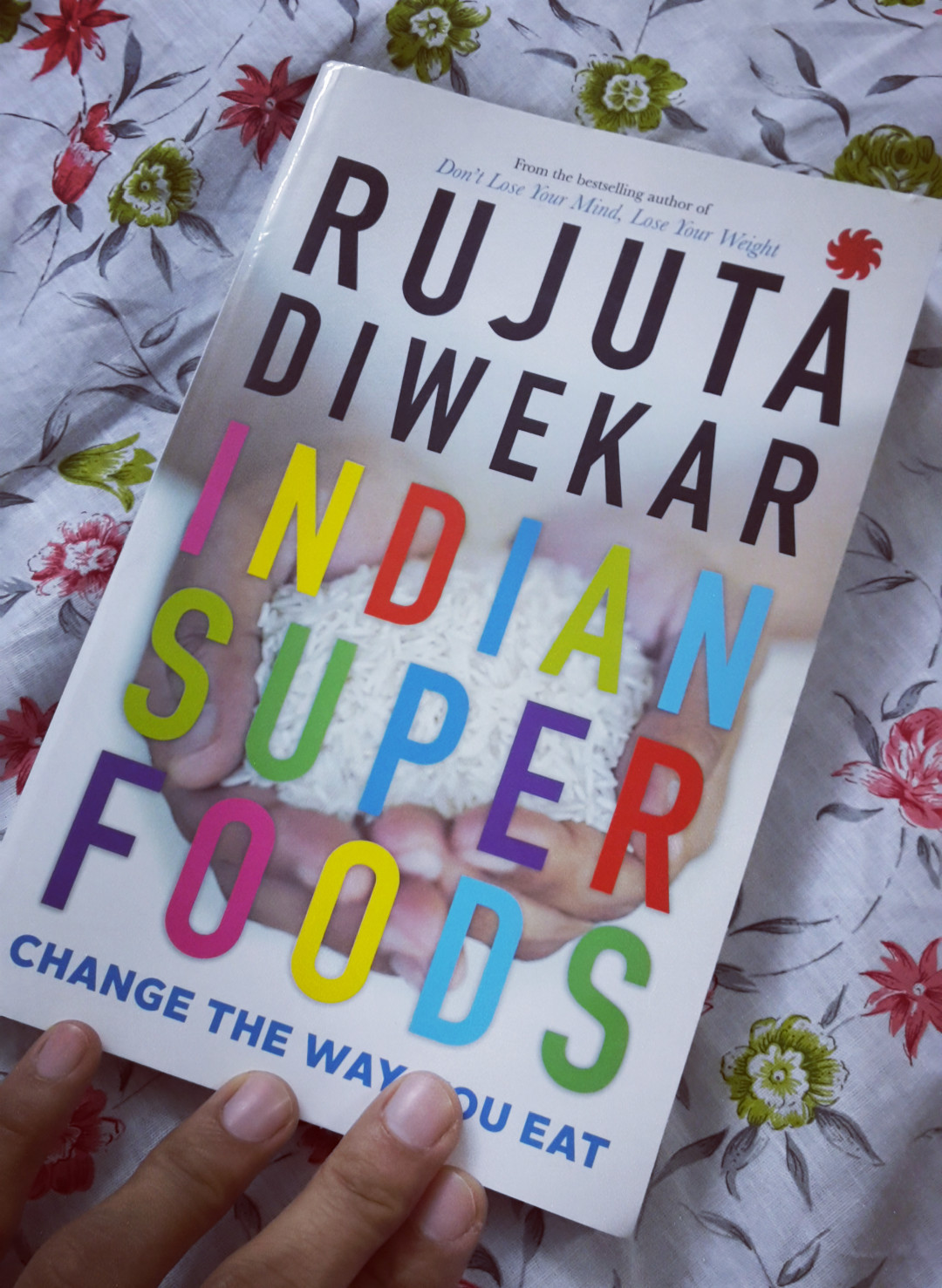
Indian Superfoods by Rujuta Diwekar [Book Review]

September 7, 2016

Today was the first day I had an early morning session.  I’ve become used to waking up around 7, so 5 am was a challenge (funny how easy it is to get into the habit of waking up late).  I got ready quickly and hurried to the class.  As usual the class was full, even at that early hour.  Besides the yoga classes, I continue to read voraciously, and these days I’m reading Indian Superfoods by Rujuta Diwekar.

Rujuta’s books are relevant to our lives and times.  By advocating for local food she makes health and fitness accessible to the masses.  Most of us are so busy with the mundanity of life, that we don’t have time to hunt down the best quality goji berries or chia seeds.  So this book is a great resource for those who would like to eat well with the least hassle.  For me it was great because I believe in simple food and wholesome health.  To stay in  optimum health and shape is more a function of eating simple unadulterated food, instead of exotic produce and unpronounceable ingredients lists.

I believe if you focus on quality, then the most commonly available ingredients will have you glowing like a lightbulb.

In addition to this, Rujuta has also brought to light lots of fruits and vegetables from different regions in India.  It helps in us becoming curious and a bit more experimental with our food, and also inculcates a sense of awareness of the richness of what our land has to offer.  From ghee to something called the ambadi fruit, her book makes local produce come alive and become tempting.  This blog isn’t a summary of the book, but just a little bit of info.  The book has a lot more information to offer and I would really suggest that you read Indian Superfoods.  However, here is a little bit of information to pique your interest:

  1. Ghee – It’s a myth that ghee is fattening.  In fact, it is lipolytic, it breaks down fat.  So if you eat ghee you’re helping in breaking down stubborn fat.  Helpful advice that she gives for women:  If you get skin breakouts before or with every period eat ghee at least three times a day.  Plus she has a bonus recipe for how to make ghee.
  2. Kokum – this is a fruit I haven’t had, but I had a drink made out of this at Dastkaar.  Rub kokum butter on the soles of your feet right before you sleep and you will sleep deeply, regardless of how stressed and frazzled you are.  Definitely on my shopping list.
  3. Banana – here I have a banana before every class.  Actually, in Bangalore as well.  It’s a myth that bananas are fattening.  They are low in fat and  help in fat burning and in reducing cholesterol!
  4. Kaju – good to combat PCOD and hypothyroidism.  Prevents adult acne and improves fertility too!
  5. Ambadi – I’ve never had this plant nor heard about it.  Another item on my shopping list.  If you know how to pronounce this word, do let me know.  Interestingly, this local green (and other’s like it) are called ‘orphan crops’, crops that no one grows because there is no demand for them.  You can make it into a sabzi and get your iron, vit B and folic acid from it.  The stems of the Ambadi plant are used to make jhadoos and fabric.  I wonder if they make yoga mats out of this…
  6. Rice – prevents premature wrinkling and supports good hair growth.  Need I say more?
  7. Coconut – doesn’t contain cholesterol because it’s a plant based food.  Plus it actually helps in reducing ‘central adiposity’ (fat in the middle) and so helps in ensuring a slim waist.
  8. Aliv – used in laddoos!  Great for skin, it evens out skin tone, gets rid of patches and naturally brightens the complexion.  Wonder if Diwali laddoos contain this seed…
  9. Jackfruit – low in fat and rich in fibre, so it helps in reducing cholesterol levels.  Also, the fruit has a lot of anti-oxidants.
  10. Sugar – don’t replace with jaggery as both have different properties.  Jaggery adds heat to the body while sugar is a coolant.

If the above points were interesting, you should go out and get a copy of Indian Superfoods.  It does give you food for thought and even if you’re unable to apply everything she talks about into your life, it still helps to be aware of what we are eating and what are the food choices that are available to us.

My copy of the book.

My copy of Indian Superfoods by Rujuta Diwekar.

I’ve written about fenugreek or methi, another spice I consider a superfood in this blog.  Because it’s available readily in Indian kitchens, you might find the post useful.


Travels Yoga

Stretching – Then and Now

January 16, 2014
pomelo_20160910012039_save.jpg

@Malaka Spice


It’s been close to 10 days here and my routine here is as challenging as ever.  I realize that if it’s your first time here, then it does take a while to adjust and adapt.  The first time I had a 4 hour practice I was incredulous … and didn’t know how to deal with it.  Rather, I didn’t know how to make the most of it.  When I practice at home it’s only for an hour and a half, and by the end of it I’m drained out.  So the first few days here, I was always exhausted.  So much so that I felt I couldn’t give the best in the asanas and always felt sloppy and ungainly throughout the practice.  Mondays and Tuesdays specially, since practice on those days is almost 4 hours long, and by the time I’m done with practice its an ordeal just to walk home.  My fantasies these days centre around buying an apartment next to the institute so that I can crawl home in no time and surface again only for the next class.

However, now I’ve started to get used to the routine.  I’m actually able to make the most of the extended practice sessions.  In fact, 2 hours is just about enough time for a satisfying practice…how I’m going to sustain this when I’m back in Bangalore is the stuff other blog posts are made of.

Yesterday I had my class in the evening (where I’m referred to as ‘Bangalore’, and another

pomelo_20160907151815_save.jpg

Milk tea just this once 🙂

girl is called ‘USA’, oh and then there’s ‘Madam China’ in the 6 am session).  It was an amazingly intense session.  The class was fast paced with a focus on stretching the lower body (Janu Sirsasana, Paschimottansana, Baddhakonasana etc).  Finally we did the Upavista Konasana, which is a challenging pose for me.  I slowly made my way down and eased my torso onto the floor.  I remember the days when I started practicing yoga and this pose was a big challenge.  I wouldn’t be able to extend my back and my hip joint was stiff.  As the years went by, I was still pretty reluctant to practice this pose because it didn’t come naturally at all and it was frustrating.  Even now, sometimes I’m able to execute this pose well, and sometimes I feel like lead.


Yesterday I was able to ease myself down and placed my forehead on the floor.  I stayed there kind of happy and satisfied with myself.  There’s always an element of pleasant surprise also, because some days your body can extend and some days it just doesn’t.  This reverie lasted until I heard, “BANGALORE!  You’re sleeping!  Extend more!  Walk forward with your hands!!!  That’s it, that’s good.  Trance mein chali gayi thi phir se.”

And I realized that for the most part, this is how I practice.  I arrange myself into a pose and then my mind says, “This is it, you’ve done well.  You’re done.”  And then my pose goes dead, and progress stops.  Or, as the teacher said, I fall asleep.  So when I was told to extend more, I had to push through the limitations of my mind (kind of still the internal dialogue) and discover if I could, in fact, go further.  I realized that I could, and for that little bit of time I experienced new life.  And received a bit of enlightenment.

The Halasana is a pose that we do daily in class.  We use props to ensure that the spine and neck are straight.  The picture is of me doing the Halasana many years ago.  When my internal dialogue was loud and overpowering.  I’m sure it’s improved over the years.  And after this class, I know how to work in this (and in all other asanas).

Halasana (Plough Pose)

How To

  1. Lie down straight on your back making sure your head lies on the floor.
  2. Exhale, bend your legs at the knees and bring your knees close to your chest.
  3. Lift your buttocks off of the floor supporting your back with your hands.
  4. Make sure to plant your elbows firmly on the floor.halasana
  5. Bring your body perpendicular to the floor, until your sternum touches your chin.
  6. Gently extend your legs out behind your head.
  7. Keep your face and neck relaxed.
  8. Practice with your arms stretched out behind and fingers interlocked to relive pain and cramps in fingers, hands, wrists, elbows and shoulders.

Benefits

  • Relieves fatigue.
  • Helps to calm down the mind.
  • Relaxes your eyes and brain.
  • Controls hyper tension.
  • Improves digestion.
  • Lengthens the spine and improves alignment.
  • Reduces insomnia and anxiety.
  • Relieves stress-related headaches and migraines.

Contraindications

  • Don’t practice during menstruation and if you have cervical spondylosis.