Pragya Bhatt | yogawithpragya

Browsing Tag

iyengar yoga

RIMYI Experiences

The Use of Props

July 28, 2017

POMELO_20170727201403_save

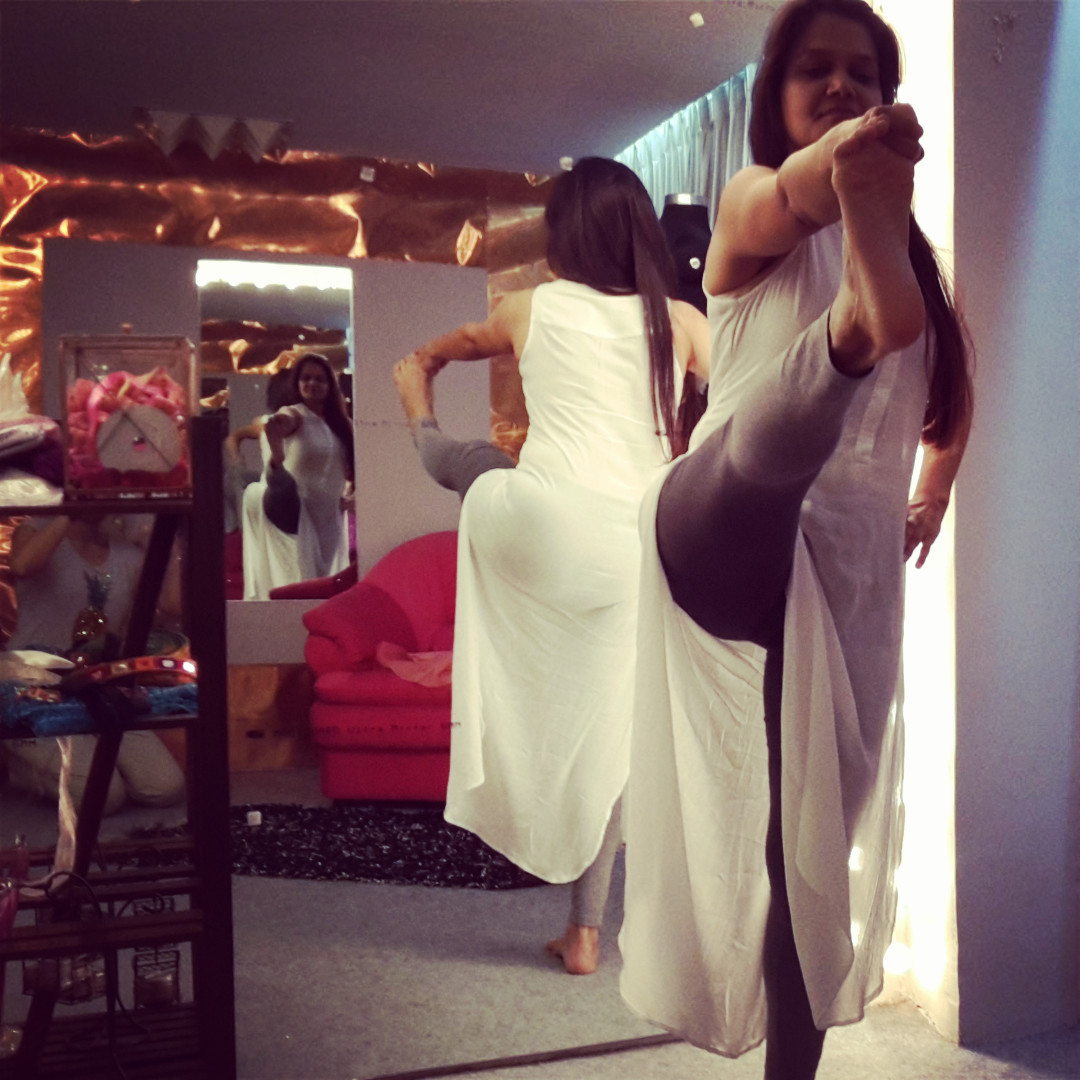
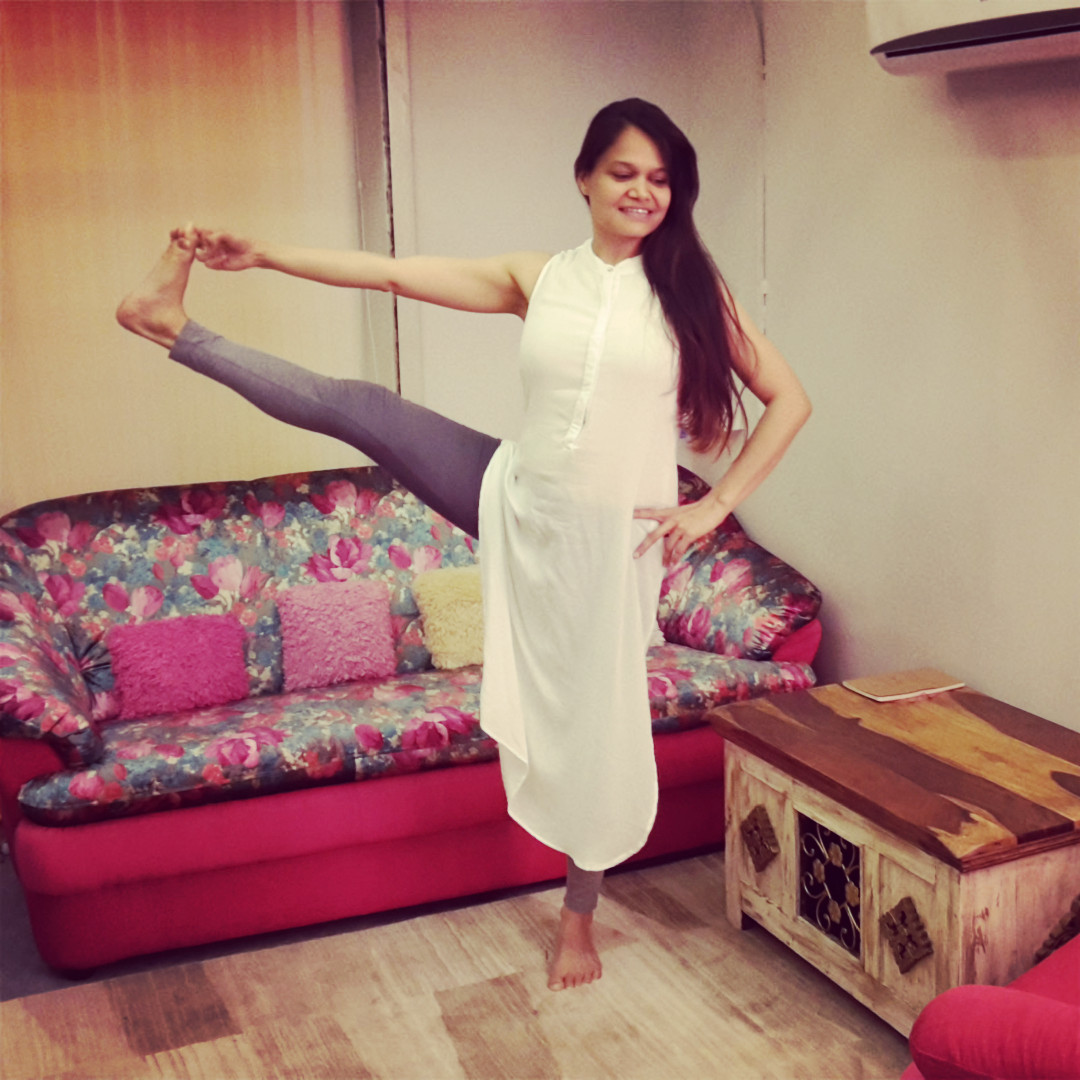
Blocks and belts have become a permanent fixture in most yoga classes.  If you are into this practice for the long term it might be helpful to invest in a few props right now.  For me props are indispensable and I use them daily.  Some I use more than others.

Mat – There are many different kinds of mats I use depending on what I’m practicing.  I have a thick mat for when I need to practice the Halasana or any other pose where I feel I need some cushioning.

Most Iyengar teachers call your regular yoga mat the ‘sticky mat’.  I own two sticky mats and I’ve had them forever.  One stays in my car and the other one I use for my personal practice.  And I’ve had these mats for over 5 years now.  I think the best thing to do for your yoga mat is to wash it regularly and hang it out to dry.  The stickiness somehow gets replenished and they are as good as new. Someone gave me this tip during my teacher’s training and I’ve recommended this to others.  I haven’t heard any complaints from anyone (yet).

Floor – I think it was in a Manouso Manos workshop that I heard that the floor is your first prop.  It gives you a solid foundation.  It stays strong during your standing, seated, prone or inverted asanas.  A clean, uncluttered surface looks inviting.  In my teacher’s class it’s a clay floor.  When it’s really hot I sometimes practice on the cool bare floor.  In my house I get the floor cleaned every day so that I have a fresh palette to play on daily.
POMELO_20170727201317_save

Wall – I started practicing the Adhomukha Vrikshasana in Pune last year.  I continued to practice it at home and have steadily moved away from the wall.  When it comes to some asanas – like handstand or the headstand – you need to determine when you are ready to move away from the wall.  In this way, the wall helps you in exploring yourself and taking risks, but at the same time staying available for you always, should you need it.

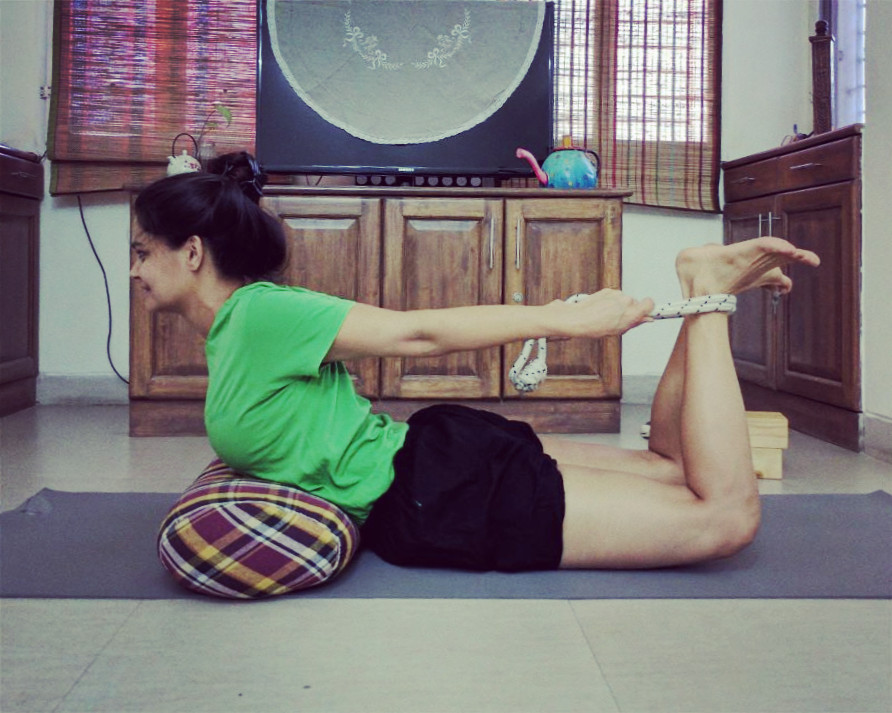
Blocks – My first blocks were foam ones that I got as part of a ‘yoga set’.  Foam blocks work well when you’re just using them for minimal support.  However, when I’m working on chest opening or the Setubandhasana, I prefer the sturdier wooden variety.

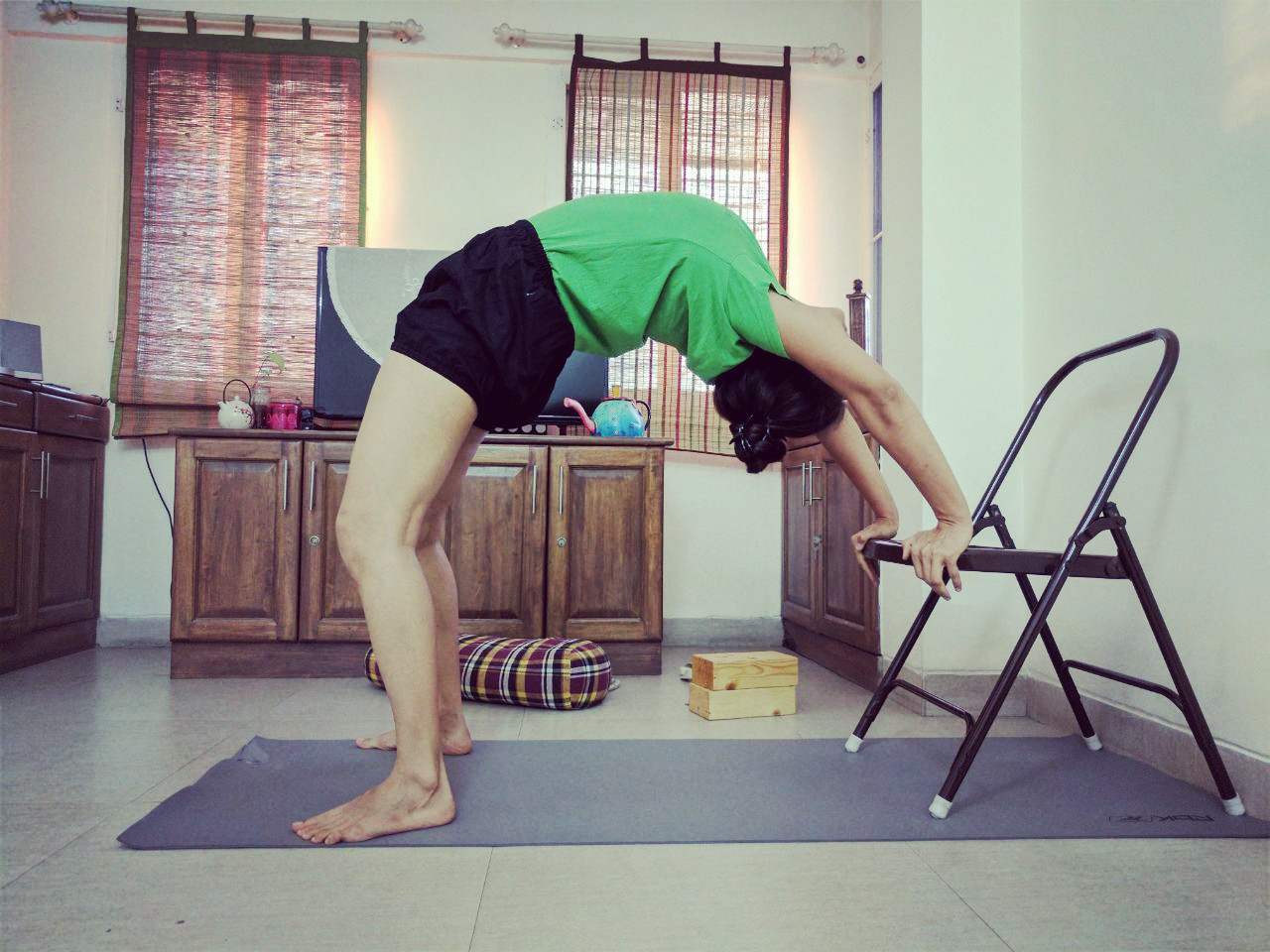
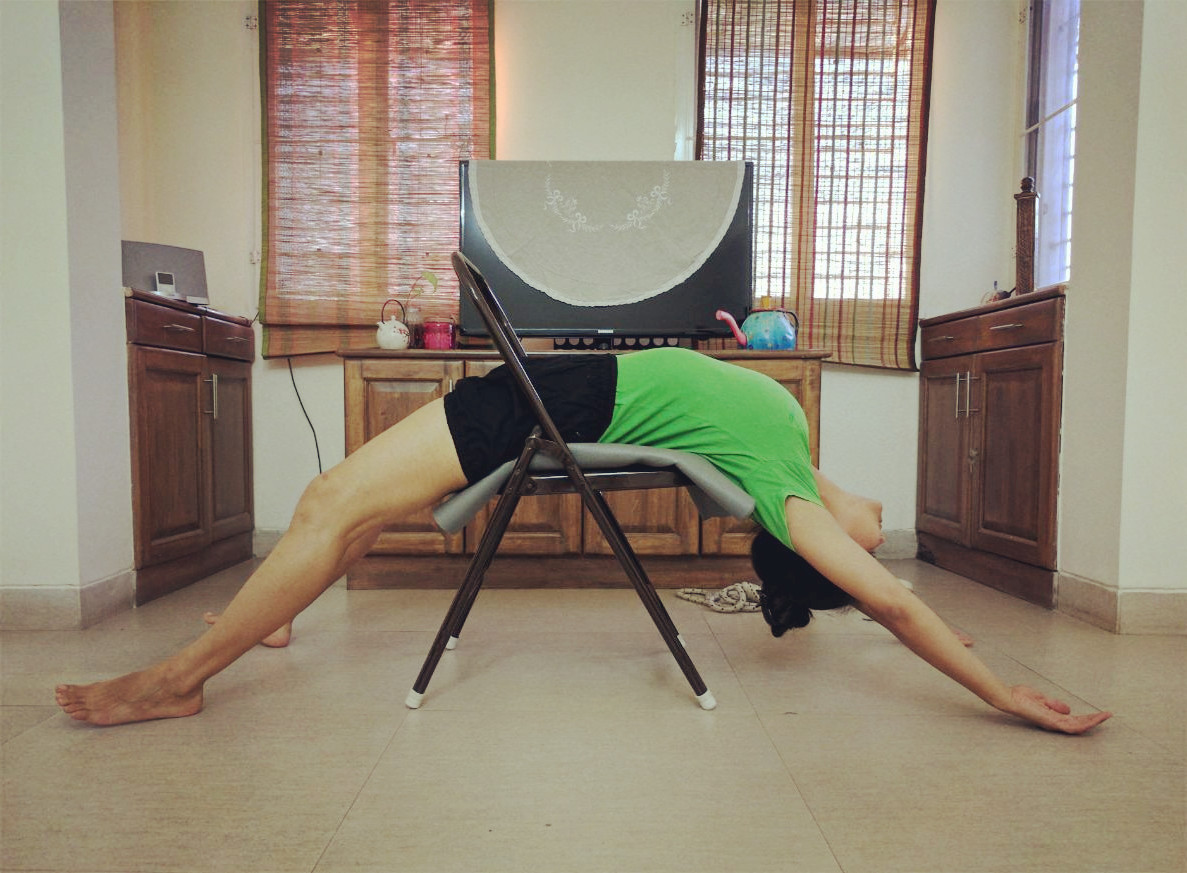
Chair – during my last retreat I shared a personal story about the Viprita Dandasana.  Basically, I would have a horrible reaction to this pose.  I would feel queasy, my heart would start racing and I would start sweating profusely in only 20 seconds.  When I went to RIMYI last year the dreaded asanas was part of a the women’s only class.  I resigned myself to 2 minutes of queasiness.  But I was pleasantly surprised.  The way Gulnaz explained the asana was so clear and concise and it opened up the asana for me.  It was one of my biggest takeaways from my time there last year.  An asana (or a problem) can seem unsurmountable until someone guides you correctly.
POMELO_20170721044702_save

Blanket – When I think of blankets I think of softness.  I use my blanket under me when I do forward folds.

Ropes – I use these daily.  Because I do traction for my back daily.  Because you should do traction for your back daily.  Because everyone should do traction for their back daily.

Belt – I use belts mainly when I need to work on shoulder opening in various asanas.  In fact, watch this video  illustrating an easy shoulder opening trick using the belt.  Also, as most of my students know, I almost always use belts in the final relaxation.

Props ALWAYS enhance your practice.  I know a lot of people think that they don’t ‘need’ props.  I used to think so too, but I now feel that if you utilise your props well then you uncover nuances of the asanas that you wouldn’t otherwise.

Leave me a question if you have one!



Yoga

Hello Wonderful World!

June 13, 2017

welcome

“And suddenly you know…It’s time to start something new and trust the magic of new beginnings.”

Life is continuously changing, evolving and growing.  And if you’re a yoga practitioner who is also an entrepreneur then change truly is the only constant.  To be honest, I’m not very comfortable with the term ‘entrepreneur’ because I see myself only as a practitioner and a teacher.  I don’t consider myself a part of the energetic and pulsating Bangalore start-up/entrepreneur scene.  Teaching yoga came organically to me, as it has to many who decided to make it their life’s work…but who also have to pay the rent.  The philosophy and practice of yoga is ancient, mystical and vast.  I would need lifetimes of study before I can bring in innovation which can be turned into a business opportunity.  However, I do realize that I have been able to make a significant contribution to the lives of many individuals who have trusted me and have had faith in me to guide them through their own journeys towards holistic health.

In our closely connected world,  it was inevitable that word about my work would get out and many people separated geographically from me would evince an interest in working with me to give direction to their practice.  With that came the conceptualization and later the implementation of The Yoga Practice.  The process unfolded at its own pace.  Today this online module is a combination of what my students need and the best way for me to provide it to them.

Seeing my work and perhaps identifying with it, an old friend decided to come on board and help me structure and organize my work.  Once I recognized the need and accepted the help, the floodgates opened.  Mentors appeared with helpful guidance, supporters came in droves, constructive advice started pouring in…and the result is greater clarity and sharper focus.

For many years I have been designing and leading workshops and retreats, conducting group and private classes, helping people far away through online sessions, making videos etc…and now we are organizing all of these under one roof so that the message has more impact.  Most importantly, our work is accessible to everyone everywhere who wants to improve their quality of life.

This website is all of my work under one roof.  Here you can read my blogs, access my YouTube videos, take a look at my upcoming classes & events, see what others are saying about my work and even send me a few lines!  As we get busy planning our activities for the rest of the year, we hope you will subscribe to our blog and share it with your friends too.

I sincerely hope our work adds meaning to your life.

Travels Yoga

When the going gets tough…

September 22, 2016

I watched ‘Eat Pray Love’ and later devoured the book.  I loved the book and the movie.  I remember googling to find out what ashram Elizabeth Gilbert had checked into.  My friends and  discussed the book and its ideas to death.  We planned similar journeys.  And finally, all of us hoped that should we ever experience a life altering event, we would have the courage and strength to overcome it just like Elizabeth Gilbert.
Elizabeth Gilbert went on to write another book about her life post marriage with the love of her life (whom she met in at the end of ‘Eat Pray Love’).  I haven’t had a chance to read that book yet, but I do hope to pick it up soon.  Over the past few weeks the internet exploded with news that Elizabeth Gilbert has divorced her husband of 12 years – for the woman she’s in love with.  The thing is, this news wasn’t brought to the world through newspapers and magazine stories; Gilbert put it up on her Facebook page herself.  She included a picture of herself with the woman she loves.

Today while in the Sirsasana, with rivulets of sweat running down(up?) my torso and onto the mat, I think I gained a new perspective.  This morning we were taught how to balance our shoulders and torso in the headstand.  The teacher took us through various moves that helped us understand the positioning and behaviour of our shoulder blades and other parts of the torso.  This was to give us insight into how we can improve our headstand.  I was experimenting with my headstand and the experiments had me almost toppling and definitely very very unstable.

I’m sure falling in love while married, deciding to commit to the woman you love (despite knowing she has terminal cancer) and finally calling it quits on a relationship of 12 years with the love of your life (and which has been immortalized in a couple of best selling books) wasn’t easy.  And it didn’t happen overnight.  There must’ve been moments of uncertainty, of fear, of helplessness, anxiety, doubt, anger…and an overwhelming sense of insecurity.  Deciding to go public with an intensely private matter of this kind also couldn’t have been easy for  a woman known the world over for her soul searching trip to India and Bali.  No one in the public domain is impervious to criticism.  With social media being so pervasive, every detail of your life can be analysed.  You can be publicly berated for your actions, opinions and personal choices.  Therefore I think it was very very brave of her to be open about the choice that she made, and to risk a lot of bad publicity, ‘unfriends’, ‘unfollows’ and ‘unlikes’.  In an age where lifestyle choices are beamed out to the world the second they are made, we are constantly under the scanner.

For health and fitness professionals, it is imperative to look their best in every post.  Even pictures of them looking less than their best are always pictures of them looking fabulously less than their best.  The constant scrutiny from fans and followers creates intense pressure to look a particular way or make certain choices.  For fitness professionals choices such as drinking, smoking and indulging the sweet tooth present a challenge – to broadcast or not to broadcast?  I wonder, for instance, as a yoga expert what if I were to one day get a condition that yoga is meant to prevent – how would I go public with it?  Would I, like Gilbert, have the courage to talk about my experience?  Or what if I were to gain all the weight back (a fear that I constantly live with)?  How would I even begin to talk about it?  Which is why I feel like the protagonist on ‘Eat Pray Love’ is more courageous than what was portrayed in the book.  Her courage is uncommon and her quest for herself is very honest.

This is something we can all learn from.  What if an event in your life forced you to re-evaluate everything you’ve stood for so far?  Most of us are so fixated in our opinions and lives that we can almost never admit that we are wrong.  And what if we had to do so publicly?  I can’t imagine what Elizabeth Gilbert went through, but I think it would have been a process of immense growth and fulfilment.

When was the last time you were faced with a situation that challenged your basics and how did you deal with it?  Was it a process of growth and learning?  If yes, what did you learn?

RIMYI Experiences

The Standing Asanas – Day 17

September 17, 2016

It’s been raining non stop in Pune for the last 3 days.  The last time I experienced rain like this was in Wellington.  There the rain was accompanied by mist and the smell of Eucalyptus and Citronella.  Here I’m hurrying to RIMYI as quickly but as carefully as I can so as to make it to class on time while avoiding getting muck on my shoes and clothes.

20160916_102256.jpg

The 7 am class this morning was taken by Abhijata.  We started with the Uttanasana and the Adhomukha Svanasana.  We frequently start classes with these poses.   Then we were asked to get bricks and then started the series of standing poses.  We did all the standing poses without a break.  We did the entire sequence on both sides taking a break in between.  It took us only about 10 minutes.  Abhijata then told us that we can do the entire sequence of standing poses every day and in only 20 minutes.  In Iyengar yoga we start with the standing poses.  These poses are sort of like the entry point to other poses and also the entry point to start correcting alignment issues.  Structural and postural defects can be corrected only once the corrections from basic standing asanas are experienced by the body.

Another reason we begin with standing asanas is because while doing the asanas you focus on nothing but the asana.  It’s difficult to think about how much you hate your boss when your thighs are screaming in Virbhadrasana 1.  So for 20 minutes (while you are performing the sequence of standing poses), you get a mental break from whatever thoughts disturb you for the rest of the day.  This state of focus and concentration is what meditation tries to get you to.  In Iyengar yoga we use the asanas as a means to attain the meditative state.

When you try to sit and actively concentrate on emptying your mind or focusing on an object/word/thought, it’s difficult.  It could lead to frustration as well (the opposite of what we hope to achieve through meditation).  However, practicing asanas with consciousness and with an attention to detail ensures that for the time you are practicing you are also in a meditative state.

Perhaps this explains why I feel a sense of lightness here.  (Starting to wonder if I want to make it back to Bangalore….)


Travels Yoga

Stretching – Then and Now

September 11, 2016

pomelo_20160910012039_save.jpg

@Malaka Spice


It’s been close to 10 days here and my routine here is as challenging as ever.  I realize that if it’s your first time here, then it does take a while to adjust and adapt.  The first time I had a 4 hour practice I was incredulous … and didn’t know how to deal with it.  Rather, I didn’t know how to make the most of it.  When I practice at home it’s only for an hour and a half, and by the end of it I’m drained out.  So the first few days here, I was always exhausted.  So much so that I felt I couldn’t give the best in the asanas and always felt sloppy and ungainly throughout the practice.  Mondays and Tuesdays specially, since practice on those days is almost 4 hours long, and by the time I’m done with practice its an ordeal just to walk home.  My fantasies these days centre around buying an apartment next to the institute so that I can crawl home in no time and surface again only for the next class.

However, now I’ve started to get used to the routine.  I’m actually able to make the most of the extended practice sessions.  In fact, 2 hours is just about enough time for a satisfying practice…how I’m going to sustain this when I’m back in Bangalore is the stuff other blog posts are made of.

Yesterday I had my class in the evening (where I’m referred to as ‘Bangalore’, and another

pomelo_20160907151815_save.jpg
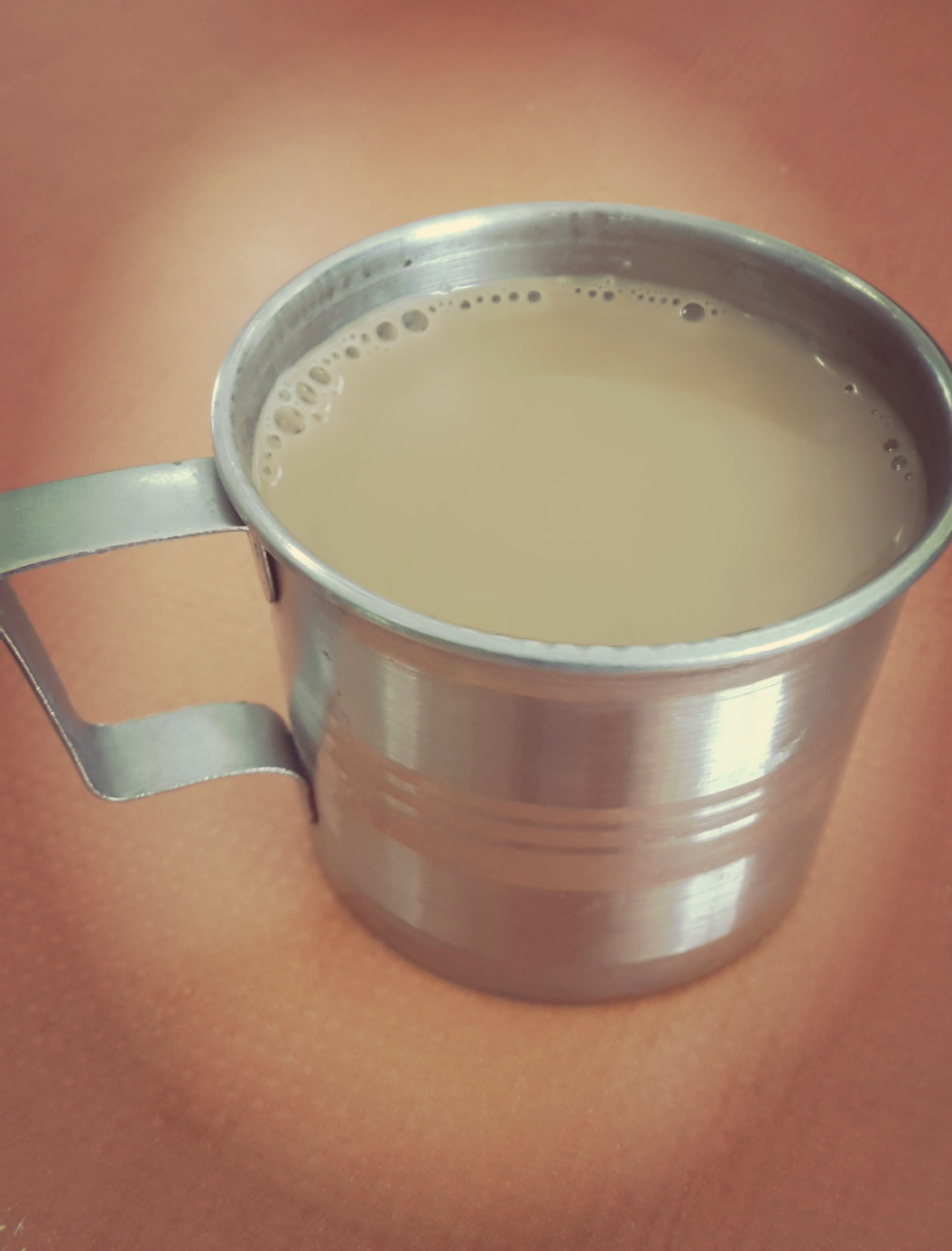
Milk tea just this once?

girl is called ‘USA’, oh and then there’s ‘Madam China’ in the 6 am session).  It was an amazingly intense session.  The class was fast paced with a focus on stretching the lower body (Janu Sirsasana, Paschimottansana, Baddhakonasana etc).  Finally we did the Upavista Konasana, which is a challenging pose for me.  I slowly made my way down and eased my torso onto the floor.  I remember the days when I started practicing yoga and this pose was a big challenge.  I wouldn’t be able to extend my back and my hip joint was stiff.  As the years went by, I was still pretty reluctant to practice this pose because it didn’t come naturally at all and it was frustrating.  Even now, sometimes I’m able to execute this pose well, and sometimes I feel like lead.

Yesterday I was able to ease myself down and placed my forehead on the floor.  I stayed there kind of happy and satisfied with myself.  There’s always an element of pleasant surprise also, because some days your body can extend and some days it just doesn’t.  This reverie lasted until I heard, “BANGALORE!  You’re sleeping!  Extend more!  Walk forward with your hands!!!  That’s it, that’s good.  Trance mein chali gayi thi phir se.”

And I realized that for the most part, this is how I practice.  I arrange myself into a pose and then my mind says, “This is it, you’ve done well.  You’re done.”  And then my pose goes dead, and progress stops.  Or, as the teacher said, I fall asleep.  So when I was told to extend more, I had to push through the limitations of my mind (kind of still the internal dialogue) and discover if I could, in fact, go further.  I realized that I could, and for that little bit of time I experienced new life.  And received a bit of enlightenment.

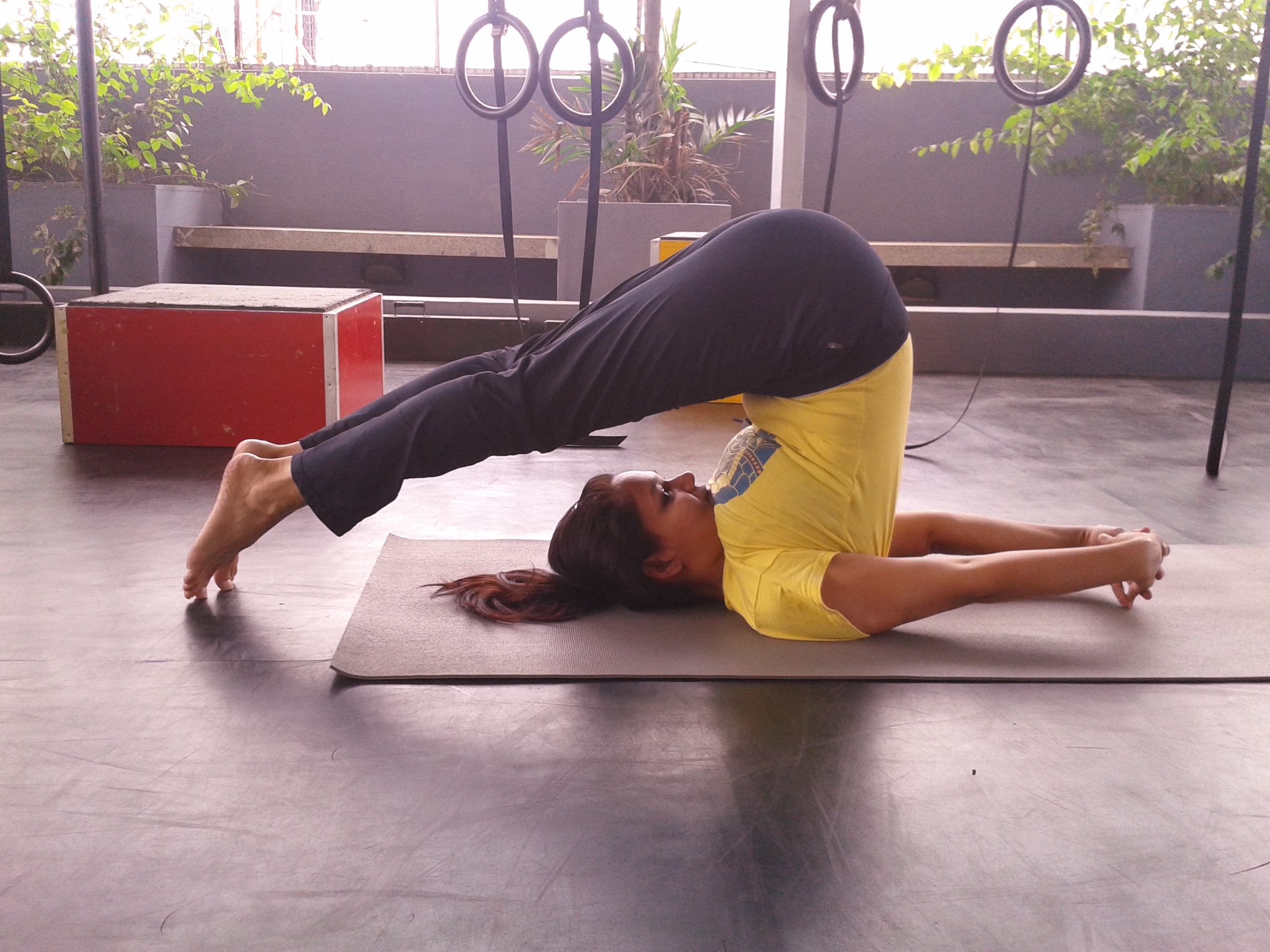
The Halasana is a pose that we do daily in class.  We use props to ensure that the spine and neck are straight.  The picture is of me doing the Halasana many years ago.  When my internal dialogue was loud and overpowering.  I’m sure it’s improved over the years.  And after this class, I know how to work in this (and in all other asanas).

Halasana (Plough Pose)

How To

  1. Lie down straight on your back making sure your head lies on the floor.
  2. Exhale, bend your legs at the knees and bring your knees close to your chest.
  3. Lift your buttocks off of the floor supporting your back with your hands.
  4. Make sure to plant your elbows firmly on the floor.halasana
  5. Bring your body perpendicular to the floor, until your sternum touches your chin.
  6. Gently extend your legs out behind your head.
  7. Keep your face and neck relaxed.
  8. Practice with your arms stretched out behind and fingers interlocked to relive pain and cramps in fingers, hands, wrists, elbows and shoulders.

Benefits

  • Relieves fatigue.
  • Helps to calm down the mind.
  • Relaxes your eyes and brain.
  • Controls hyper tension.
  • Improves digestion.
  • Lengthens the spine and improves alignment.
  • Reduces insomnia and anxiety.
  • Relieves stress-related headaches and migraines.

Contraindications

  • Don’t practice during menstruation and if you have cervical spondylosis.