



I learned how to swim pretty late in life (early 30s) thanks to a Mrs. Vardhan who was generous with her patience and with her time. I wanted to learn because it’s a wonderful workout, and therapeutic at that. Little did I know that one day I’d be swimming with sharks in the expanse of the great Indian Ocean.

All set to snorkel near our water villa. Sea life differs from area to area and we looked forward to seeing the variety of fish surrounding the island.
My first experience of snorkelling was years ago during a school trip to the Andamans. My memories of that experience aren’t particularly fun, so I wasn’t overjoyed about snorkelling in the Maldives (at the Sun Island Resort). But Animesh was super excited, and so off we went. It wasn’t until I got into the choppy waters with the snorkelling gear jammed tightly over my face did I recognise that the discomfort I was feeling was actually a sense of fear. I was out of my territory – I’ve spent years training myself to breathe deeply through my nose. Breathing through the snorkel with my mouth felt strange, unnatural and very very uncomfortable.
BKS Iyengar famously said, “Your nose is for breathing and your mouth is for eating. If you breathe through your mouth I will put food in your nose.” Under the water, with tiny (and not so tiny) fish flitting all around me, I strained to inhale and exhale through my mouth. And then it dawned on me that a truly flexible human isn’t one who is able to breathe rhythmically when on a yoga mat with the intention of doing so. True flexibility is being able to breathe in whatever way the situation demands. So, as I struggled to get comfortable in the depths of the Indian Ocean, I forced myself to calm down. I started to engage my lungs to breathe deeply and rhythmically through my mouth.

A lazy tree pose on deck. Happy to see the sharks and other fish up close.
Recently I lectured my students about the importance of cultivating a self-practice. When there is no self-practice, yoga is merely an activity confined to our mats and we remain limited to and by our physical boundaries. Our physical boundaries are a fraction of what we are as humans. The expanse of the human mind is more vast than the Indian Ocean, and just as interesting. When we practice by ourselves, devoid of the expectation of cues and the ‘experience’, we can begin (and hope) to tap into this space. In this space lies the ability to breathe better when needed, to calm down and detach, to relate to others more intelligently, to listen to the wisdom our inner voice and to marvel at the plethora of life in the universe,
Once I worked this out in my mind, swimming in the ocean seemed like an extension of my practice. I observed more, moved my arms and legs in different ways, swam in place or in circles, didn’t panic at the sight of sharks or a little water in my face mask, and most importantly, was able to explore more of the deep blue sea…
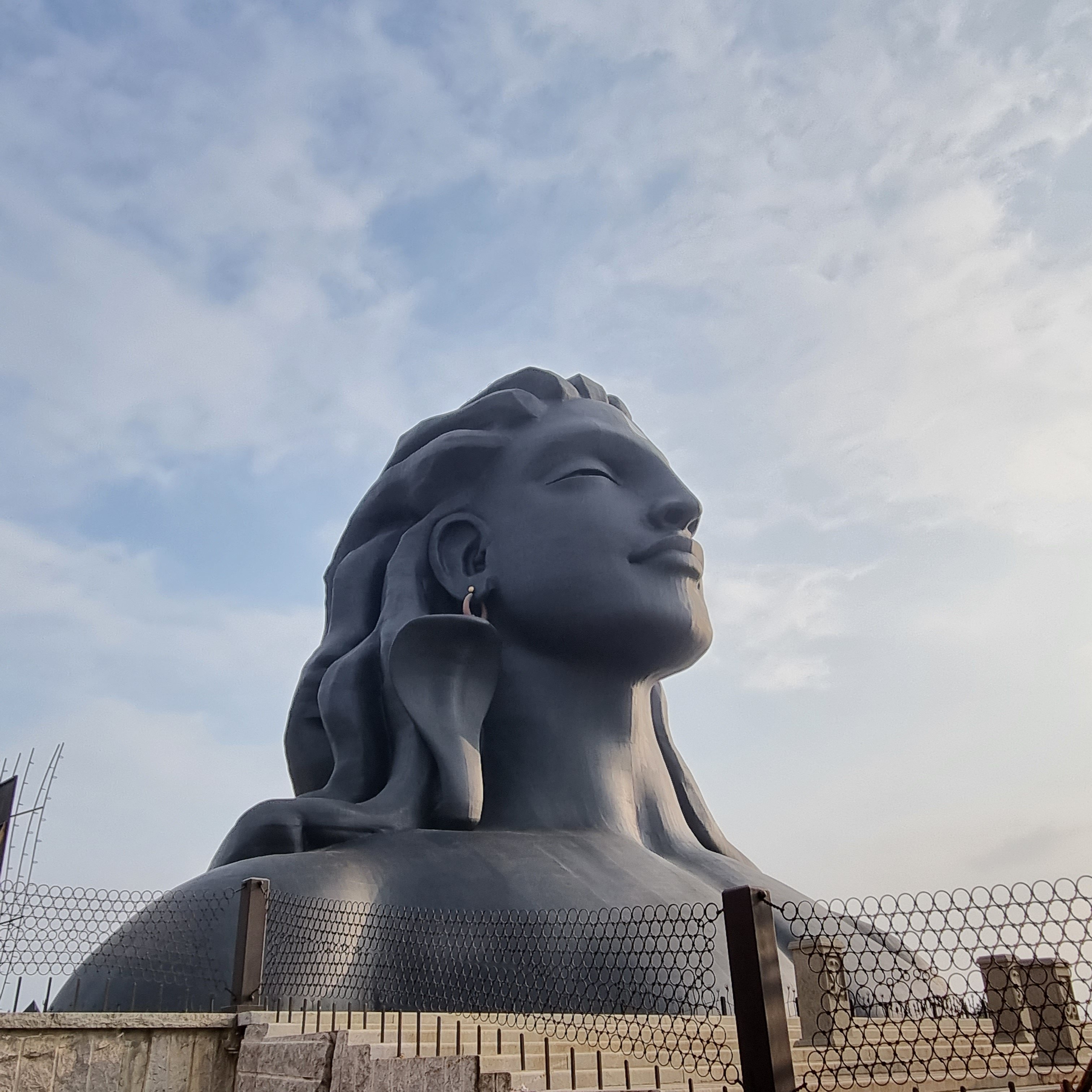
The Adi Yogi statue is built of steel and placed on a raised platform. It’s visible as you enter the Isha Yoga centre.
A dip in sacred waters is a mainstay of Indian civilisation, and it’s common to see people taking a dip in one of the numerous rivers in the country. I never thought I’d actually do it myself one day…
Sowmya and I arrived at Isha Yoga centre early one morning, hoping to beat the usual crowds. But the day we chose was only 4 days ahead of Maha Shivratri and the devout were up and they were about. Hordes of selfies were being taken in front of the Adi Yogi. It was only 8 am, but the places was bustling with activity. A large stage was being constructed and barricades were being erected to keep the imminent crowds in check. Announcements were blaring from the speakers.
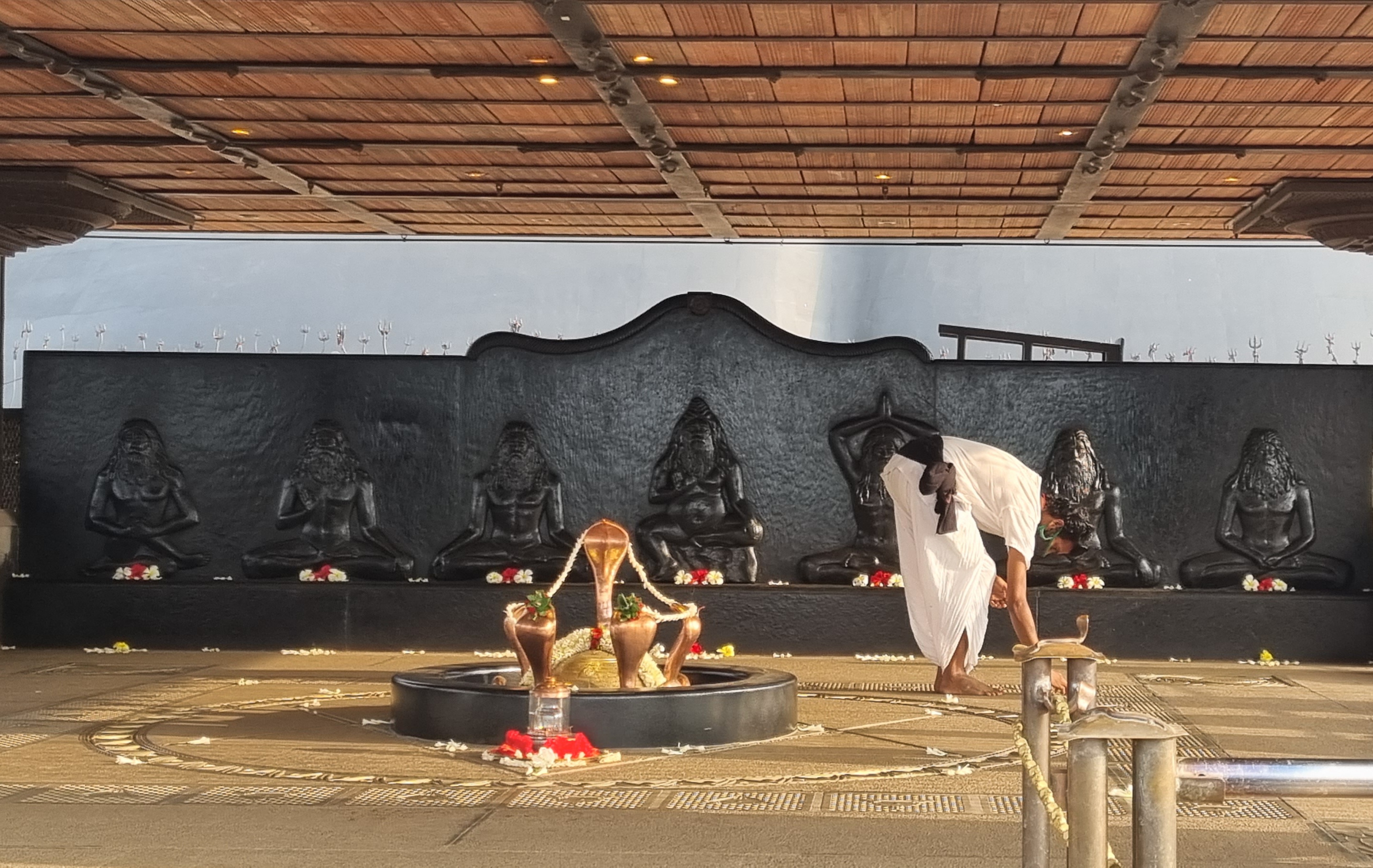
A beautiful mural of 7 siddhas. In the temple in front of the Adi Yogi temple at the Isha Yoga Centre.
In front of the Adi Yogi statue is a temple where daily homas are done. We reached the temple as special morning prayers on account of Mahashivaratri were were being conducted. We had a chance to sit around the fire listening to the chanting. There is a metal lingam in the centre of this temple (several people were doing parikramas around it). Coiled around the lingam are 5 metal serpents of various heights. Behind is a beautiful mural of 7 siddhas. Several people were doing the sashtanga namaskars in front of these statues and the lingam.
After about 10 minutes we got up and decided to walk further into the ashram. Before entering into the grounds of the main ashram, we were asked to deposit our phones and other valuables (except our wallets) at the security. We were also allowed to take our towels into the ashram, for which we were given a bag at the security.
The Isha Yoga Centre has two kundas – water tanks for men and women to bathe in and thereby purify themselves. The Surya kunda is for men and Chandra kunda is for the women.
To bathe in the kunda, you’ll be given ochre robes by the centre. You will need to take a shower first. I was hoping no one would notice that my hair was dry, but they did, and I was promptly sent back to the showers to rinse my hair.
The kunda is artfully designed. As we descended the large stone steps, I was reminded of the Kamakhya temple. Unlike the Kamakhya temple, the Chandra kunda is man-made and designed to be rustic yet elegant. It is carefully cultivated class – a 5 star temple water tank – as Sowmya puts it. Silence is mandatory here, and it seems to reverberate within the tastefully designed stone dome of the kunda, adding to the somber mood. There is a small waterfall on one side and as I descended the metal stairs on one end, I felt the weight of the heavy silence closing in on me. The kunda is windowless, and the cold water is about 4 feet deep. There is a huge shivalingam in the centre – made of a stone base and a metal dome jutting out of the water. We circumambulated the lingam in the water, savouring the resistance of the water on our relaxed limbs, the splashing sound soothing to the ears too.
Once we exited the Chandra kunda we decided to visit the Bhairavi Temple. This too has a cave-like structure and early in the morning the sounds of the aarti and accompanying chanting were steadily reaching a crescendo. The devotees were engrossed in their devotional practices, and there was no social distancing. Not too keen to be a part of the melee we decided to exit.
We continued practicing our silence as we entered a doorway to get to the famed Dhyana Lingam. On either side of the hallway leading to the Dhyana Lingam there are stone murals depicting various scenes from mythology about devotion. Sowmya and I were happy to see a huge statue of Sage Patanjali. The Dhyana Lingam is housed inside a huge dome shaped hall specially made for meditation. The shivalingam stands tall and imposing in the center of this hall and is decorated with flowers. There are squares compartments cut into the walls to sit and meditate in. There is no artificial light here, and the style is similar to the Chandra kunda – stone, understated, elegant. For a fee you can also light a lamp and offer rudraksha of various prices to the Dhyana lingam.
Sowmya and I found a square each and enjoyed some of the serenity for half an hour.
After a bit of shopping at the gift shop (I picked up their famous sambramani) and some breakfast (steaming hot idlis and some pongal), we decided to walk past the famous tamarind tree and the nandi in front of it. The Nandi is five times the size of a real one, and made entirely of black stone. The tamarind tree is covered with threads and other pieces of cloth (mostly fuchsia, red or black). Those who complete the challenging Shivanga sadhana gain the privilege of tying these cloths/threads on this tamarind tree. The Shivanga sadhana is a special 42 day sadhana that only the most devout can complete. It is believed that our sweat contains our samskaras and when these are absorbed (along with our sweat) into the clothes we wear. By tying these clothes around the branches of the tamarind tree, we rid ourselves of our samskaras.
The experience of the rituals and worship at Isha yoga differed so much from our experience at the Perur temple, just a few kilometres away. It is said that there are as many beliefs as there are people in India. Experiences like this one certainly gives us insight into just how complex, intricate beliefs, culture and traditions can be.
If like me you’re a temple buff, then make sure to check out this blog about the Koti Lingeshwara temple on the outskirts of Bangalore, a temple that has one million shivalingas!
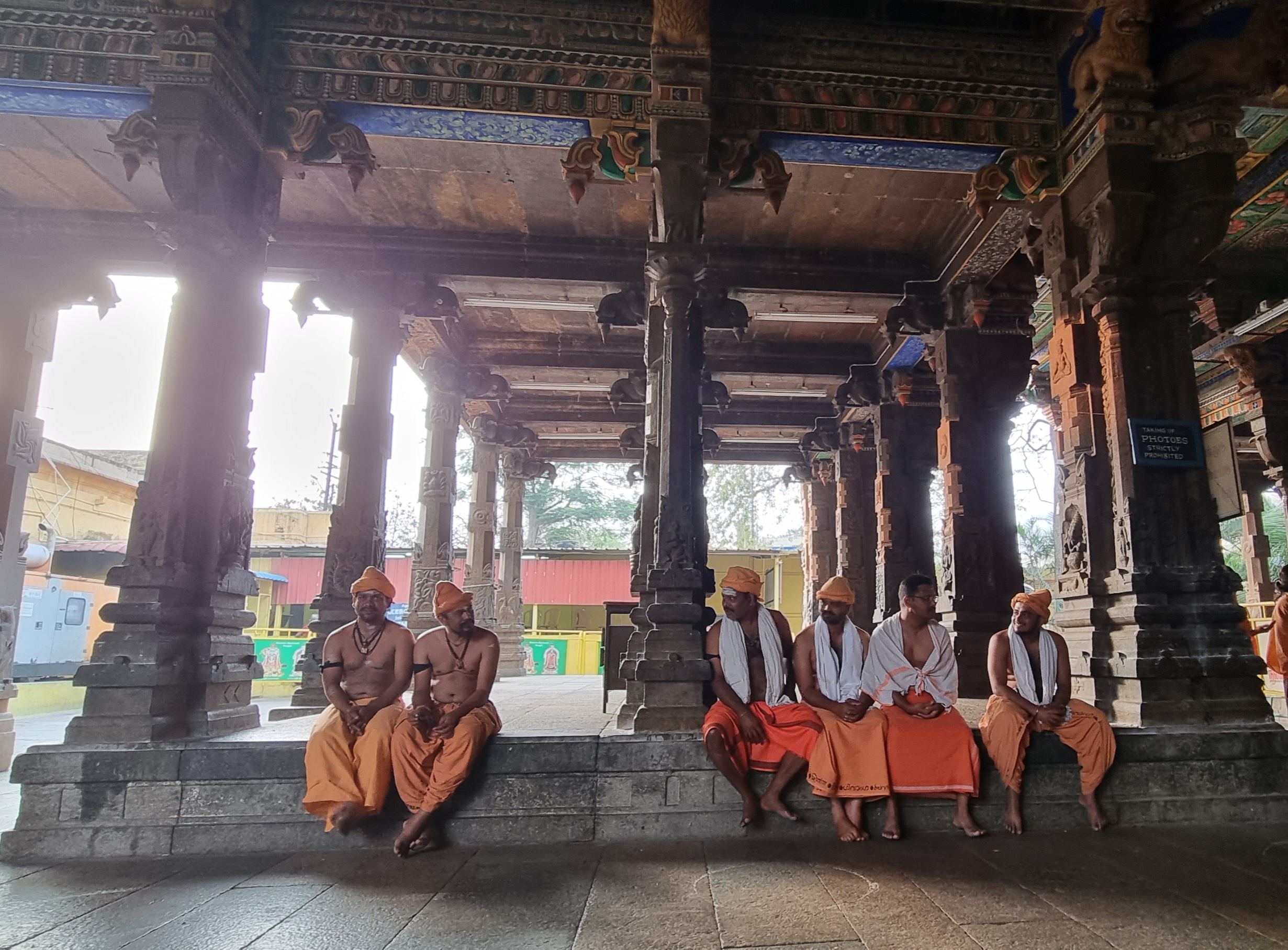
Off duty priests.
Once I realised that deeper study of yoga needs a closer look at it in its cultural and traditional context, I started to consciously seek out yoga stories and connections in daily life in India. In retrospect, I’ve been doing this ever since I started researching for my book ‘Beyond Asanas’. Perhaps if I hadn’t been on this quest, I wouldn’t have had the unexpectedly special Mahashivaratri experience I had this past weekend…
Sign up for my newsletter to get all the updates right in your inbox