Pragya Bhatt | yogawithpragya

Browsing Tag

yoga with pragya

Yoga

Untying the Knots

October 9, 2015

A couple of weeks ago I had a student in Supta Baddhakonasana.  That’s Lying Down Bound Fixed Angle Pose, a supine variation of a pose popularly called the ‘Butterfly Pose’.

As the relaxation came to a close, I gave the instruction to keep the eyes closed and to come out of the pose in the easiest and most comfortable way possible.

The student started to undo the belt binding his legs in the pose.  He realized that he couldn’t reach far enough to actually undo the belt easily.  He started to reach around and fumble with the belt a bit more.  All the effort made him want to open his eyes, but he wasn’t going to not follow the instructions.  Finally he managed to twist and turn enough to grab a hold of the buckle and wrest the belt off.  Once done he sat upright and relaxed his tightly closed lids.  Hmmmm….

Sometimes a student’s behaviour on the mat is highly indicative of his/her approach to real life.  Does a student twitch and move a lot when relaxing?  Post Savasana do they quickly jump up and run out to meet the rest of their day?  Do they fall asleep during relaxation?  In this case, the student had to complete his relaxation and face the real world.  One which, at that point, literally had him up in knots.

When faced with sticky, frustrating, tight, claustrophobic, rigid etc situations, our first reaction is to fight for dear life.  So we close our eyes tightly and twist and turn and try to grab that which we feel is smothering us and wrench it away from us.  However, if you breathe deeply and instead of struggling, you work on accepting that you are in a bind (in this case quite literally), then you may have an easier time getting out of the unpleasant situation.

Someone once told me that you can consider roadblocks to be either problems or  constraints.  You can choose to dwell on your problems and try to (unsuccessfully) wish them away.  Or you could think about how you can carry on with your life’s work with the existing constraints.  I believe that changing your perception is all it takes to change your life, and this forms a huge part of that philosophy.  So next time you’re in a conundrum, think, do you want this to be a problem, or do you want it to be a constraint.
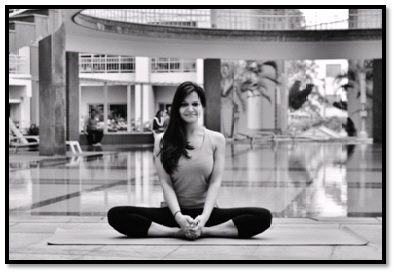
badhakonasana

The Supta Baddhakonasana is when you lie down on your back and keep your legs in this position.

Yoga

The King of the Asanas

September 27, 2015

Whenever I teach the Sirsasana, I never forget to mention that it’s the King of Asanas.  And I go on to say something like, it’s the King ‘cuz it’s the grandest and most amazing pose.  And well, it’s really difficult too.  Until the other day when a student pointed out that that describes pretty much most advanced asanas.  Got me thinking, so I did some research.The reason the headstand is the King of the asanas is the role the head plays in the life and times of an individual.  The head defines a large part of who a person is.  The thoughts originate in the head.  Rational decisions come from the head.  The power of reason and discrimination lie in the head.  So much so that when a baby is born, it’s the head that comes out first.  Metaphorically, the head deals with the world before any other parts of the body.

20150914_133352_-1575466813[1]20150914_133449_570824101[1] 20150914_133531_2052623839[1] 20150914_133832_920563252[1]

The skull and the brain are located in the head, and these control the nervous system of the body.  A healthy mind is essential for a healthy body.  The brain is responsible for intellect, knowledge, discrimination, wisdom and power.  According to ‘Light on Yoga’  just like a King controls the kingdom, the brain controls the body.  Therefore, the Headstand is the King of all the other asanas that the body can perform.

Regularly practicing this inversion stimulates circulation of blood to the brain cells, which helps in rejuvenation of the mind (and also helps in giving you that yoga glow).  This flush of fresh blood to the brain cells enables you to ‘see’ and think more clearly.  Quite literally, you see from a different perspective.  This pose is great for insomniacs because it gives the brain some respite from the stress and tension of life.  In the correct posture your torso is expanded, enabling you to breathe better and more deeply.  It’s great to increase your lung capacity.

20150914_134000_193050774[1] 20150914_134212_-1596057775[1] 20150914_134613_157411077[1]20150914_134731_1622070687[1]

According to BKS Iyengar, regular practice of Sirsasana ensures that “One becomes balanced and self-reliant in pain and pleasure, loss and gain, shame and fame and defeat and victory.”

Yoga is a state of equanimity.    (Samatvam yoga ucchyate.) – Bhagvad-Gita.

Photo Collage Maker_1CTZOu[1]

Yoga

Vegan For a Day

September 3, 2015

I got invited to a full day workshop about veganism this past weekend.  We were invited for a detailed talk about what it is and why it’s good for us.  We were going to be treated with a vegan breakfast, lunch and snack.  And we were surprised with a goodie bag at the end of the session to enable us to continue on our Vegan journey without a stop.  The session was quite intense, but there were a few things that stood out and they made sense to me as well.  What I’m trying to say is that it wasn’t all mumbo jumbo.  Some of the ideas were logical.  And I’m going to try a few of the things they spoke about.  And in no particular order these principles were:

  1. Eat a whole plant based diet.  Vegetarian food is high in fibre.  Not only is animal based food high in fat, it is high in cholesterol as well.  Because only animals produce cholesterol.  So effectively cholesterol is a hormone made by animals.  And ghee happens to be 100% fat.
  2. Good sources of fat are nuts and seeds.
  3. Meat and milk are equal.  Both contain hormones, antibiotics and pesticides.  On top of this milk contains IGF – Insulin-like Growth Factor.
  4. It is a common misconception that we are a milk drinking nation.  We are consuming more milk now than ever before.  Historically in India, people used to have one cow and not feed it hormones to give more milk.  The milk that humans would consume would be the one left over after the calf had finished nursing.  So that would be very less, not gallons upon gallons that we consume today.  Krishna was stealing other people’s milk products because he wasn’t drowning in milk and ghee himself.  Even though he was quite wealthy and had no reason to steal anything.
  5. The body gets enough protein on a whole plant based diet.  Think about it, very few people report protein deficiency.
  6. Plants are better sources for Calcium than milk.  Only 30% of the calcium in milk is assimilated.  And anyways, you need Vitamin D to absorb Calcium into your bones.  So having only milk doesn’t mean that you will assimilate all the calcium in the milk.  What you should do is ensure that you have adequate Vitamin D so that all the calcium you provide to your body is assimilated.
  7. Eat whole foods because refined foods lose a lot of nutrients.
  8. Replace animal milk with soy, rice, almond peanut etc milk. (Basically plant based alternatives.)  Sesame seeds have more calcium than milk.
  9. Say no to sugar.  Have dates and raisins instead.  Fruits have plenty of natural sugars.  And jaggery and honey not allowed because they aren’t whole.
  10. Replace plain butter with peanut butter, cashew butter, sesame butter or almond butter.
  11. Replace paneer with tofu.
  12. Don’t have curd made of animal milk.  Make your curd out of soya, peanut milk etc.
  13. No meat.
  14. Replace white rice with unpolished rice.
  15. Replace maida with atta, jowar, bajra, nachni etc.
  16. White salt with Himalayan salt, rock salt or sea salt.
  17. Don’t fry your food because vegans don’t use oil.
  18. Have smoothies for breakfast.  So blend bananas, coriander and mint and have that for breakfast.
  19. Avoid tea/coffee because the increase blood sugar and stress.
  20. People tend to say that sugar causes diabetes, but it’s actually fat that causes diabetes.  so avoid fat in your diet.  The technique to eliminate fat is to eliminate all refined fats.  Refined fats are those without fibre.  Animal products don’t have fibre.  But coconuts do, so coconut fats are good.  After a fatty meal your blood thickens and fat cells get deposited in the arteries.  If you remove the fat, your blood will start flowing again.  Meat has free radicals which can damage the inner lining of muscles.  Plants on the other hand contain anti oxidants.
  21. People think that Diabetes and Hypertension are hereditary, but that’s false.  Both these conditions are lifestyle related and directly related to your diet.
  22. Honey and Jaggery are not ok.  Both are not whole.  However, you can eat sugar cane is good because it’s whole and unrefined and natural.
  23. Cheese is 70% fat.  Cheese is like Vaseline.  Your system can’t ingest cheese, it can’t ingest Vaseline.
  24. Have only 10 nuts a day.  However, peanuts are not nuts.  They are legumes.  So you can have more than 10 a day.
  25. Whole foods have complex carbs.  They take longer to digest and keep you full longer.  Hence you end up eating less.  Refined foods have simple carbs.  They digest immediately and you want to eat more.
  26. Don’t have two grains in one meal.  So don’t have rice and roti together.
  27. Broccoli has more protein than steak.  Excess protein causes osteoporosis and kidney disease.

So the two things you should ask yourself if you want to aim to eat vegan is whether what you are eating is plant based, and whether it is whole.

Yoga

When Your Back Hurts

August 20, 2015

All of a sudden I have lots of people asking me how yoga can help with slipped and herniated discs.  These are people who don’t want to go in for the surgery that the doctor has told them is inevitable.  These are people who are not interested in taking drugs to numb the pain.  Basically, these are people who have heard that yoga can help and want to manage their condition rather than let doctors cut them open.

So here are a set of moves that you should do in the sequence given below.  You need to hold each posture on each side for about 10 minutes.  So you do need to set aside about an hour to do this every day.  Yes, do these every day.  If you do this set of postures while you are experiencing the pain, you will get instant relief.  Tried and tested.

I only had a makeshift yoga belt with me when my friend and I found time to take these pictures.  You can use a stole or a dupatta, basically anything long enough to use for these asanas.

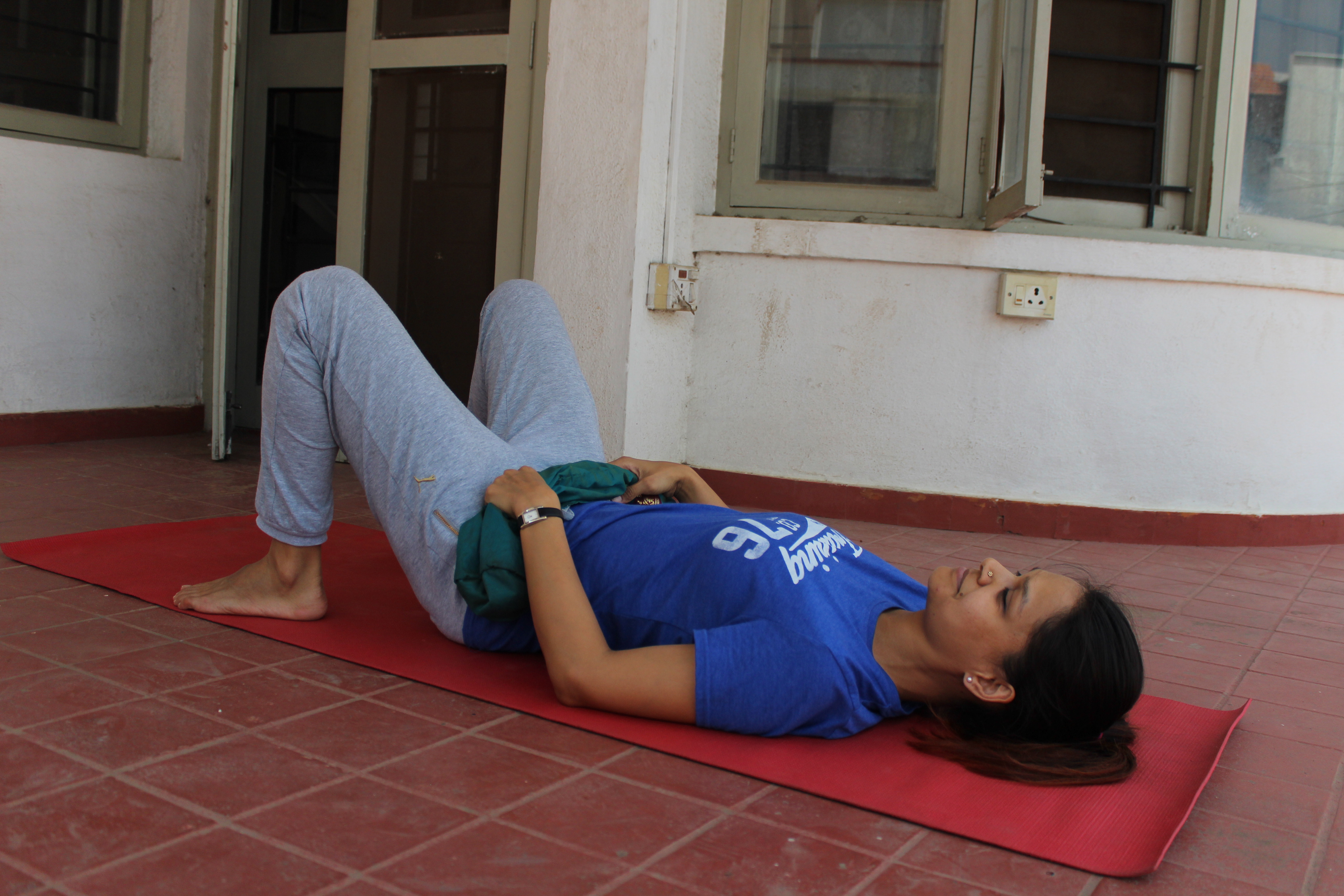
  1.  Start with lying on the floor.  You must fold your legs like in the picture.  The lower back should lie flat on the floor.

IMG_5866

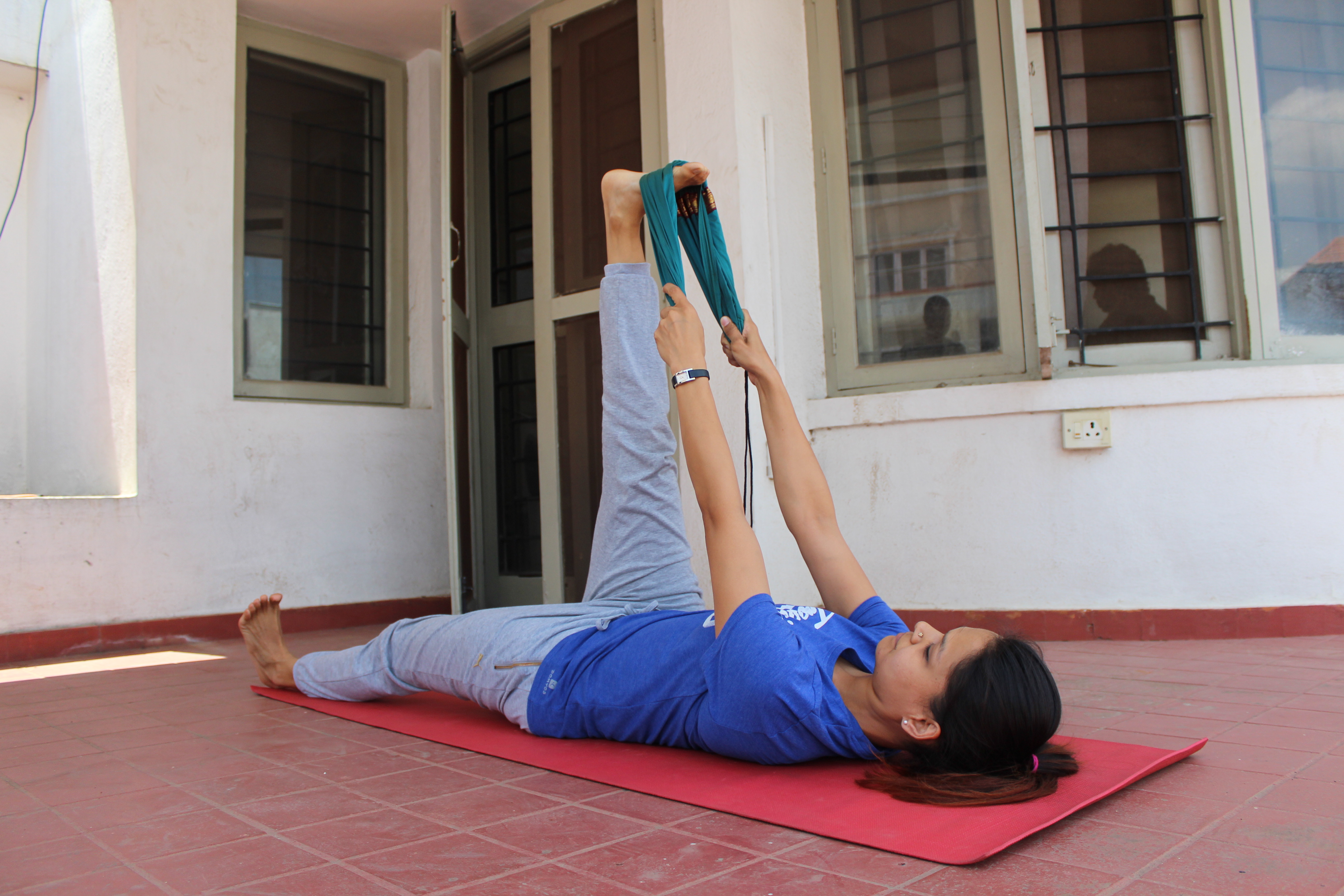
2. Next loop the belt around one foot and straighten the leg.  You lower back should still lie flat on the floor.  Push the heel out.  Keep the toes inclined towards your face.  Also, people tend to think that the closer they can bring the leg to the torso, the ‘better’ it is.  That is not true.  You must keep the leg either straight up, perpendicular to the floor.  If that’s too intense of a stretch for you, then you can bring the leg closer to the floor, until the stretch becomes tolerable.  The heel must always stay extended outwards.  Knee must be locked.  Note: the other leg is bent with the foot on the floor.  This is intentional and you must practice just like this.IMG_5867

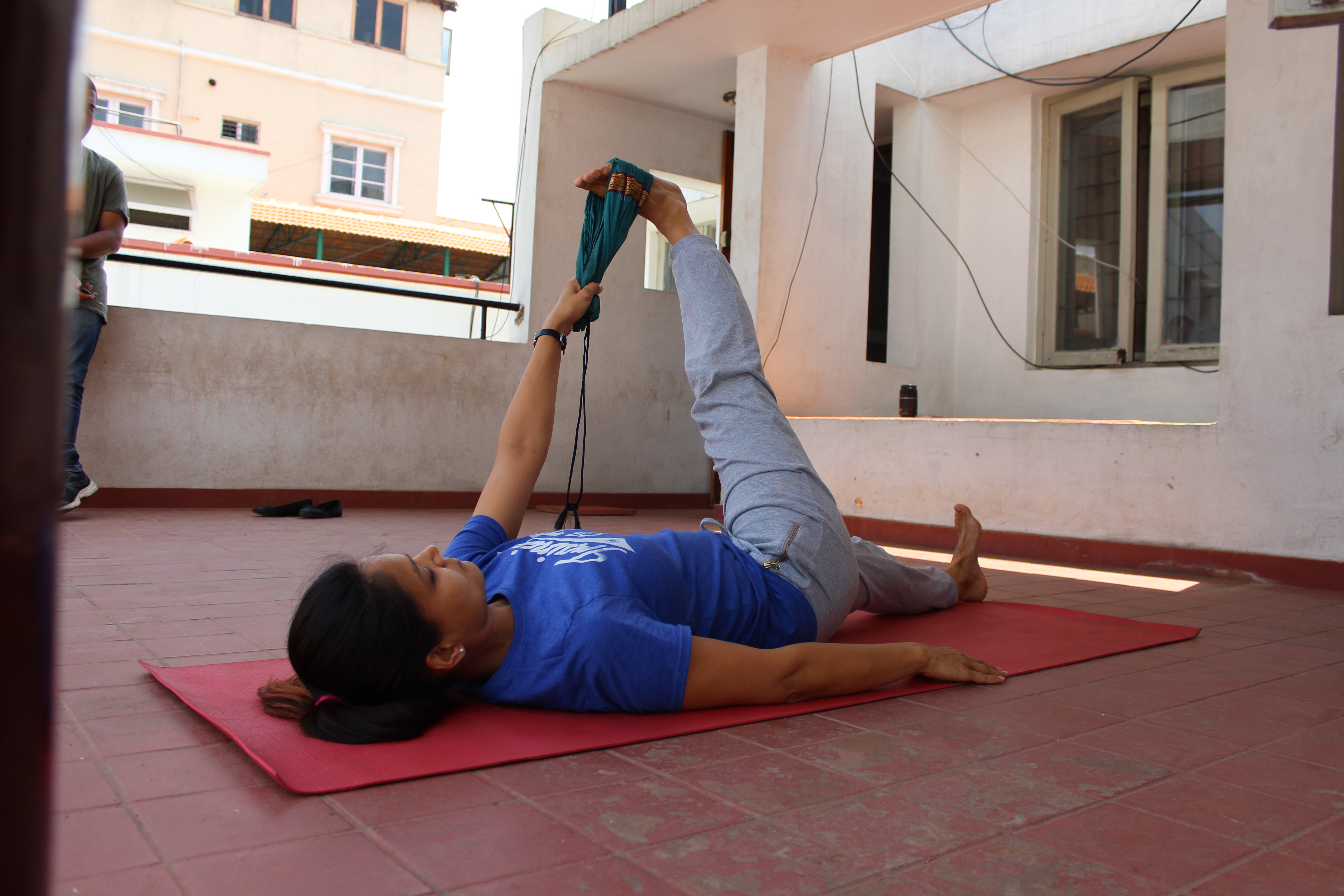
3. Straighten the leg which is on the floor.  Do this by slowly walking it out, and not by lifting it up and pushing it forward.  You have to do all these movements slowly and carefully, after all, you want to be careful with you back.  In this posture, both legs mimic each other.  Knees are straight and locked.  Heels are pushed out.

IMG_5868

4. Next ease our leg on to the floor.  Again, no jerky movements.  Also, if you are unable to get the leg all the way down to the floor, you can use a pillow or a small table to rest you leg on.  Heel pushed out.  Knee locked.  And the torso should be flat on the floor.  Usually there is a tendency to lean to one side because of the weight of the extended leg.


IMG_5870IMG_5871

5.  Bring the leg back up and this time, ease it to the opposite side.  Only 30 degrees to the other side.  So lower back is still in touch with the floor.  The opposite leg should stay active.

IMG_5869

6. And finally, the posture which gives the most relief.  For this one you will have to tie the ends of the belt together.  Then insert a leg through the loop and put the opposite shoulder through the other end of the loop.  Almost like you’re carrying a shoulder bag.  Allow the leg to fall sideways.  It doesn’t matter how close your knee/thigh/leg is to your torso.  What matters is how relaxed your leg is.

IMG_5872

Remember to practice each posture on both sides.  Hold for 10 minutes on both sides.  When done daily these moves ensure that your back pain is eliminated.

Thanks Sujith for the photos. 🙂

Yoga

The LINgGAN Yoga & Lifestyle Studio, Den Haag

April 8, 2015

While in the Netherlands I had the opportunity to visit this quaint studio called LINgGAN Yoga & Lifestyle.  The studio was awesome.  I mean, how can you not like a studio which has such cute magnets? (I want!)

20150323_173200[1]

The best thing about my visit was talking to the owner of the place, Savitri Thissen Sattoe.  What started out as a little hello-how-are-you chat soon grew to become this extremely insightful conversation about yoga as a passion and what we can do with our passion so that it becomes more meaningful to us.  We chatted for a long long time, but there are some things that really stuck out in my mind which I think are valuable for a lot of people.  Even if you’re not an entrepreneur.

1.  Make sure you want to do this.  Because if you’re sure then you’re going to work hard.  If you work hard then you’ll taste a reasonable bit of success.  And then with consistent hard work you will be able to build a body of work you are proud of.

2.  Have a plan.  And go back to it every once in a while.  Because with time your plans can change.  When you find you are unable to meet your timelines then change the plan!  Be flexible!  There is no right or wrong plan.

3.  Network with people.  That’s the best way to learn.  Cooperate with others.  Collaborate with them.  Brainstorm with them.

4.  Be positive because you never know what lies right around the corner.

Oh and I forgot to mention, Savitri Thissen Sattoe is really cool.  She runs Yoga Teacher Trainings in Suriname and speaks Hindi also!!!

20150323_173146[1]