Pragya Bhatt | yogawithpragya

Browsing Tag

bangalore yoga teacher

Yoga

Crack Open to Heal – Day 9

August 9, 2018

Yoga helps.  It heals.  It gets rid of emotional blockages and psychological pain.  It brings peace.  It brings clarity.  We’ve all heard this at one point or another.  And I’m sure we all wonder – how?

Yoga helps by teaching us how to create space.  Our demons reside in our joints.  Achy, stiff joints are permanent residences for the demons of our past.  To get rid of these demons we must lengthen our joints.  Create space so that the joints can breathe and release the demons holding them tightly together.  Once these demons are gone your joints will be free to move easily and pain free.

The same applies to backbends.  Bending backward is so difficult for many of us because it requires (amongst other things) flexible back and shoulder muscles as well as a flexible hip joint.  For a long time I wrestled with a stiff upper back.  After years of practice I’ve managed to overcome this challenge….only to realize that I’m unable to access and push the hip joint up.  And this will take a few more years to overcome.  The point is that the only way to let go of years of deep rooted fears and blockages is to spend years creating space between the bones and muscles so that the tightly held demons are let go.

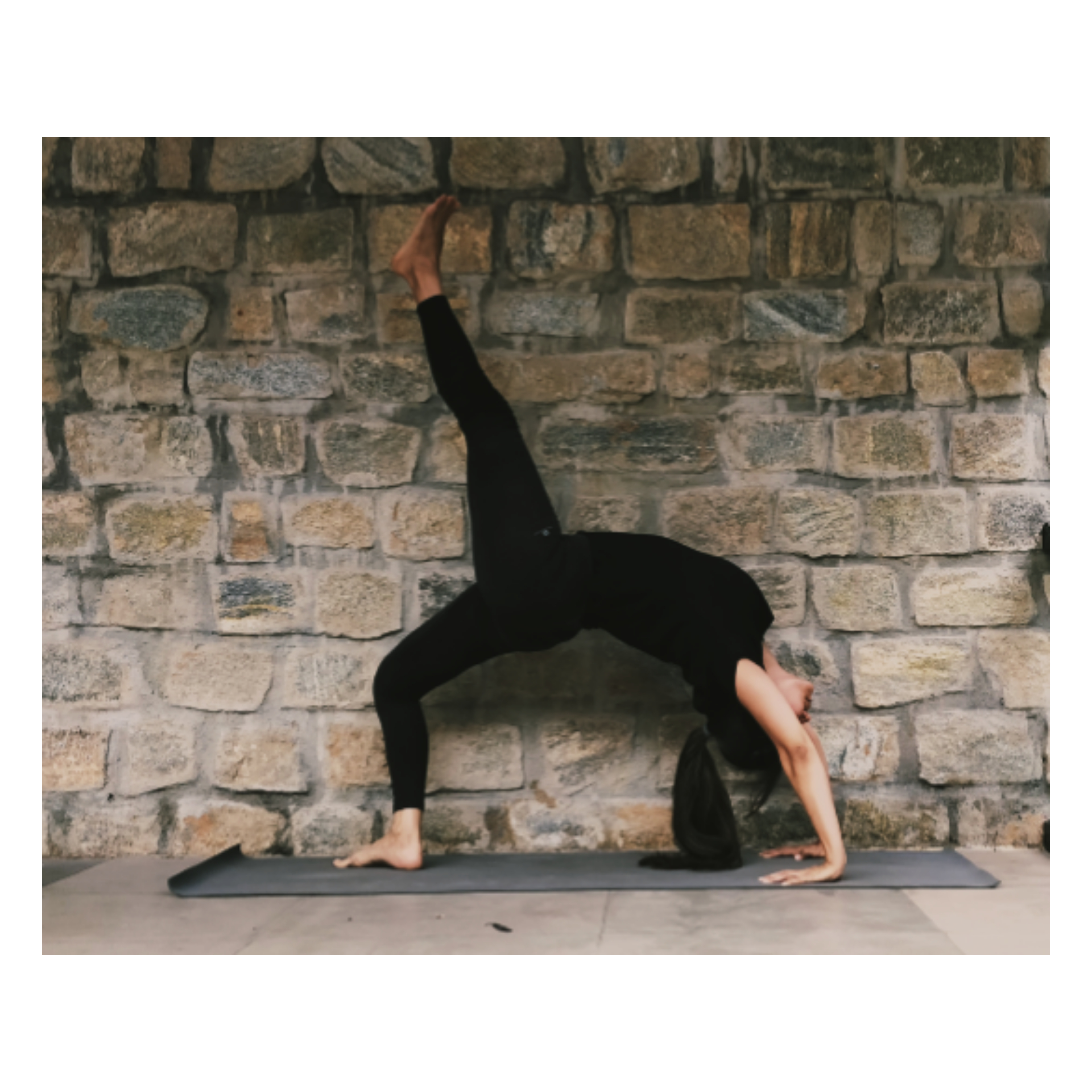
To overcome past samskaras it is important to crack yourself in two.  For instance, when doing the Urdhvadhanurasana I’m almost trying to split myself into two, body below the sternum and above the sternum.  For the next couple of years it will be focusing on body below the hip joint and above the hip joint.  The practice of reaching within yourself to access an area which has been ‘sleeping’ automatically infuses this place with new life…and also enables you to release the ghosts of lives past.
 

Yoga

How Your Practice Grows

June 25, 2018

Lately I’ve been reading a lot of Yoga philosophy.  The stories of the asanas.  The significance.

During practice I find myself going inwards to observe myself more closely.  My practice these days is focused on the basics.  So even if I practice Adhomukha Vrikshasana (handstand), I’ll start from Uttanasana.

Last weekend I attended a workshop at the Krishnamacharya Yoga Mandiram.  It was a two day workshop where we learned about Krishnamacharya, and his contribution to modern yoga and the style of yoga taught at KYM.

On the first day of the workshop the teacher spoke about the 8 limbs of Ashtanga yoga.  In his lecture he asserted that the 8 limbs grow like a baby.  Equally and in all directions.  So as you work on Yama and Niyama, you also work on Dhyana, Dharana etc.  This is a new idea for me, but the more I think about it, the more I see the similarity between this statement and asana practice.

A good friend of mine (also a yogi) told me once that when you’re struggling with a particular asana, it sometimes helps to go beyond that asana to one which is a little more advanced, and then come back to the asana that isn’t working for you.  Just because you aren’t consciously working on a particular asana doesn’t mean that it’s lying dormant.  Every time you practice, there are imperceptible changes in your body.  Whether the practice is good or bad, a change occurs.  Over time these changes accumulate and previously inaccessible asanas start to emerge, with relative ease.  In this way, your practice grows equally in all directions.

If you practice with focus and devotion, you are working on all aspects of the practice and not merely the physical one.  As your asana practice improves, your ability to speak the truth increases, you feel more compassionate towards Life and everyone in your life, you become more content and you stop vacillating between extremes.  The practice grows almost on its own accord, pulling the practitioner along with it.


Yoga

Repetition of vs Repeating (an Asana)

April 29, 2018

Your body exists in the past and your mind exists in the future. In yoga, they come together in the present. – BKS Iyengar

The other day one of my students mentioned (rightly so) that in my class he spends a lot of time in Adhomukha Svanasana. Other classes he’s attended didn’t repeat asanas as much our class.

Why the repetition?

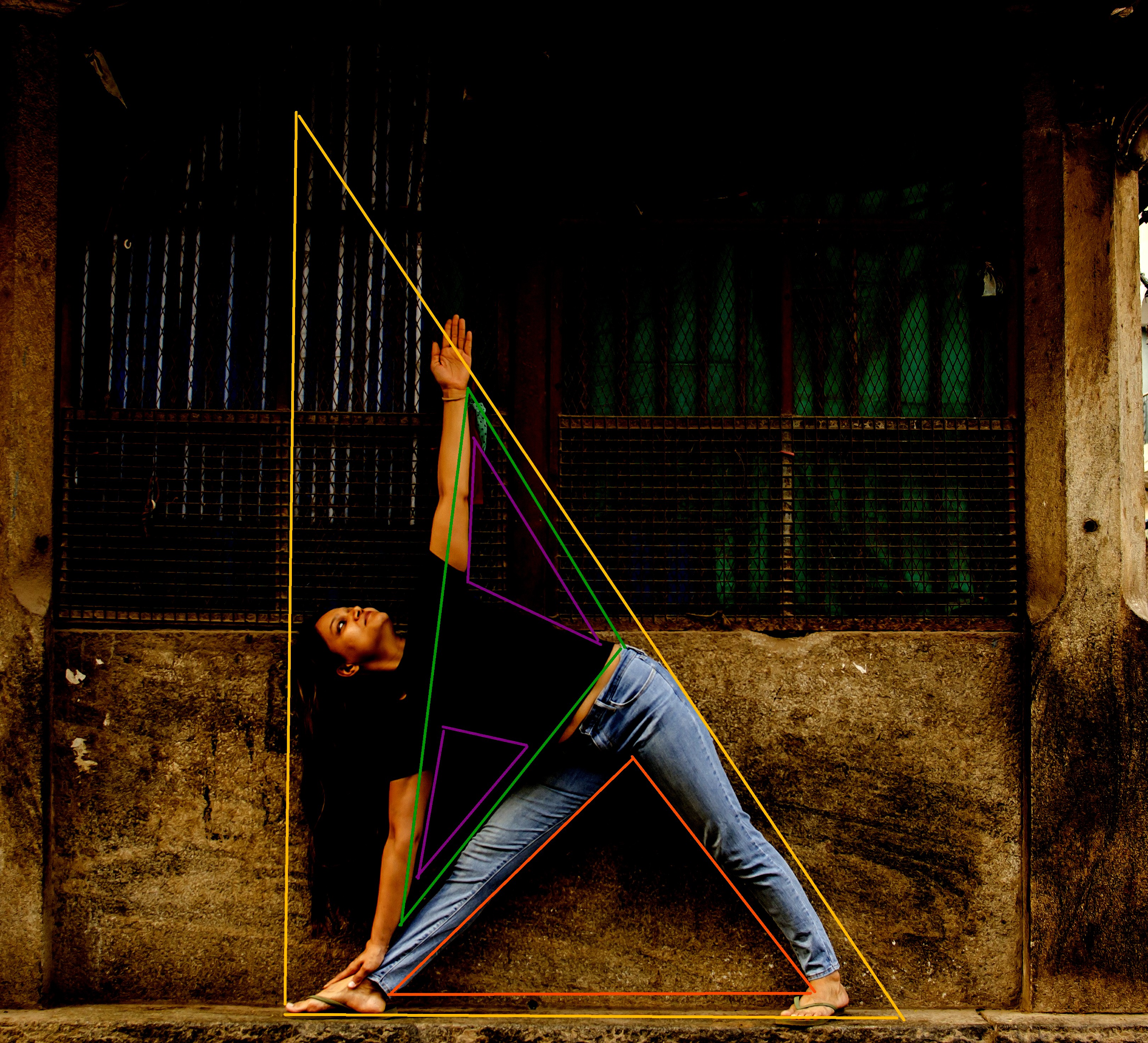
The thing is, we might be doing the same asana over and over again, but we’re not actually repeating it. Emotionally, physically and mentally, the asana is different every single time we redo it. Each time we execute it, we go deeper. We look at nuances, uncover hidden depths. It’s a new asana every time. In Trikonasana, for instance, I can focus on the alignment of my ankles, or on my shoulder blades, or the rotation of my spine, my drishti, or the alignment of the femur and shin, or even the extension of the metatarsals and soles. To maintain awareness simultaneously on all the factors that build the Trikonasana is hard, and we practice to achieve that. And, if for a moment we attain that state, we meditate upon what it taught us, what we learned.

I frequently come across posts on social media about ‘flipping your perspective’ or ‘get a new perspective’ and usually such posts are usually accompanied by pictures of Sirsasana (headstand) or Adhomukha Vrikshasana (handstand). In an Iyengar yoga class, you will gain new perspective and flip existing ones while doing basic asanas repetitively, constantly, consistently and persistently. To gain new perspective, we don’t really need to look beyond what we already have. Perhaps all we need is to be more attentive.

Take the Trikonasana above for instance. We can always focus on bending to the side and making contact with the toes/foot/ankle/ground. Or we can focus on bringing out the various triangles in the posture more distinctly and intensely.

Your focus will determine the quality and maturity of your practice and your life.

Travels

Yoga and the Art of Stillness

April 3, 2018

A couple of weeks ago I read ‘The Art of Stillness’ by Pico Iyer and thought it was a cute little read. As a yoga teacher I’ve given and received spiels about the topic innumerable times. I understand the importance of being still, that’s why we have Savasana at the end of every class.

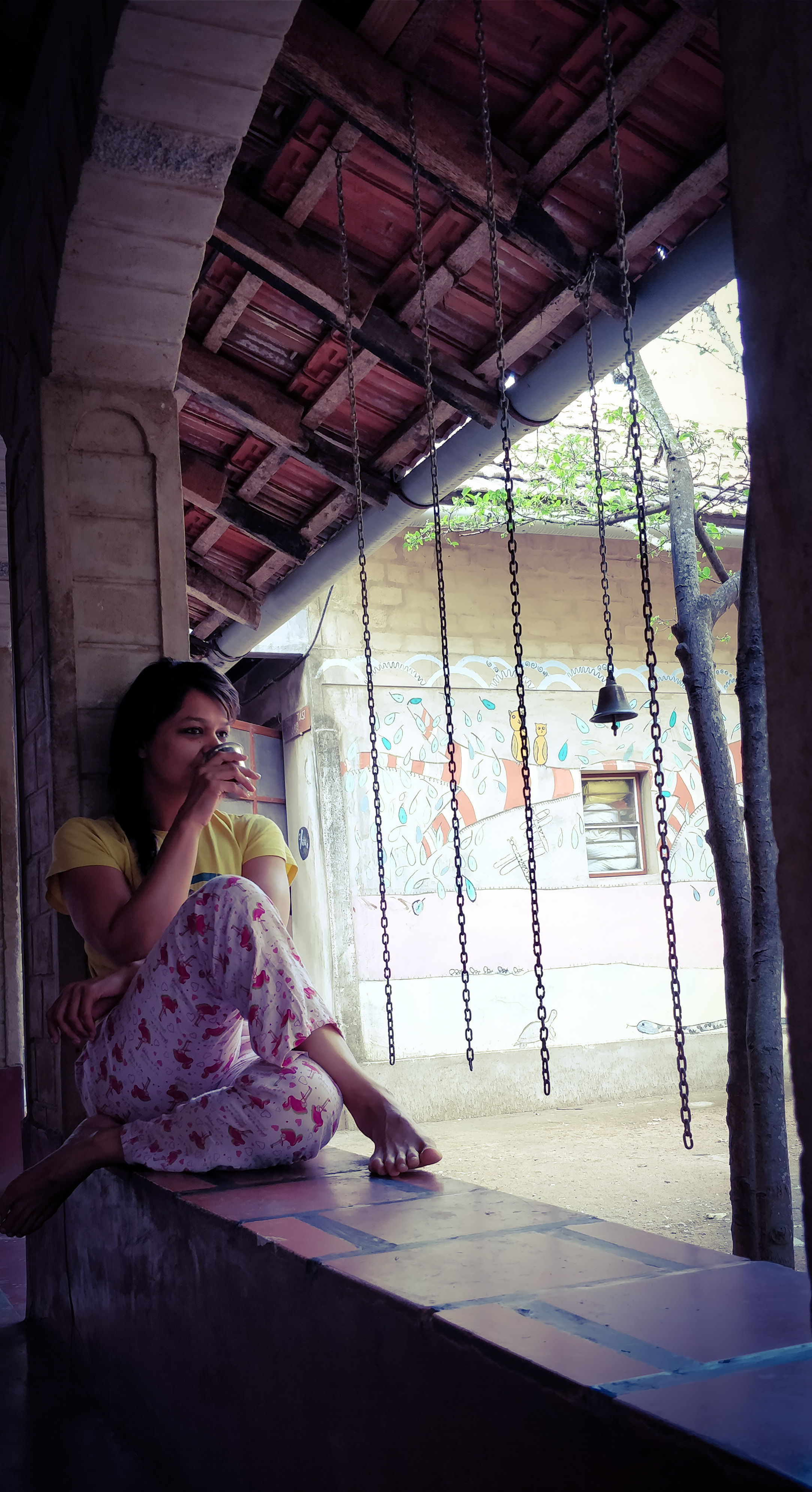
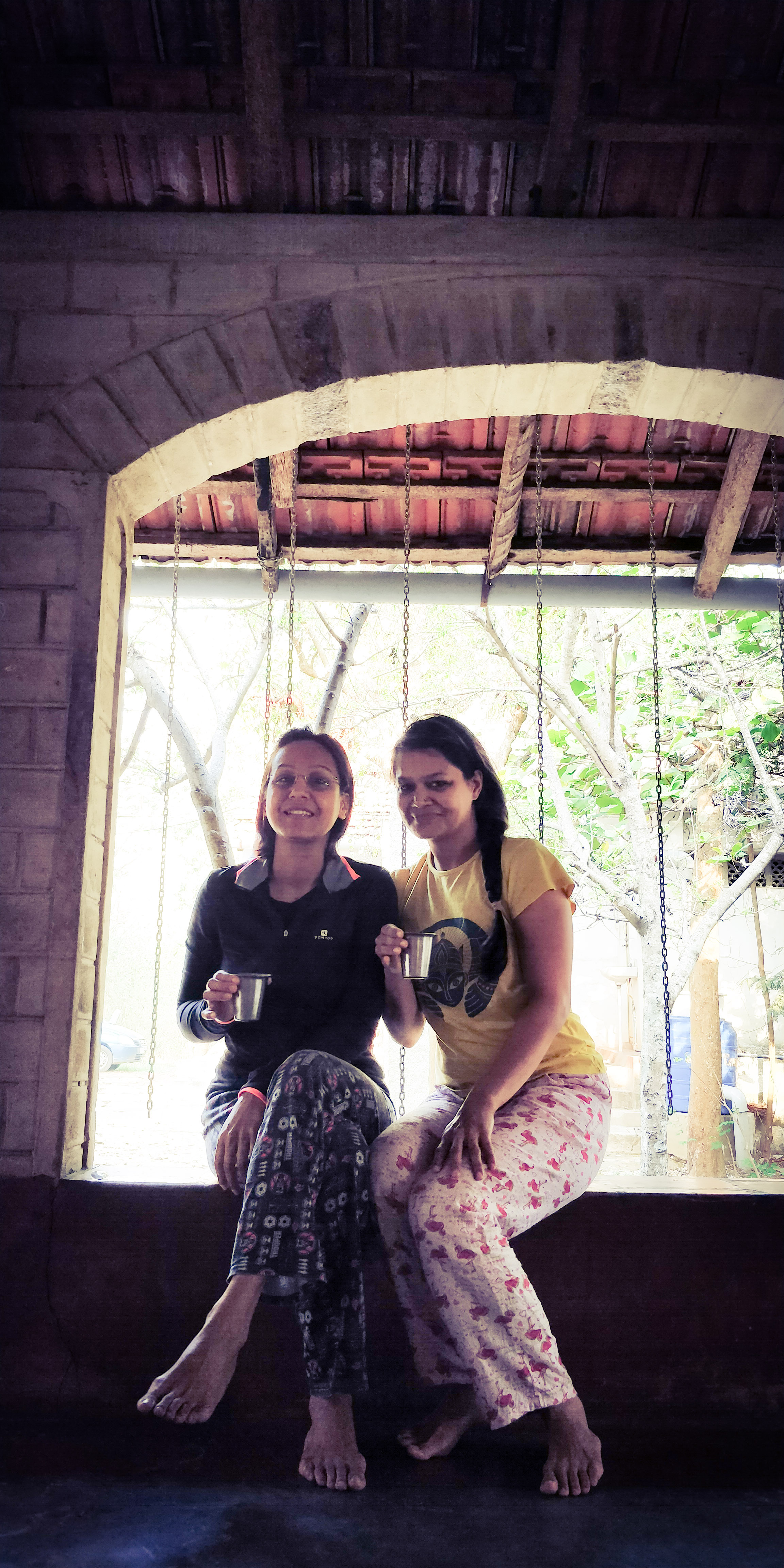
The thing is, you may understand something theoretically, but it’s only when you experience it that you actually know it. And this weekend I actually got to know stillness. My sister in town and we decided to spend time at the Navadarshanam farms, situated right outside Bangalore (actually in Tamil Nadu).

Wilderness surrounds the entire acreage of the farm. It’s a no fan zone. It’s a pleasure to walk barefoot on the red oxide floor of the huts. I saw a charcoal rice cooker for the first time. The tea was amazing. The air was clean. The sky was clear. We watched the evening rain from the coolness of our veranda. Bougainvillea grew in abundance and after the rains there was lavender all over the ground.

The most striking thing, though, is that there is absolutely no agenda. There are walks, but no fixed time for the walks. Food is served on time, but you eat in calm silence. Every once in a while they bake bread. So we spent our time gazing out at the trees and reading our books. We lay on our beds and chatted and read a little more. We snoozed a bit. All our questions ceased. We started to just be.

I’ve recognized stillness because on good days, I experience it during my practice. The happy glow that radiates even through my WhatsApp messages when I’ve had a great practice is not because I nailed an advanced asana. It’s because, for an instant, I managed to transcend the mere physicality of the movements to find stillness.

“Sitting still is a way of falling in love with the world and everything in it;” writes Pico Iyer in The Art of Stillness. Finding stillness in your yoga practice is a way of falling in love with yourself and everything around you.

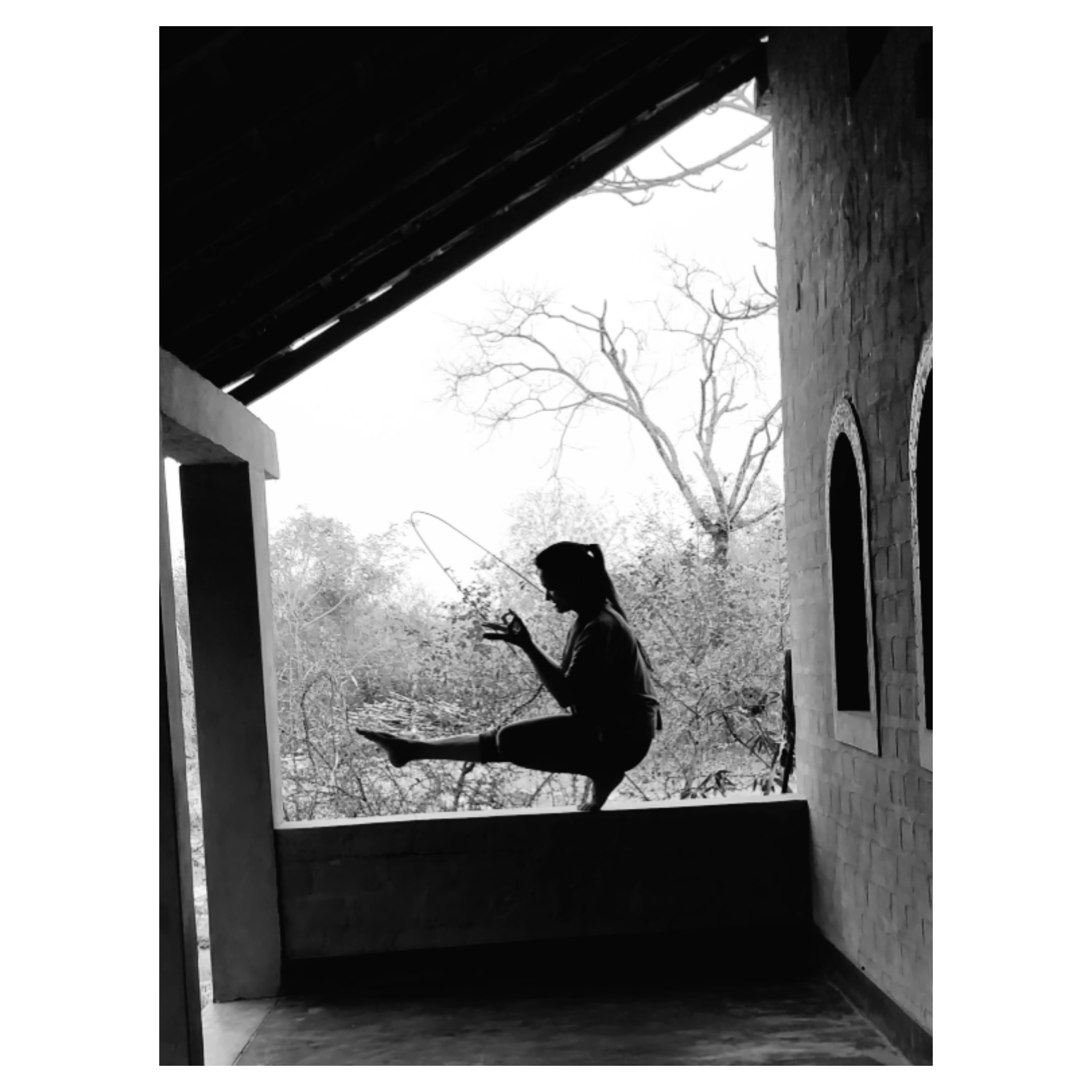
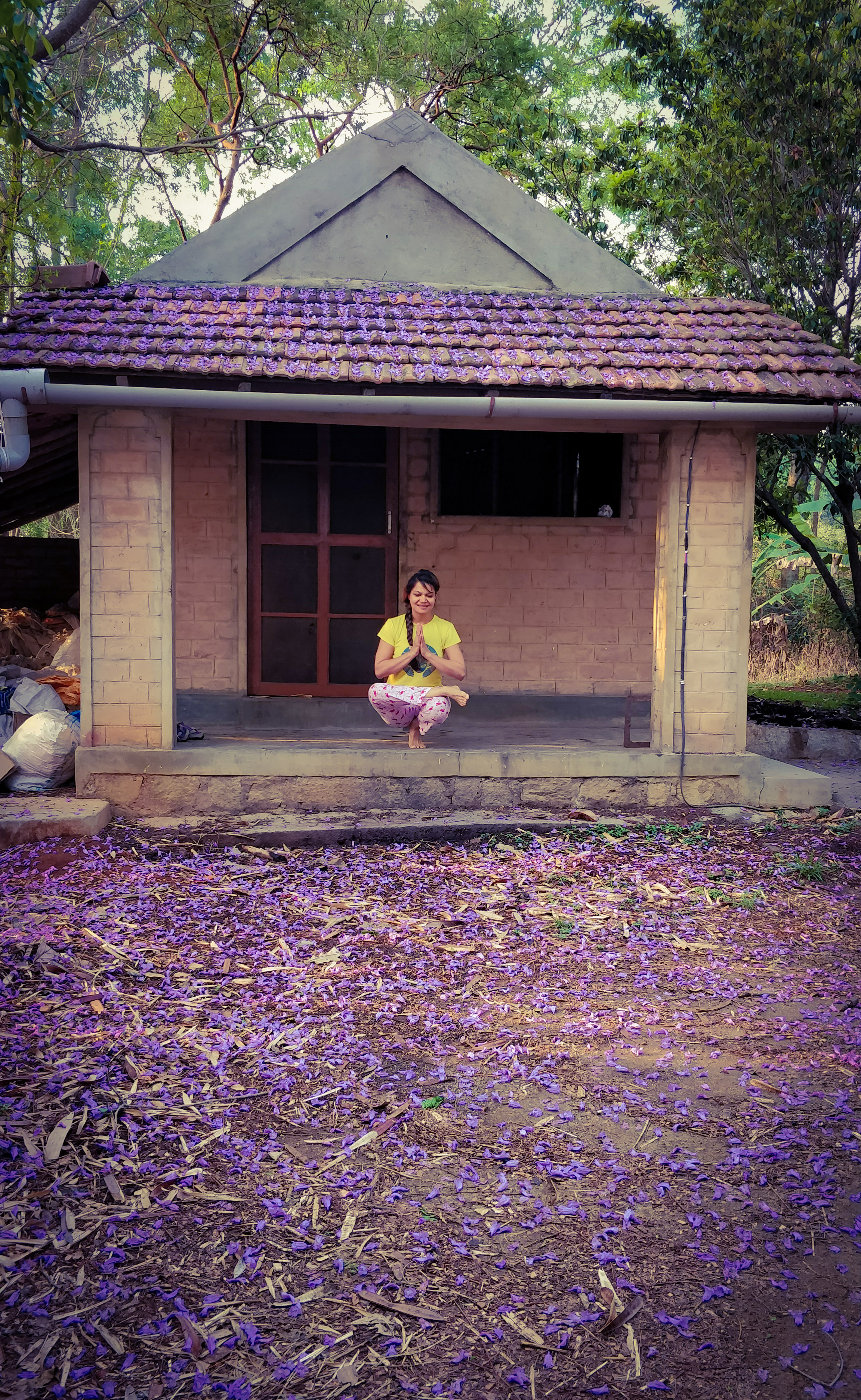
Striking a pose, as usual.

Everything lavender post the rains.

The herbal tea is truly delicious.

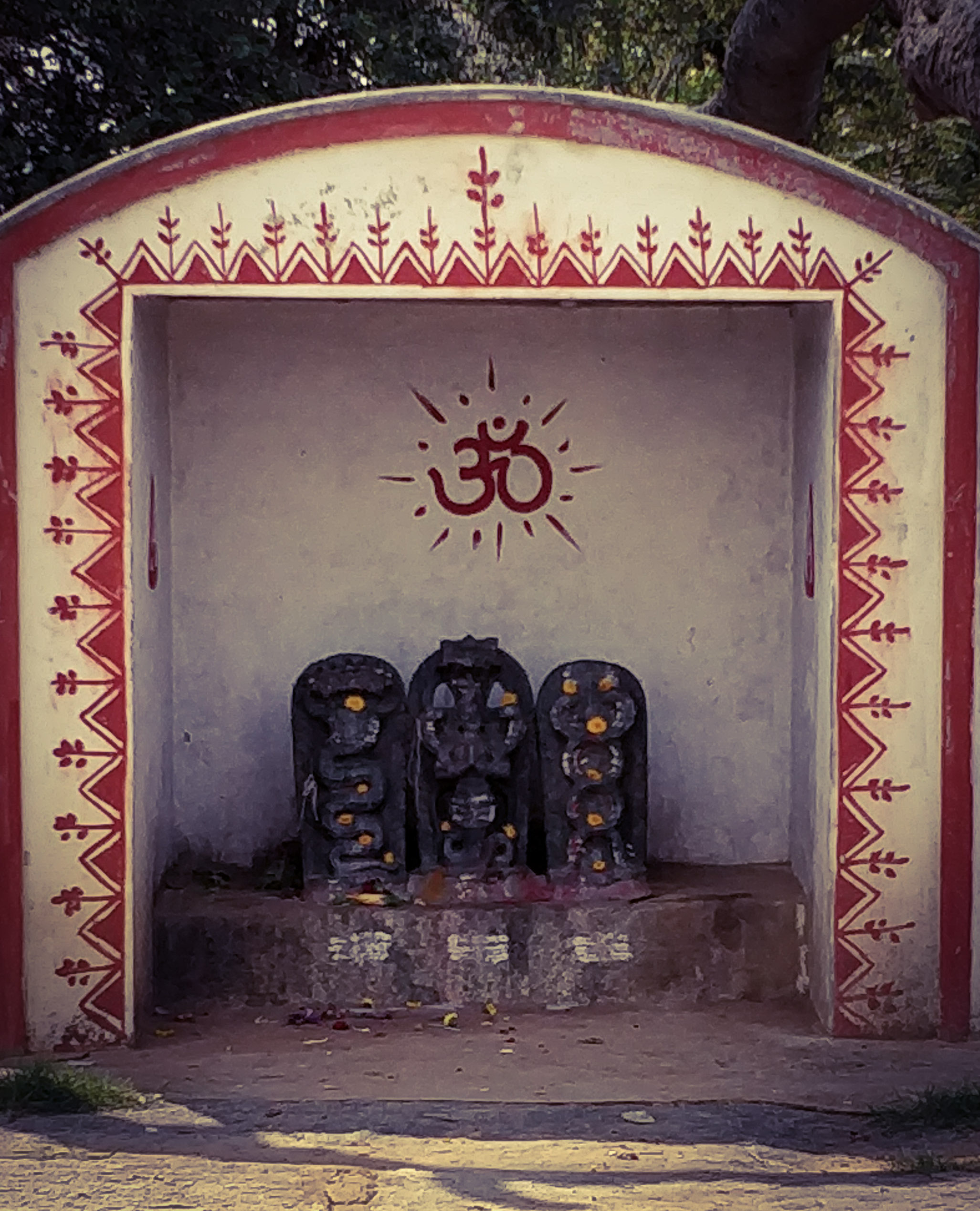
Small temples dot the road to the farm.

Yoga

Always on the Lookout…

February 17, 2018

for a yoga bag…

Whether you are a yoga teacher or a yoga student, chances are you are lugging more than just your mat to class.  The basics in a yogi’s bag are: phone, water bottle, towel, car keys, house keys, money.  As a teacher I carry a little notebook with my class plan, belts and sometimes even blocks.

Most of us have a yoga bag and also lug around our mats.  That might be fine for you, but I’ve been doing it forever and it’s getting a tad bit tedious.  Just as I was browsing online for a bag which could work for me, Meraki Decors contacted me!  Megha, the woman behind this quirky venture spoke to me at length about her journey and passion, and the connection was instant.

And, Meraki Decors decided to customize a yoga mat for me and send it for review!

When I looked up the term Meraki, I found out that it’s one of those words in a language that can’t be literally translated.  They describe a mood or a behavior.

You can bring Meraki into pretty much whatever you’re doing, be it cooking, decorating your home or your table, and (in my case) creating a life based on holistic health and conscious movement.


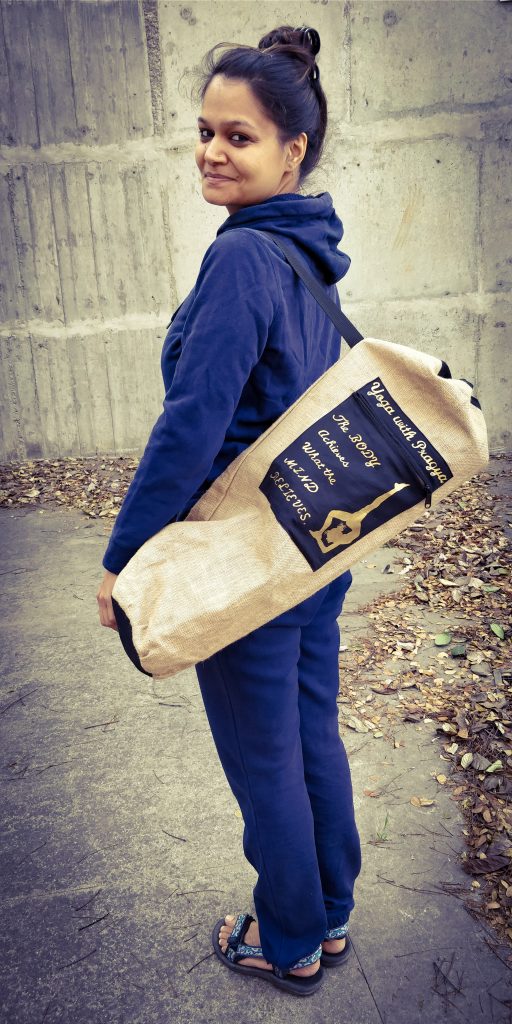
So, I was excited to receive this mat and below it is for your viewing.  Needless to say, it serves me perfectly.  It’s roomy enough for even really thick and big mats.  I use a thin mat, and that leaves enough room to put my jacket into the bag too.  And even my water bottle!

There’s a really convenient pocket in the front where I usually keep my phone, car keys, notebook, spare change etc.  And the best part is that Meraki Decors put my name with an inspirational quote on the mat.  Because #postiiveaffirmations.

I’ve been using this bag for a while now and I like the way it looks and the convenience.  Meraki_Decors has so much other stuff that you’re going to love (I certainly do!)


And I got lucky on Valentine’s Day because Megha gave me a beautiful handmade candle stand.


Check out their Facebook and Instagram pages for other offerings.  Some of the stuff I really like:

Megha at an exhibition with all her artwork.