Pragya Bhatt | yogawithpragya

Browsing Category

Yoga

Yoga

All Hail the Sun God…in Detail

June 13, 2013

The Surya Namaskar or Sun Salutation is probably the most well known yoga routine.  It also happens to be a ‘complete’ routine in that it works on your stamina, strength and balance.  The sequence of asanas and how to breath in coordination might be a bit daunting for beginners.

So, let’s break down the Surya Namaskar and take a closer look.

suryanamaskar

1.  Namaskar Mudra – Stand up straight and tall.  Make sure your toes and knees are touching.  Spine should be erect and shoulders relaxed.  Eyes should be closed and face relaxed.  This is the first pose of the Salutation so take your time  breathing deeply and motivating yourself to do the best Sun Salutations you can.

2.  Hastauttanasana –  Inhaling stretch your arms up and over your head.  Keep our eyes on your fingers and keep your awareness on the stretch on the front part of your throat as well as your abs.

3.  Padahastasana –  Exhale and bring your hands all the way down to your feet.  If you can place your hands flat next to your feet, then do so making sure your fingers and toes are in one line.  Also, if you’ve had a knee injury then you can bend your knees.  People with back problems should exercise caution when doing this pose.

4. Ashwa sanchalasana/Horse pose – Inhale and take one leg back.  Look up towards the ceiling/sky.  Awareness on the stretch on your things.  Keep your shoulders and your hands strong.

5. Chaturanga danda asana –  Exhale and take the other leg back.  Your body should be in a straight line, so make sure your shoulders are strong and squared and use the power of your abs to keep your hips in line with your body.  Your wrists and shoulders should be in one line.

6.  Ashtanga namaskar asana –  Holding your breath bring your knees down to the floor.  Next bring your chest down between your hands.  Finally bring your chin down.  In this pose you should feel a mild stretch in your neck area.

7.  Bhujangasana –  Inhale and slide your upper body forward and up.  Look at the ceiling and feel the stretch on your back and abs.

8.  Parvat asana – Exhale and take your hips up towards the ceiling.  Look at your navel.  Make sure your knees and elbows are straight.  In this pose your body should be in a straight line starting from your wrists all the way up your back and then down to your ankles.  The body should look like a mountain – hence the name of the pose.

9.  Horse Pose – Inhale and bring one leg back between your hands (the same one you had taken back in Step 4).  Try to get your toes and fingers in one line.  Look at the celing and take your awareness to the stretch on your thighs, your abs and the front of your neck.

10.  Uttanasana – Exhale and bring the other leg back.  Make sure (if you can get your hands flat on the floor), you do so with your fingers and toes in one line.  Look at your knees and awareness on the stretch in the back of your legs and lower back.

11.  Inhale and come back to the stithi – or the starting pose.

Let me know if you have any questions about any of the asanas.  I’ve tried to be detailed about where you should feel the stretch and where you should be looking whenever you’re in a particular asana, but there might be points which require more clarification.

Yoga

The Ayurvedic Way.

May 19, 2013

I recently attended a talk about Ayurvedic diet and nutrition at the Sivananda Yoga Centre where I practice yoga these days.  The session was conducted by a yogi couple who used to own a raw food restaurant in New York.  I gleaned a lot of practical advice on how we can tweak our food habits to reap more from what we eat.

Yogis seek to delay the catabolic process of aging, which begins at 35.  Along with a balance in terms of proper breathing, relaxation and exercise, a proper diet can go a long way in combating a lot of health problems.  In fact, numerous lifestyle related health problems can be cured by diet ALONE.

Over the years focus has shifted away from unprocessed and natural (i.e ‘whole’) foods to impure products.  For example, the most commonly used grain is white rice.  White rice is NOT a whole food.  In order for a grain to be whole it must have bran, endosperm and the germ.  White rice has no bran, and bran contains the fibre.  White rice has been denatured, and polished white rice even more so.  Substitute white rice with brown rice.  Try basmati brown rice. 

White flour is not whole.  You can use barley, millet, wheat, gram, quinoa (not locally available in India), oats and buckwheat instead.  The best thing is to use products that are grown locally.  You would be surprised at how many healthy options are available at your local market.  You can ask the shop keeper for brown rice, kuttu ka atta, makki ka atta etc, and chances are that he will have it.  Flax is a great alternative to wheat.  You can grind your flax seeds and use it in lieu of wheat.  Also, for those who don’t eat eggs, flax seeds are a great alternative.  If you start eating whole even one day a week, then you significantly reduce the amount of disease causing matter that goes into your system. 

The more your body is able to digest and break down the nutrients that are available to it, the healthier you will be.  Sprouting is a great way to make your food more digestible.  Sprouts are sattvic. 

Seeds and nuts are another source of nutrition and are available abundantly.  Sunflower seeds contain protein and carbohydrates.  Pumpkin seeds have a lot of zinc.  Sesame seeds can be sprouted.  Snacking on nuts is a great option.  The best nuts to consume are almonds, walnuts and cashews.  Walnuts have omega 3 fatty acids as well.  Always make sure to soak nuts over night before consuming them.  This process will remove the toxins.  Remember to never eat raw peanuts.  They must always be roasted to get rid of toxins.

A discussion about nutrition in the Indian context is incomplete without talking about fried foods.  Why are fried foods so bad for us?  Besides the fact that they increase cholesterol in your system, fried foods also contain free radicals – unstable oxygen molecules.  These oxygen molecules lose electrons and these electrons then bind to other molecules creating more free radicals (unstable molecules).  We need anti-oxidants to combat this attack of the unstable oxygen molecules.  The most common and popular source of anti-oxidants is green tea.  Also, it’s an excellent way to combat dry skin.

Fruits are a good source of natural sugars, minerals and vitamins.  But they can also be a source of toxins.  Most fruits are grown with the help of pesticides and artificial growth hormones.  Try and get organic bell peppers because these require a large quantity of pesticides to grow.  Some fruits that you are better off eating organic are grapes and strawberries.  Also, it’s a good idea not to juice your fruits.   Juice has a lot of concentrated sugars without the added fibre of actual fruits, even if you’re making it at home.  Baked fruits also contain a higher sugar concentration.

About sweeteners:  White sugar is polished and dehydrates you.  Opt for more natural sugars such as honey, agave, brown sugar, stevia, jiggery and zylatol.  Zylatol is a product which comes from birch trees.  Other sources of natural sugars are dates and raisins.

White salt does more harm to your system that good.  It can cause hypertension and high blood pressure.  The best salt to use is sea salt.  Sea salt has a greyish hue to it.  It also contains natural iodine.  White salt on the other hand has iodine added artificially.  Rock salt is also a great healthy alternative and has a slightly pinkish hue.  Celery is a source of natural salt.

About dairy products:  In ancient Ayurvedic texts, milk has been classified as a sattvic food.  However, over the years the process of obtaining milk from cows has changed and this has changed the nature of milk.  Now cows are being injected with artificial hormones, they are underfed, they live in confined spaces which are dirty and sometimes they end up grazing on their own faeces!  A cow living under such conditions is an unhappy one and this alters the quality of the milk she produces.  So milk is no longer an ‘ideal’ source of protein and calcium.  Needless to say, yogurt made from such milk will contain all of the rajasic properties associated with cows.  Sesame seeds are an excellent alternative to milk.  In fact, they contain more calcium than milk.  The process of making cheese also deserves a mention.  To make cheese from milk rennet is required.  Rennet is a GMO – Genetically Modified Organism.  Furthermore, the body doesn’t have the ability to digest cheese.  So it pretty much passes through your system undigested and if you examine your stool you will see the undigested cheese in it.  Also, cheese causes excessive production of mucous, so that might be why some people are more prone to stuffed noses and congestion.  Remember this next time you’re tempted to shove pizza slices down your throat.  Soy and corn are GMOs too, so best to avoid these as well.

Some excellent sources of PROTEIN: Sprouts, pulses, legumes, avocadoes, olives, nuts & seeds and sea vegetables such as kelp and sushi.

Quinoa and hemp are complete proteins.  Complete proteins are essential proteins.  These are proteins that your body needs but does not produce on its own.      The combination of rice + pulses/legumes is also a complete food/protein.

Excellent sources of CARBS: Rice, fruits, veggies

Sources of STARCH: potatoes, bread, pasta and corn.

Excellent sources of FATS: Coconut oil, sesame oil, olive oil.  Always keep your oils in the fridge to preserve their properties.

Finally, always remember that what you eat is not as important as how you eat.  At least one meal in a day must be consumed in silence.

Yoga

And the Last Class is Over….

April 16, 2013

A while ago I took my last yoga class in Wellington.  For the last class I thought I should focus on a few guidelines for yoga that might come in handy going forward.  Here’s a recap of what we discussed (in-between Surya namaskars, bandhas and pranayama).

1.  Do yoga everyday.  40 surya namaskars in 10 minutes + any pranayama exercise + 3 bandhas.

2.  When it comes to a teachers remember that only your comfort level matters.  A teacher might come with a fancy certification and years of experience, but if you just don’t feel right in their presence, then they are not for you.

3.  Eat a banana before yoga class and something post the class.

4.  ALWAYS be suitably dressed for yoga.  You don’t want to be worried about wardrobe malfunctions while in your inversions.

5.  Never laugh at anyone.  Also, never compare yourself to anyone.  Also, don’t forget to switch your cell phones off.  Nothing is more irritating than having your shavasana interrupted by an annoying ring tone.

6.  Meditate for 5 minutes every day.  5 minutes might not sound like much, but you’d be surprised how little time you spend on yourself every day.

7.  The power of positive thought can never be underestimated.  Once a week practice turning all your negative thoughts into positive statements.  Eventually this will become second nature.

8.  Always give ‘guru dakshina’.  In a consumerist society, many people forget to/don’t want to compensate their yoga teachers for the time and effort they have spent.  A particular teacher might not suit you, but if you’ve taken up space in their studio, then you need to compensate them.  A lot of studios offer a free trial class, but I’ve also come across students who’ve attended 5 days and have disappeared.

9.  When at home don’t try new asanas.  Do new asanas only around a teacher.  A teacher can give you guidelines about your asanas and that minimizes risk of injury.

10.  Keep your practice true and honest.  Everyone seems to have ‘done’ yoga.  Again, yoga is not a chore.  It is a lifestyle.  Have an honest look at your yoga practice now and then.  More specifically, ask yourself: am I making enough time to practice?

Wellness Travels

The Vipassana Meditation Retreat

February 11, 2013
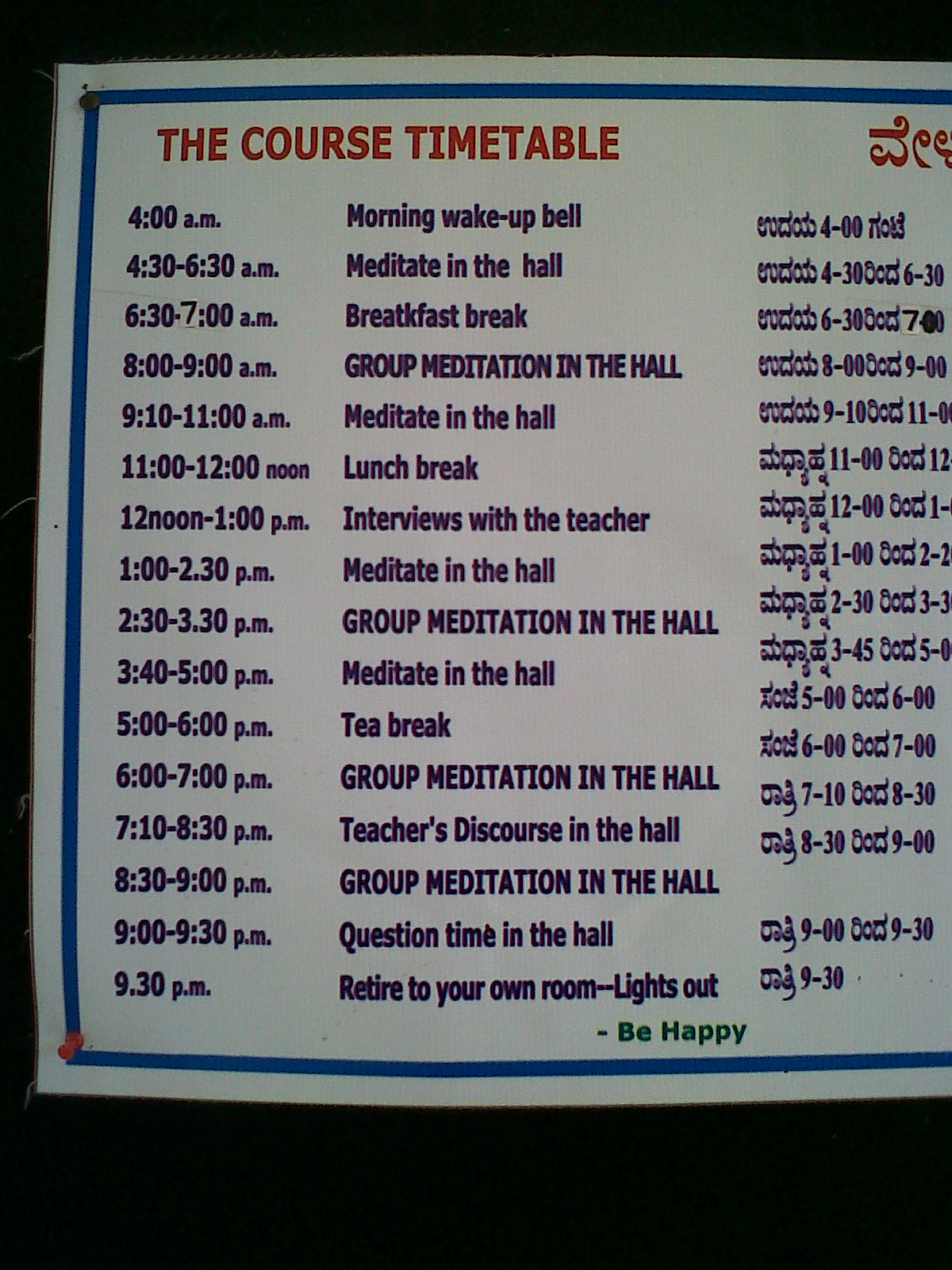
daily schedule

The schedule at the Vipassana retreat.

A Tibetan lady I met last year in Vienna said to me, “I go to a beauty parlor for my body, but I go to India for my soul.”  So, while a trip to the beauty parlor is essential and relaxing, once in a while it is necessary to look within and ensure that things are OK.

I heard about Vipassana mediation many years ago through someone who had attended the course. I vaguely remember her repeatedly saying, “It’s really good, really good. If you get a chance you should do it.” A few months later I met an army officer who had done the course. Again, “It’s really good, really good. If you get a chance you should do it.” And then finally one day I got a mail from the meditation center saying my application had been accepted.  I drove down to Alur village, near Bangalore.  Little did I know that almost 2 years later, I would be back in Alur to undergo the course again.

The Vipassana Meditation Course is a 10-day meditation retreat where you learn the meditation the Buddha practiced. However, it is not a practice limited to Buddhists. It is a practice that works on an individual’s mind and body. It is a process of observation of the sensations in the body and not reacting to any – i.e. practicing equanimity.

The Important Precepts

At the start of the course students have to take 5 precepts:
(1) not to kill
(2) not to steal
(3) not to commit sexual misconduct
(4) not to speak lies
(5) refrain from intoxicants.

In addition to these there are 3 more precepts for the old students:
(6) abstain from eating after midday
(7) abstain from bodily decorations
(8) abstain from using high or luxurious beds.

Furthermore, students are not allowed to indulge in other meditation techniques, rites or rituals, any form of worship and any physical exercise during the course. Also, students are not allowed to wear/use rosaries, religious objects or talismans. And lastly, all students have to take a vow of silence.

My Experience

While not speaking, and for that matter, communicating in any way, for 10 days may sound very difficult, I assure you that not eating after midday for 10 days is more difficult.

The vow of silence is important for any form of meditation to be successful.  In most spiritual discourses inner silence is emphasised over the silence of speech.  Many wonder how Vipassana can help cultivate inner silence if the focus is only on external silence.  By staying silent we reduce our interaction with the external world, which helps us focus on our internal world.

I remember how difficult it became to sit for meditation on the 10th day, which is when our vow of silence ended. The daily routine, otherwise, left very little time to talk. After sitting straight for an hour it is essential that you lie down to give your back some relief. Never have I been more grateful for 5 minutes of free time in which I can just lie down and close my eyes. So tiring is the routine that many people would fall asleep in the 10-minute breaks that we had in between our meditation sessions!

Vipassana for Everyone

The technique of Vipassana requires daily practice. An hour in the morning and one in the evening is the minimum requirement. There are no shortcuts in the technique. With consistent practice it gives amazing results. This is what Kiran Bedi found when she arranged for the Tihar Jail inmates to have a Vipassana Meditation 10-Day Course. I suppose even the powers that be agreed because they awarded the Magasaysay Award to her for her initiative.

Everyone has an issue or other in their lives. Some big, some small. Many of us have gone through emotional trauma that has changed us forever. All around us there are manifestations of inner turmoil (backbiting, cribbing, rudeness, nastiness, jealousy, ill will, foul moods etc.). We aren’t impervious to all the negativity around us, but perhaps we can start by reducing the negativity within us.  Vipassana can show us how.

I’d say I’m still a novice at meditation, but here’s a blog about another meditation technique I’ve tried.


Yoga

The New Year Cometh…

December 31, 2012

It’s the last day of 2012.  It’s the time for closure and for new beginnings.  It’s great to make new resolutions but it’s also important to take stock of the year that has gone by and think through your achievements, what you gained, what you learned and what you cherish about the year gone by.  This gives you a sense of achievement and also gives you a reality check about what you can expect from the coming year.  You’ll end up making more realistic resolutions and can spend 2013 effectively. 

So spend the last few hours of 2012 thinking about the good things of the year gone by and the greater things that the coming year is bringing your way.  Think of a great way to spend the first few days of 2013.  I’m going on the Vipassana retreat: http://www.paphulla.dhamma.org/ – you can perhaps meditate at home?

The last video for 2012: https://www.youtube.com/watch?feature=player_embedded&v=87S8GMxITWM.  Remember to ‘Like’.

Have a great New Year! 🙂