Pragya Bhatt | yogawithpragya

Browsing Category

Yoga

Travels Yoga

The Bags Are Packed

November 29, 2015

20151129_200421[1]

Dinner with my favorite people before I head to Mysore.

I’m pretty much done with packing for my 15 days of yoga, reading, writing, thinking and resting.  For those of you who don’t know, I’m headed to KPJAYI (Shri K Pattabhi Jois Ashtanga Yoga Institute).  I’ll be there for 15 days, longer than I’ve ever been on any retreat.  Vipassana is only 10 days.

I’ve read up everything I can about what to expect there, but most blogs are quite vague.  The only thing everyone seems to agree upon is that

POMELO_20151129154114_save[1]

A separate bag for these.

everyone’s experience is different.  However, I reason that the Ashtanga yoga practice is quite intense and since I’m a complete beginner, the sessions may be very challenging for me.  So I’m taking a suitcase full of workout clothes and towels.  And books.  Because the TBR list has a mind of its own.

Another thing I’m looking forward to is driving all the way to Mysore in my humble Alto.  I’ve never done something like this before.  A road trip by myself sounds like a good way to unwind and spend some time reflecting about 2015.  And this weather helps!


POMELO_20151129204651_save[1]

Fuel for Mysore.  Fresh, healthy and homemade by my friend’s kind mom.

All I need now is a good night’s rest.  Tomorrow I’ll throw my toothbrush into my bag and head out to what promise to be a phenomenal two weeks in Mysore.  Stay tuned for the Mysore Diaries!

Yoga

The Teacher Today

November 25, 2015

The relationship between a teacher and student in yoga has changed over time.  Centuries ago students were expected to devote their entire lives in the service of their teacher.  The teacher’s word was law and blind, unquestioning faith was expected of the student.

The relationship has evolved over the years.  In the plethora of yoga teachers and classes available in the market, students sometimes get confused about what they are searching for. After all, a certain amount of discernment is only fair. A yoga class can change your life, or leave you feeling flustered. A yoga teacher can point you in the right direction, or get on your nerves. You could end up learning something about yourself, or end up looking for reasons to avoid class for the rest of your life.

Where once a teacher held absolute authority over a student and her practice, nowadays the relationship has become a bit tricky. Teachers are younger, and prone to all the foibles that come with youth (relationship troubles, anxiety about getting a ‘real’ job, peer pressure etc.). And frequently they have another job on the side to pay the bills. This is in sharp contrast to traditional yoga teachers who lived to practice and to teach. Needless to say, all these aspects effect the vibe of a class.

I have mulled over the question for a while now. What is the role of a modern day teacher? After all, it’s the age of consumerism and yoga teachers and classes are being consumed with a vengeance. What then is a yoga teacher’s role? When a student walks in, you know they may walk out the next day. Or next year. How can you make a meaningful contribution to a student’s life with this uncertainty?

As it frequently happens, my teacher unwittingly gave me the answer. The other day in class, he demonstrated the Viparita Dandasana and asked us to correct his posture. He modified his pose according to our inputs. By the time we were done with our cues he looked extremely uncomfortable in the posture. He came out of the pose and told us that as a student we must learn not to depend on the teacher too much. He told us that tomorrow he may not be around and we would then be lost in our practice. He said we must observe our own bodies in all asanas, independent of the cues given by the teacher. We must focus on how the ‘right’ asana feels and use that feeling to get into the pose next time.

What this means is that a student needs to cultivate a practice which fits them. We are bombarded by information about yoga all the time, and sometimes this information is just opinion disguised as fact. The real life asana is in being able to distinguish what works for you from what doesn’t. It lies in being truthful to yourself about whether you are blindly following a teacher or school and losing yourself. Or are you learning and being guided by all this information and eventually finding yourself?

In the modern day scenario, the role of a yoga teacher is to empower a student. Encourage your students to explore. Encourage them to try out other classes and teachers and encourage them to think about how they feel. Encourage self reflection (pratyahara). It is rewarding to see a student find wings under your tutelage. If you teach a student how to be self reliant, the decisions they make on and off the mat will come from a place of confidence and trust, rather than insecurity. You will foster a culture of exploration and abundance. A culture of respect and tolerance. A culture of healthy minds and healthy bodies.

“Illuminated emancipation, freedom, unalloyed and untainted bliss await you, but you have to choose to embark on the Inward Journey to discover it.” – BKS Iyengar

Yoga

Have a Healthy Diwali.

November 11, 2015

Finally Diwali is upon us and all of us are being inundated by calorie laden sweets, fried snacks and namkeens, tea/coffee and coke (shudder) multiple times a day.  And the season has begun.  From now until the end of the year you will be invited to numerous parties and get togethers and the main theme of these (specially in North India) is food.  I don’t believe in deprivation.  That’s does more harm than good.  Here are a few tips that are tried and tested (and don’t include deprivation).

  1.  Don’t have sugar in tea/coffee.  Not even a little bit.  Since you’ll be gorging on mithai and chocolate, try and cut out the added sugar in any way that you can.  Switch to herbal teas.  Not only are these lower in calories, but they also prevent the onset of colds and allergies, an important thing to consider during the onset of the winter.
  2. Increase your water intake.  So every time you help yourself to a piece of mithai, grab a tall glass of water as well.  Increased water intake will also help keep your hunger pangs an check.
  3. EXERCISE.  This is non-negotiable.  The first thing you must do before the day gets in the way is 20 Surya Namaskars.
  4. Share your treats.  Yes, even the most delectable, custom made, piece-of-heaven delights.  Share them.  Lower your calorie intake and earn goodwill from those around you.
  5. Lastly, I just want to reiterate something that I’ve already spoken about:  Choose your indulgences wisely.  I’ll have chocolate (preferably dark), but I won’t touch laddoos.

Also, spare a thought for the environment.  Burn calories, not crackers!

Yoga

The Importance of Transitions

October 18, 2015

I was leading a class of students through the Surya Namaskars yesterday.  Most of these students know each other really well and have been in the class for about the same amount of time.  They can all do the Surya Namaskar in their sleep.  So they are dedicated, punctual and regular with their practice.  However, differences still abound.

For one, there was a difference between how each of them was performing the Surya Namaskar.  There are always those students who are a second or two ahead of the instruction they can anticipate coming.  Then there are those who will follow your instructions to the T.

The first kind will always be a little ahead of their classmates.  Their foot will start sliding back from Ashwasanchalanasana to Chaturanga a couple of seconds before everyone else.  They will finish the round a few seconds before the rest of the class.

The second kind will also glide from one pose to another, but in 100% synchrony with the teacher’s instructions.  As the last instruction comes to a close, so does their namaskar.

You can tell a lot about a student and how they live their lives by observing how they practice yoga.

What became jarringly clearer as time went on was the fact that none of these students were pausing between the poses.  The transition from one post to the next was mechanical and thoughtless.  They were doing it by rote.  Each pose led automatically to the next.  Their bodies didn’t pause for a second in any of the poses to assimilate the moment between poses.  The moment when you complete one pose and are poised to do the next.  This moment, which in the case of something repetitive like the Surya Namaskars, exists only briefly, is an opportunity for the body and the mind to synchronize.  This moment is the ‘pose in repose’ that BKS Iyengar often talked about.

This moment exists in life as well.  It’s the transition from the old job to the new, from one relationship to the next, from one task to another, from work to a vacation and back, from one project to the next, from one meeting to the next, from dinner to dessert etc.  These periods of transition are meant for deep breaths and reflection.

What did I learn from my old job?  Why did I really quit?  What am I taking with me to my new job?  Am I doing the right thing? (Is my asana in alignment?)  How has my old job shaped me?  What do I hope to gain from the new job?

Am I at peace?  What is the impact the relationship had on me?  Do I even like being in a relationship?  Am I alone or am I lonely?  Am I OK with myself?  (How does my body feel in this asana?)

Was it a task/project/meeting well done?  Did it drain my energy?  (Is this my best version of this posture?  What if I tried to straighten my leg a bit more?)

Do I feel rested enough to go back to work?  What does ‘rested’ feel like?  (What modifications can I make so that this asana doesn’t lead to injury?)

Was the dinner enjoyable?  Would the dessert be worth the calories? (Why am I doing the Surya Namaskars?  After all, I can choose not to and instead save my energy for challenging asanas.)

Transitions are important in yoga, and they are important in life.  The moment between an inhalation and an exhalation is given a lot of importance in meditation and pranayama practice because it is in that moment that we can assimilate what we have taken in, and prepare for what we want to let out.  Many people are uncomfortable with the ‘in between’ time.  They are uncomfortable with not having a job, or not being in a relationship, and want to complete their next task yesterday.

Only when we inhale fresh clean oxygen are we able to exhale the harmful carbon dioxide.  Only when you understand what exists in your life right now will you be able to let go of all that inhibits the shaping of a fulfilling future.

Yoga

Untying the Knots

October 9, 2015

A couple of weeks ago I had a student in Supta Baddhakonasana.  That’s Lying Down Bound Fixed Angle Pose, a supine variation of a pose popularly called the ‘Butterfly Pose’.

As the relaxation came to a close, I gave the instruction to keep the eyes closed and to come out of the pose in the easiest and most comfortable way possible.

The student started to undo the belt binding his legs in the pose.  He realized that he couldn’t reach far enough to actually undo the belt easily.  He started to reach around and fumble with the belt a bit more.  All the effort made him want to open his eyes, but he wasn’t going to not follow the instructions.  Finally he managed to twist and turn enough to grab a hold of the buckle and wrest the belt off.  Once done he sat upright and relaxed his tightly closed lids.  Hmmmm….

Sometimes a student’s behaviour on the mat is highly indicative of his/her approach to real life.  Does a student twitch and move a lot when relaxing?  Post Savasana do they quickly jump up and run out to meet the rest of their day?  Do they fall asleep during relaxation?  In this case, the student had to complete his relaxation and face the real world.  One which, at that point, literally had him up in knots.

When faced with sticky, frustrating, tight, claustrophobic, rigid etc situations, our first reaction is to fight for dear life.  So we close our eyes tightly and twist and turn and try to grab that which we feel is smothering us and wrench it away from us.  However, if you breathe deeply and instead of struggling, you work on accepting that you are in a bind (in this case quite literally), then you may have an easier time getting out of the unpleasant situation.

Someone once told me that you can consider roadblocks to be either problems or  constraints.  You can choose to dwell on your problems and try to (unsuccessfully) wish them away.  Or you could think about how you can carry on with your life’s work with the existing constraints.  I believe that changing your perception is all it takes to change your life, and this forms a huge part of that philosophy.  So next time you’re in a conundrum, think, do you want this to be a problem, or do you want it to be a constraint.

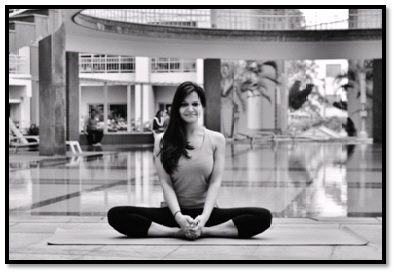
badhakonasana

The Supta Baddhakonasana is when you lie down on your back and keep your legs in this position.